


Quick Answer: What Does Shaolin Temple Preserve?
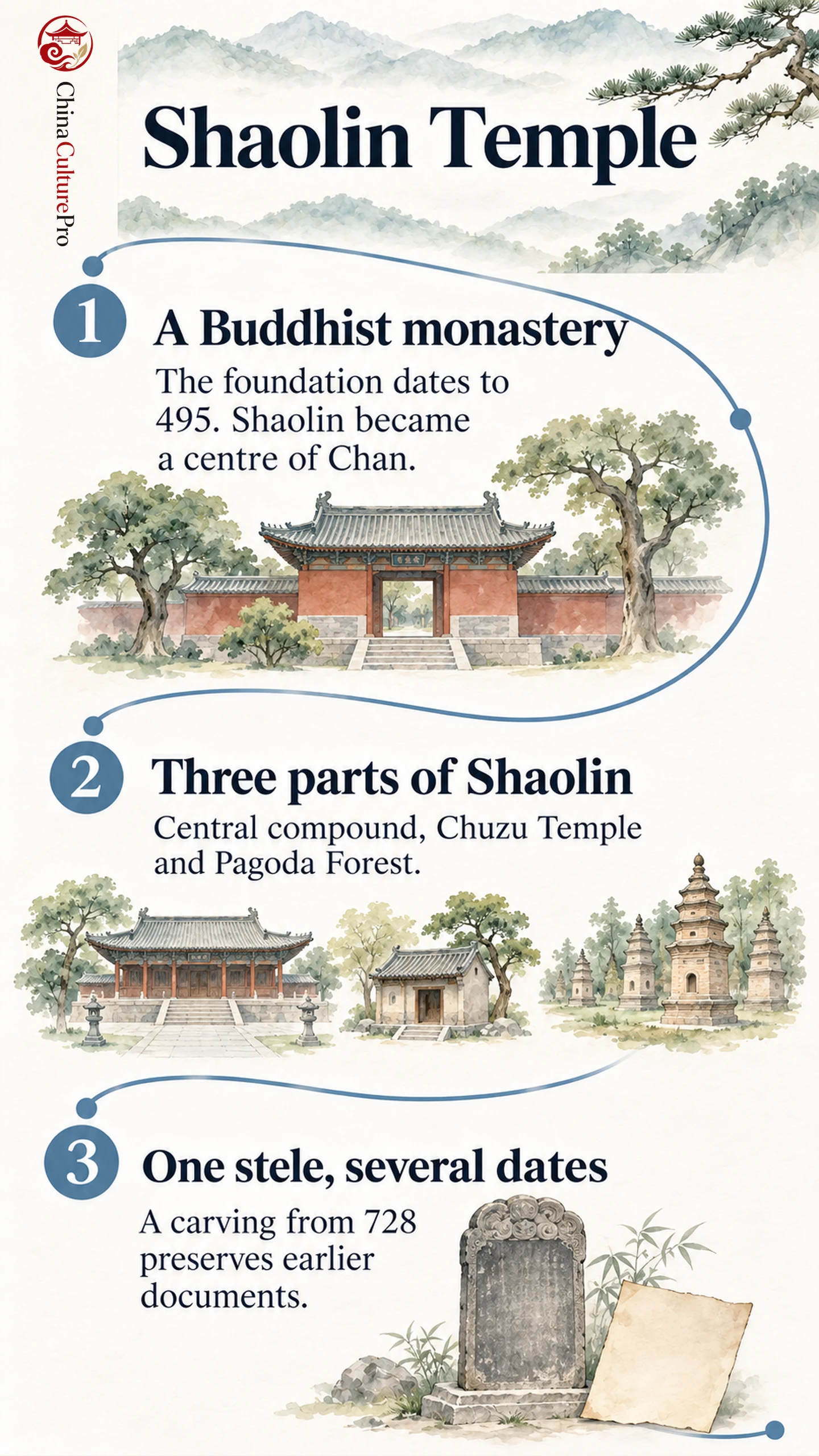
Shaolin Temple (少林寺, Shàolín Sì) is a Buddhist monastery at Mount Songshan in Henan with a foundation dated to 495 CE. Its central compound, Chuzu Temple (初祖庵, Chūzǔ Ān) and Pagoda Forest (塔林, Tǎlín) preserve architectural evidence of worship, patriarchal commemoration and monastic burial.[1][2][3]
- A monastic institution. Shaolin became an important site in the tradition of Chan (禅, chán) Buddhism.[1][2]
- A wider property. The three Shaolin components form one group within the World Heritage monuments around Dengfeng.[3]
- A written record. A Tang stele carved in 728 contains earlier documents about the monastery as well as its inscription.[4]
The foundation date, the dates of the buildings and the dates of the texts each matter to a different question.[1][3][4]
Shaolin’s martial reputation is part of its history. The monastery buildings and surviving stone records help establish what that reputation can tell us about one Buddhist institution in particular places and periods.
From a Northern Wei Foundation to a Chan Monastery
The monastery’s foundation is dated to the Northern Wei in 495. Shaolin is also associated with Bodhidharma and the transmission of Chan. In monastic tradition, Bodhidharma is revered as the first patriarch of Chan in China. That status explains the dedication of a later shrine without establishing the date of every building or practice associated with him.[1][2][3]
The surroundings matter. Shaolin belongs to the Dengfeng historic monuments, a series that also includes an observatory, an academy, gateways and other religious sites around Mount Songshan. The Shaolin buildings represent a specific monastic part of that wider landscape.[3]
Three Parts of the Shaolin Architectural Complex
| Site | What the architecture helps explain |
|---|---|
| Central compound | The halls and courts of a Buddhist monastery |
| Chuzu Temple | Commemoration of Bodhidharma as the first patriarch in Chan tradition |
| Pagoda Forest | Tomb pagodas that commemorate generations of monks |
The central halls support collective religious life. Chuzu Temple addresses the memory of one revered figure, while the Pagoda Forest records the deaths and remembrance of multiple monks. The pagodas can differ in date, form and inscription even though they stand in the same burial landscape.[1][2][3]
What the 728 Stele Can Establish
The Shaolin Monastery Stele (少林寺碑, Shàolín Sì Bēi) was engraved in 728. It collects texts written at different times, including a letter from Li Shimin dated 621. This gives two chronological layers to check before using the stone. The earlier document belongs to an event or relationship being recorded, while the later date marks compilation on the stone.[4]
The texts preserve evidence that some Shaolin monks became involved in an early Tang conflict. That episode belongs to the early Tang history of the monastery. To follow the later development of practices and their public reputation, see the history of Shaolin kung fu. To examine a temple record itself, use the date and text type as you would with other Chinese temple inscriptions.[4]
FAQs About Shaolin Temple’s Cultural History
Is all of Shaolin Temple from 495 CE?
That date refers to the monastery’s founding. Its structures and records were made in different periods.[1][2][3]
What is the Pagoda Forest?
It is a cemetery with pagodas commemorating monks associated with the monastery. It is listed with the central compound and Chuzu Temple as part of the Shaolin group.[2][3]
What makes the 728 stele useful?
It preserves several texts from different dates in one carving. This helps readers separate an early event from the later carving of the records in stone.[4]
出典
[1] UNESCO Memory of the World. The Steles of Shaolin Temple, 566–1990
[2] People’s Government of Henan Province. Shaolin Temple
[3] UNESCO World Heritage Centre. Dengfeng serial property component maps
[4] Meir Shahar. Epigraphy, Buddhist Historiography, and Fighting Monks: The Case of the Shaolin Monastery