

Quick Answer: How Do You Read Seal Characters on Objects?
Begin with the object and the complete mark. Identify the script, location and layout, then compare the visible forms with a reliable transcription or documented example.
- Script: Seal-style characters can look unlike familiar modern print.
- Layout: Count visible characters and identify columns or lines.
- Meaning: A reign formula may name a dynasty and era.
- Limits: Reading a mark does not establish the object’s date or authenticity.
Keep uncertain characters uncertain. A familiar formula is not permission to fill missing strokes from memory.
A compact inscription on a bowl’s base can seem like an unfamiliar symbol rather than writing. It may contain readable characters in a different script, a highly stylized imitation, or a mark serving a purpose other than a personal signature. Start by recording what is actually visible.
Separate the Script from the Kind of Mark
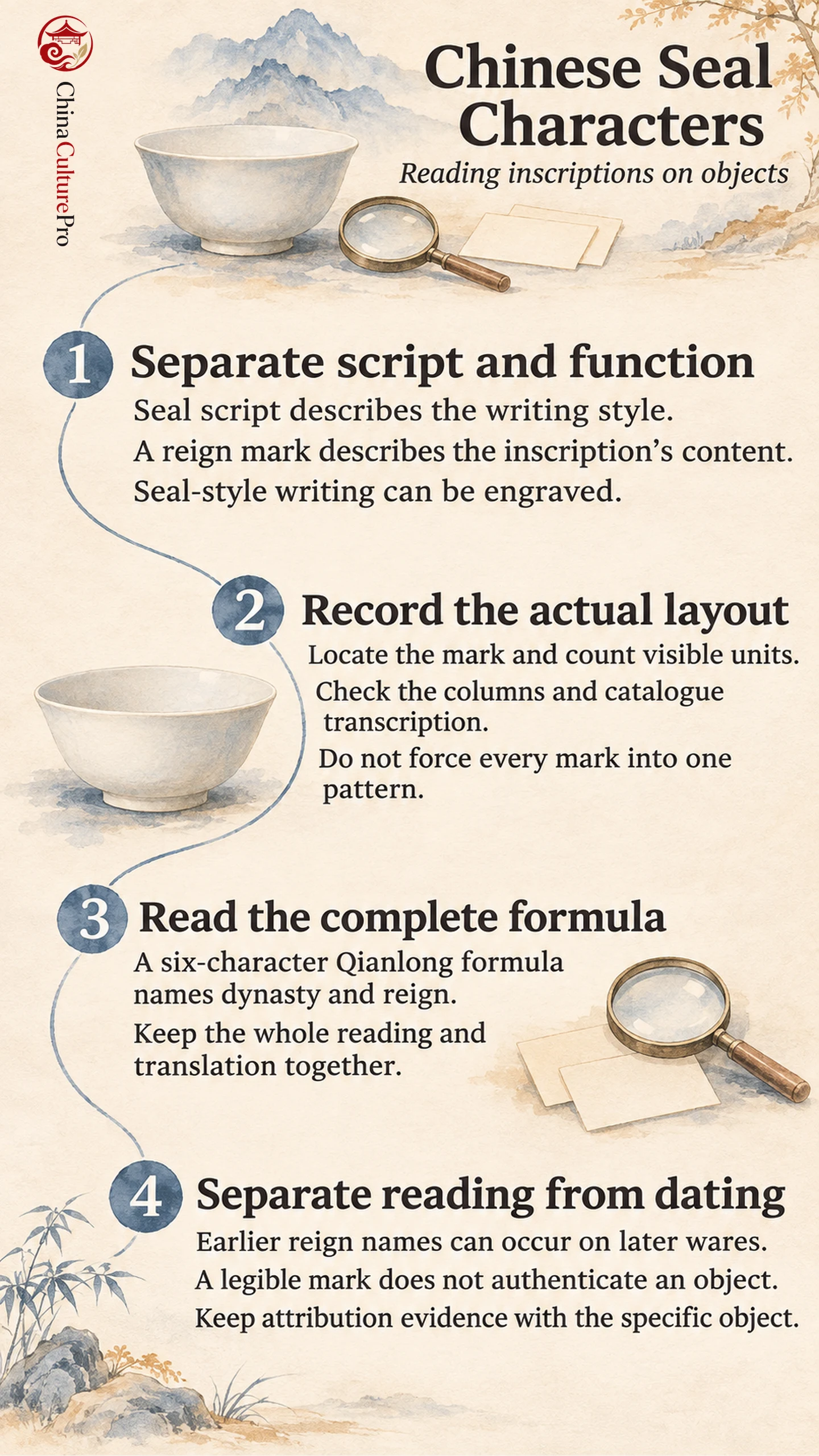
Seal script (篆书, zhuàn shū) is a writing style. A reign mark (年款, nián kuǎn) is an inscription referring to a reign. These labels describe different things: how characters are written and what the mark says. Ceramic reign marks can use regular script as well as seal-style forms. [1]
Do not infer the production method from the word “seal” alone. An actual museum example has a six-character seal-script inscription engraved on its base. Seal-style writing need not be a red ink stamp applied to paper. [2]
The Chinese characters guide introduces the broader writing system. For an unfamiliar form, compare the whole inscription rather than assuming every decorative square is an ordinary modern character.
Locate the Inscription and Establish Its Reading Order
Record where the mark sits, how it was applied and how the characters are arranged. A common six-character regular-script format uses two columns of three; a common seal-style format uses three columns of two. In those arrangements, reading proceeds down a column and then from the right column toward the left. [1]
These are documented patterns, not a rule for every object. Count the actual visible units and consult the catalogue’s transcription. Do not force an unusual layout into a memorized grid.
Some archaeological ceramic marks imitate a seal-style square so abstractly that the strokes no longer produce a legible inscription. If a reading cannot be supported, record the pattern rather than inventing six plausible characters. [1]
Read a Six-Character Qianlong Formula
One documented formula is 大清乾隆年制, Dà Qīng Qiánlóng nián zhì, meaning made in the Qianlong reign of the Great Qing. The table groups the six characters by meaning; it does not reproduce their physical arrangement. [3]
| Character group | Reference reading | Meaning in the formula |
|---|---|---|
| 大清 | Dà Qīng | Great Qing dynasty |
| 乾隆 | Qiánlóng | Qianlong reign |
| 年制 | nián zhì | made in the reign |
A historical mark may use traditional 製, zhì, where the transcription above uses 制. A variant-character reference can help with written forms, but the catalogue’s complete reading remains the starting point.
The National Palace Museum’s tea-dust-glazed conjoined vases provide a specific example of an engraved six-character inscription conveying that Qianlong formula. Keep that catalogue attribution attached to the documented object. Similar lettering on another vessel is a separate case. [2]
Keep Reading Separate from Dating and Attribution
A mark can refer to an earlier reign even when the object was made later. Museum catalogues describe such earlier reign names applied to later wares as apocryphal marks. The inscription identifies what is written; the object’s date requires additional evidence. [4]
For example, a museum response reads a Qianlong formula on a vase but assesses that vase as likely mid- to late-twentieth century on stylistic and technical grounds. The same reading therefore does not carry an automatic eighteenth-century attribution. [3]
In your notes, separate a visible transcription, its translation and any catalogue-based dating. The Qing dynasty guide supplies historical orientation; it cannot authenticate a particular ceramic object. Keep a clear photograph of the whole object and mark together for further research.
FAQs About Chinese Seal Characters on Objects
Does a Qianlong mark prove a Qianlong-period object?
No. Earlier reign names can appear on later wares. Reading and attribution are separate tasks. [4]
Must every seal-style inscription contain six characters?
No. Four-character reign marks also occur, and some seal-style patterns are too abstract to read as a normal inscription. Check the actual mark. [1]
Can an unreadable mark be completed by guessing the formula?
Keep the uncertain reading open. Compare a documented example, but do not substitute expected characters for strokes you cannot identify.
出典
[1] Society for Historical Archaeology, Philip Choy. Interpreting Overseas Chinese Ceramics
[2] National Palace Museum, Taipei. Six conjoined vases in tea-dust glaze
[3] Museum of Anthropology, University of British Columbia, Fuyubi Nakamura. Ask MOA: What Is This Vase?
[4] Dresden State Art Collections, Royal Porcelain Collection. Catalogue: Reign marks