

Quick Answer: What Can Chinese Place-Name Elements Tell You?
Chinese place-name elements can signal landscape, direction, settlement type or administrative status. They are useful reading clues, while the origin of a particular name still needs its own evidence.
- Landscape: Repeated characters can identify a mountain, river or lake.
- Administration: An ending can identify a province, city, county or district.
- Direction: North or south requires an actual geographic reference.
- History: A familiar component may survive after its original function changes.
Use the clues to understand a name, then confirm the whole place and its context.
Recognizing a repeated component can make a place name easier to remember. The same knowledge can also mislead: a reasonable dictionary meaning is not proof of why a particular settlement received its name. Learn common elements, but keep linguistic recognition separate from historical explanation.
Distinguish the Specific Name from the Feature Type
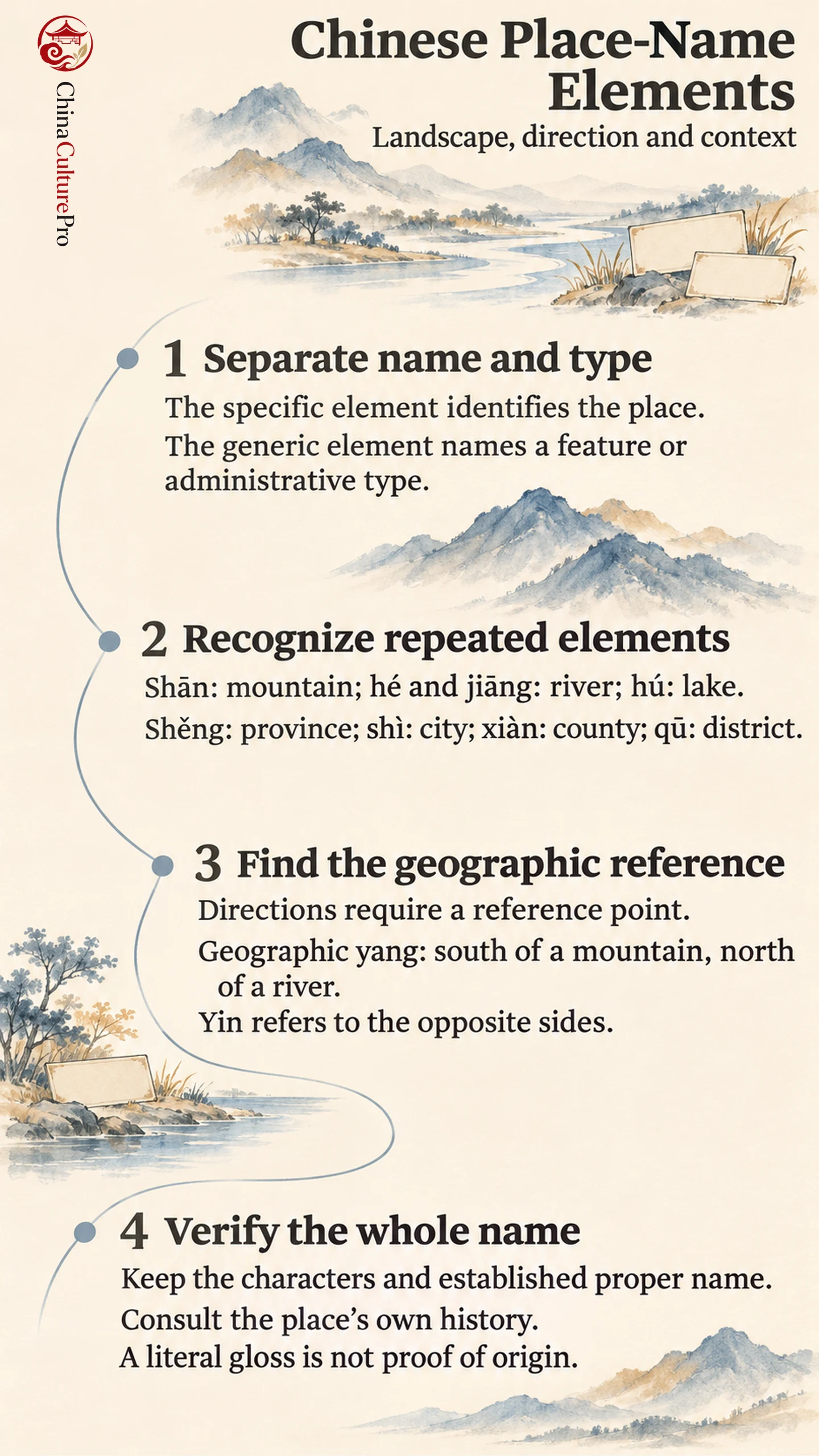
A specific element (专名, zhuān míng) distinguishes a named place; a generic element (通名, tōng míng) identifies the kind of feature or administrative unit. In 太行山, Tàiháng Shān, Taihang is the specific part and shan identifies a mountain feature. 松花江, Sōnghuā Jiāng, uses Songhua with the generic river term jiang. [1]
This is an analytical distinction, not a claim that every Chinese name divides neatly into two freely translatable parts. Naming rules recognize cases where an apparent generic has become part of a specific name, as in the province name 黑龙江, Hēilóngjiāng. [1]
Read the whole label on the map or document. A feature name reused inside another name may now identify something different.
Recognize Common Landscape and Administrative Elements
These useful reference glosses identify common roles. The first group concerns landscape or settlement meaning; the final four identify administrative types in the relevant context. [2][4]
| English reference | 登場人物 | 普通話での読み |
|---|---|---|
| Mountain | 山 | shān |
| River | 河 | hé |
| River | 江 | jiāng |
| Lake | 湖 | hú |
| Capital | 京 | jīng |
| Province | 省 | shěng |
| City | 市 | shì |
| County | 县 | xiàn |
| District | 区 | qū |
He and jiang both translate as river in these examples. Neither should be assigned a universal size threshold from this English gloss alone. Likewise, the city label identifies an administrative category when used that way; it does not by itself draw the edge of the built-up settlement. [4]
Compare the term’s actual role, not just its position in the word. The same written element can appear in a specific name as well as a generic description.
Read Direction and Yin–Yang in Geographic Context
North is 北, běi; south is 南, nán; east is 东, dōng; west is 西, xī. Beijing combines north with capital, while Nanjing combines south with capital. Such meanings help with recognition, but each name still has its own historical naming context. [2][5]
Yang (阳, yáng) and yin (阴, yīn) have a particular geographic use in many historical names. Yang conventionally indicates the south side of a mountain or north side of a river; yin gives the opposite sides. These are geographic applications, not predictions about a place’s fortune. [3]
Before locating a name by that rule, identify which mountain or river matters and which historical landscape the source describes. Do not turn one component into a modern compass bearing without checking the referent. A historical explanation needs more than a plausible translation. [3]
Check the Whole Name Before Translating It
First identify the actual Chinese characters. Then distinguish the element’s dictionary meaning from the established name and its historical referent. The Chinese characters および pinyin guides help with the writing and reading systems, but they do not supply every local etymology.
Use an authoritative gazetteer, local history or official explanation for the specific place. Keep that explanation beside the date and location it describes. The place-name changes guide addresses older labels; province abbreviations explain shorter regional forms.
For a vocabulary note, record the proper name, a verified reading and a short component gloss. Add an origin story only when the source establishes it. If you have only recognized the characters, label your note as a literal gloss rather than a proven history.
FAQs About Chinese Place-Name Elements
Does every shan in a name refer to a mountain today?
No such conclusion follows from the character alone. A generic can become part of a specific name, so check the complete name and what it identifies. [1]
Are he and jiang different English kinds of river?
Both can be glossed as river. The reference meanings do not establish a universal rule dividing rivers by size. [2]
Can a literal translation replace the proper place name?
Use it as a learning note, not an automatic substitute. A component gloss can explain a recognizable feature while leaving the actual local naming history unresolved.
出典
[1] China Committee on Geographical Names and partner agencies, via Jilin Civil Affairs. Chinese place-name pinyin spelling rules
[2] Harvard China Historical GIS. Chinese Place Names
[3] Sino-Platonic Papers. Anchors of Stability: Place-Names in Early China
[4] Library of Congress. Pinyin Romanization Guidelines: Clarification of Practices
[5] Beijing tourism authority. Meaning of Beijing