


Quick Answer: What Is a Chinese Paifang?
A Chinese paifang (牌坊, páifāng) is an ornamental gateway or gateway-shaped monument. It can mark a place, honor a person or record an event. Its posts and beams frame one or more openings, and an inscription can name the place or explain why the structure was built. [1][2]
- The structure may be freestanding or attached to a façade. Some stand over roads. Others frame the entrance to a house or ancestral hall. [1][2]
- The inscription can explain the dedication. Look for a place name, official title or phrase describing a virtue. [1][2][3]
- A gateway can do two jobs. It can mark an approach while honoring a person, lineage or relationship. [4][5]
The words for these structures overlap. Read the inscription and setting alongside the roof, rather than relying on one feature to identify the purpose. [1][6][2]
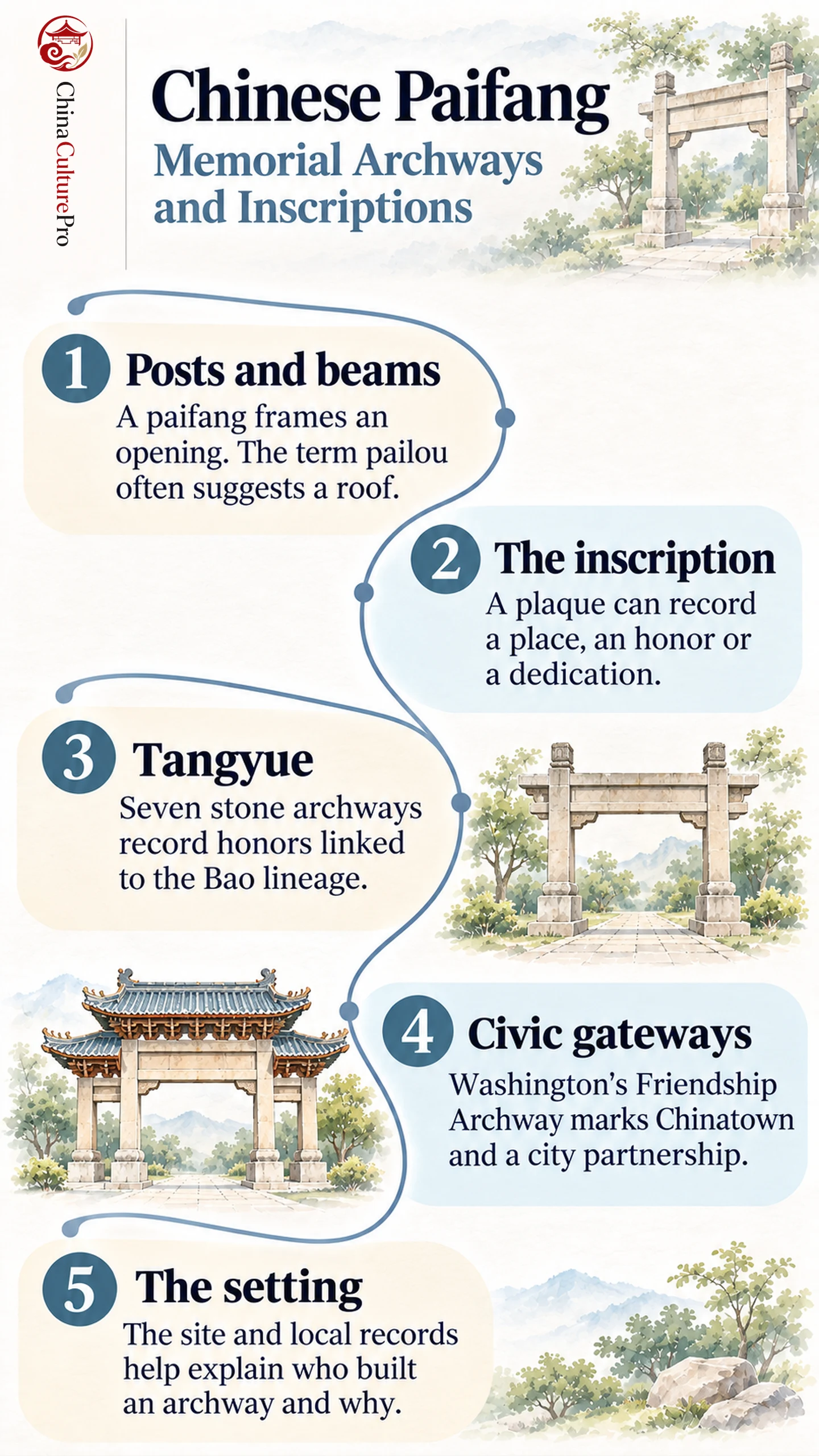
Seven stone archways on a road in Tangyue (棠樾, Tángyuè) record honors associated with one lineage. Across the Pacific, a tiled archway marks Washington, D.C.’s Chinatown and records the city’s partnership with Beijing. At both sites, the inscriptions help explain what the gateway was built to do.
Paifang and Pailou: What the Words Describe
The basic form belongs to traditional Chinese architecture. Vertical posts support horizontal beams, leaving an opening below. “Archway” describes the gateway here, even if the beam is straight. Stone, brick and timber are among the traditional building materials used in different examples. An upper tier can carry one or more roofs. [1][6][2]
A pailou (牌楼, páilóu) is often described as the roofed version. One architectural study distinguishes roofed pailou from unroofed paifang, but historical usage was broader. Ming records also use both names for the same kinds of objects. When a source calls an archway a paifang, it may still have a roof. [6][2]
How to Read an Archway’s Inscription
The principal inscription often appears on a plaque across the central opening or on the beam itself. The name or title may be more prominent than details about the date or sponsors. Look at the whole structure, including its sides and bases, because a second inscription can explain an occasion more plainly than the main board. [1][7]
In Jinxi County, Jiangxi, the freestanding Da Fu Fang (大夫坊, Dàfū Fāng) stands at the entrance of an alley. An architectural study connects it with a resident’s success in the provincial examination and eligibility for official selection. Other examples studied there are attached to a house or hall. Whether you can walk beneath a structure and why it was erected are different questions. [2]
Tangyue: Seven Archways Along a Village Road
Tangyue in She County, Anhui, has seven stone archways associated with the Bao lineage. Three date to the Ming and four to the Qing. Their place along the village road made the lineage’s honors visible beyond the family home. The group is an example of Huizhou architecture. [4][3]
The archways record several kinds of honor. The phrase leshan haoshi (乐善好施, lèshàn hàoshī) on one Qing archway praises charitable giving. Another bears the name of an official from the Bao lineage. Two Qing examples are classified as jiexiao (节孝, jiéxiào) archways, which praise chastity and filial conduct. The honors attached to widows in particular show how public recognition could reinforce different expectations for women and men. [2][4][3]
The archways stand in a landscape that also includes Chinese ancestral halls. The halls provide spaces for lineage rites. The archways display honors along the road. Together they show how Chinese memorial architecture could make a lineage’s place in village life visible in several ways. [1][4][3]
Gateways, Memorials and Modern Chinatown Archways
Paifang have been placed on streets and near schools, temples and tombs. These locations can give the structures the function of announcing a place or marking the start of a route. An archway at a street entrance can also commemorate an event. [1][5]
Washington’s Friendship Archway was dedicated in 1986 to mark the relationship between Washington, D.C., and its sister city Beijing. Sets of interlocking wooden dougong (斗拱, dǒugǒng) brackets support the tiled roofs. An English inscription at one column base and a Chinese version at the other identify the two governments that erected the archway. The street location gives it a second role as a neighborhood marker. [5][7]
What the Site Adds to the Inscription
An archway on a village road, at an alley entrance or beside temple compounds gains meaning from what people approach through it. At Tangyue, several monuments along one route describe parts of the same lineage’s public history. At Da Fu Fang, a single archway marks a smaller threshold while also commemorating an achievement. [1][2][4][3]
Read the plaque for the name or honor and the setting for the relationship to nearby places. If the date or patron is unclear, local records can supply what the surviving inscription leaves out. [1][2][7]
FAQs About Chinese Paifang
What is the difference between a paifang and a pailou?
Some architectural descriptions use pailou for a roofed archway and paifang for an unroofed one. Historical usage overlaps, so both terms can refer to roofed gateways. [1][6][2]
Did all Chinese paifang commemorate someone?
No. A paifang can mark a street, an entrance or a boundary. Other examples commemorate people, events or civic relationships. One archway can serve both purposes. [1][5]
What does a paifang inscription tell you?
It can identify a place, name the honor being recorded or explain the dedication. Check the main plaque and any secondary inscription on the beams or bases. [1][2][7]
出典
[1] Getty Research Institute. Páifāng
[2] Yansong Wang and Yapeng Duan. A Study on the Classification and Value of Ming Dynasty Paifang in China
[3] Huangshan University. Tangyue Memorial Archway Group
[4] Huangshan Municipal Government. Classic Architecture of Huizhou
[5] U.S. National Park Service. Downtown Historic District (Chinatown), Washington, D.C.
[6] Getty Research Institute. Páilóu
[7] Smithsonian American Art Museum. Friendship Archway