
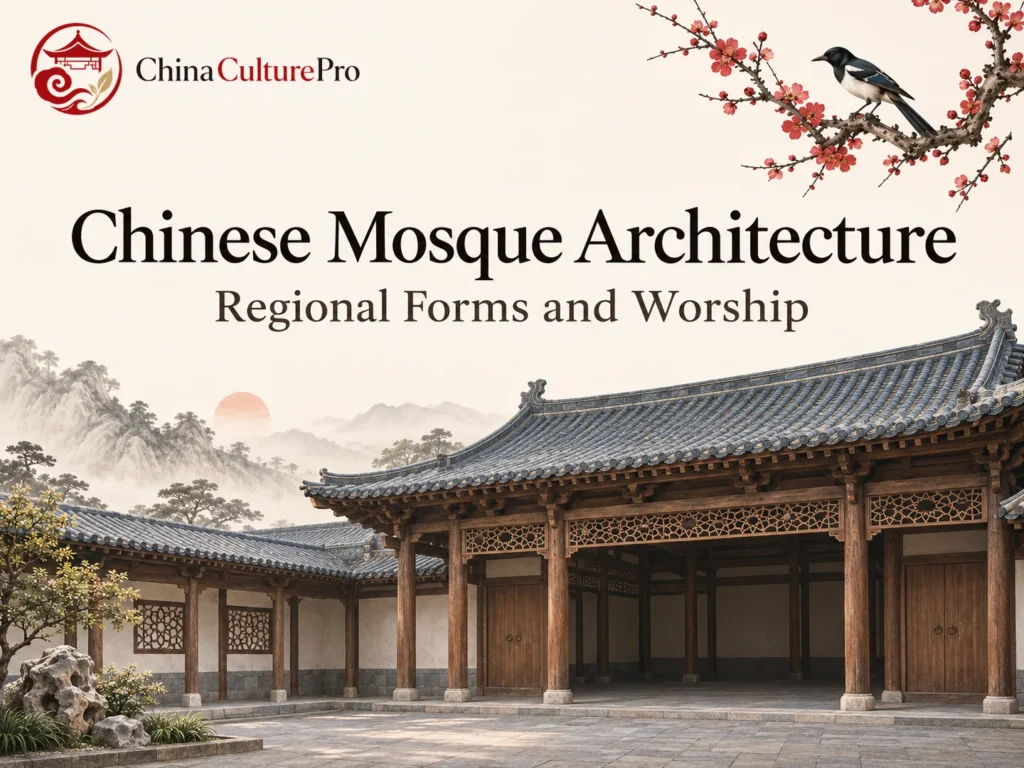

Quick Answer: What Defines Chinese Mosque Architecture?
A mosque (清真寺, qīngzhēnsì) in China provides space for Muslim worship. Its prayer area is oriented toward Mecca. The building around that space can take different forms, including timber halls with tiled roofs, stone gateways and courtyards with covered walkways. [1][2][3][4][5]
- Prayer determines the main orientation. The qibla is the direction of prayer, and a niche called a mihrab can mark it. [1][2]
- Local building forms shape the approach. Gates and courtyards lead to a timber prayer hall in Xi’an. [2]
- Different materials tell different local histories. In a coastal trading city such as Quanzhou (泉州, Quánzhōu), a mosque’s stone arches can reflect connections with communities overseas. [6][3][7]
To understand the building, start with the prayer hall and its orientation. Then look at the gateway, inscriptions and the compound’s relationship to the neighborhood. [1][2][6][4]

The main prayer hall in Xi’an comes at the end of a sequence of courtyards. At a historic port mosque in Fujian, a monumental stone arch marks the entrance from the street. These approaches show how different building traditions could serve the same requirements of worship.
How Islamic Worship Shapes the Plan
The qibla is the direction Muslims face during prayer, toward the Kaaba in Mecca. A mihrab often marks that direction in the prayer hall. A minbar, where present, is a place from which a sermon is delivered. Open floor space gives worshippers room to stand and prostrate facing the same direction. [1][2]
A mosque compound may also include a place for ritual washing and a tower associated with the call to prayer. These functions can occupy separate structures or areas. A person looking at the roof from the street may miss them. The route into the court and the relation of the prayer space to the other buildings are part of the design. [1][8][4]
Timber and Courtyards in Xi’an and Beijing
At the Great Mosque of Xi’an (西安大清真寺, Xī’ān Dà Qīngzhēnsì), successive courtyards follow a roughly east–west axis. Gates and screen walls organize the approach. The main hall stands at the west end, with the mihrab in its western wall. The hall uses timber construction and a glazed tiled roof. These forms belong to traditional Chinese architecture and were adapted to the needs of Muslim worship. [2][5]
Beijing’s Niujie Mosque (牛街清真寺, Niújiē Qīngzhēnsì) also brings several structures together within one site. The prayer hall and stele pavilions have distinct roles. The compound includes a building used to call people to worship and a hexagonal Moon-Watching Tower (望月楼, Wàngyuè Lóu) associated with observing the moon before the end-of-Ramadan festival. The tower’s shape resembles other Chinese pavilion forms, while its use follows the religious calendar. Carved Arabic script and familiar Chinese roof shapes also appear in the compound. [8]
A Stone Mosque in Maritime Quanzhou
The Qingjing Mosque (清净寺, Qīngjìng Sì) in Quanzhou, Fujian, has a different street presence. Its surviving gateway has pointed openings and vaulted stonework. The city heritage inventory identifies granite and diabase among its materials and records Arabic writing carved above a gateway arch. These details show another way traditional building materials were used for a religious building. [6][3]
An Arabic inscription records an early eleventh-century foundation and repairs completed in 1310–11 under a patron from Shiraz. The remains of the prayer hall include a western wall with inscribed niches. The mosque served a port community that included Muslim traders from Arabia and Persia. UNESCO includes it in a larger heritage property that also documents Quanzhou’s port economy through docks, production sites and transport links. The mosque belongs to the history of the communities who lived and worked around that port. [6][3][7]
The Id Kah Mosque in Kashgar
The Id Kah Mosque (艾提尕尔清真寺, Àitígǎ’ěr Qīngzhēnsì) in Kashgar (喀什, Kāshí), Xinjiang, brings together a gateway, a courtyard, facilities for ritual washing and a main prayer space. The prefecture’s description distinguishes an inner hall, an outer hall and a long passage. Rows of decorated wooden columns shape the prayer areas. [4]
Timber is also visible here. At Xi’an it frames a hall at the end of an axis, while Kashgar’s inner and outer spaces are described together with a long covered passage. Comparing the prayer areas and the route from the gateway reveals more about the building than simply classifying its façade. [2][4][5]
Reading Use Beyond the Roofline
A roof, gateway or courtyard may look familiar from other Chinese religious buildings. In a mosque, the relation of the prayer hall to the qibla and the contents of an inscription help explain how the space was used. Together, orientation and inscriptions can explain what the roof alone leaves unclear. [1][2][3][4][5]
FAQs About Chinese Mosque Architecture
Do Chinese mosques always have domes?
No. The Great Mosque of Xi’an has a tiled timber prayer hall. Other sites, including the Qingjing Mosque, use vaulted stonework in some parts. The roof form depends on the building and its architectural tradition. [2][3][5]
What is a mihrab in a Chinese mosque?
A mihrab is a niche marking the direction of prayer toward Mecca. In the Great Mosque of Xi’an, it is in the west wall of the main prayer hall. [1][2]
Why does the Great Mosque of Xi’an have a Chinese-style roof?
Its builders used local timber framing and tiled roofing in a courtyard compound. The layout leads to a prayer hall organized for Muslim worship, with the mihrab in its western wall. [2][5]
出典
[1] The Metropolitan Museum of Art. The Mosque
[2] Nancy Steinhardt. The Great Mosque of Xi’an
[3] Quanzhou Municipal Government. Qingjing Mosque: Cultural Heritage Inventory
[4] Kashgar Prefectural Administration. Introduction to the Id Kah Mosque
[5] Nancy Steinhardt. Mosques and Islamic Identities in China
[6] Quanzhou Municipal Government. Qingjing Mosque: Nationally Protected Heritage Site
[7] UNESCO World Heritage Centre. Quanzhou: Emporium of the World in Song-Yuan China
[8] Beijing Municipal Government. Niujie Mosque