


Quick Answer: What Are Chinese Euphemisms?
Chinese euphemisms (委婉语, wěiwǎnyǔ) soften expressions that might otherwise sound harsh, embarrassing or awkward. Their meaning depends on context, not simply on a hidden-word substitution.[1]
- Common subjects: Death and bodily functions often invite softened wording.[1]
- Literal meanings: A potentially euphemistic term can also have an ordinary use.[1]
- Reading task: Identify the situation before choosing an English equivalent.
The examples here are Mandarin; they are not a rule for every Chinese language or every speaker.
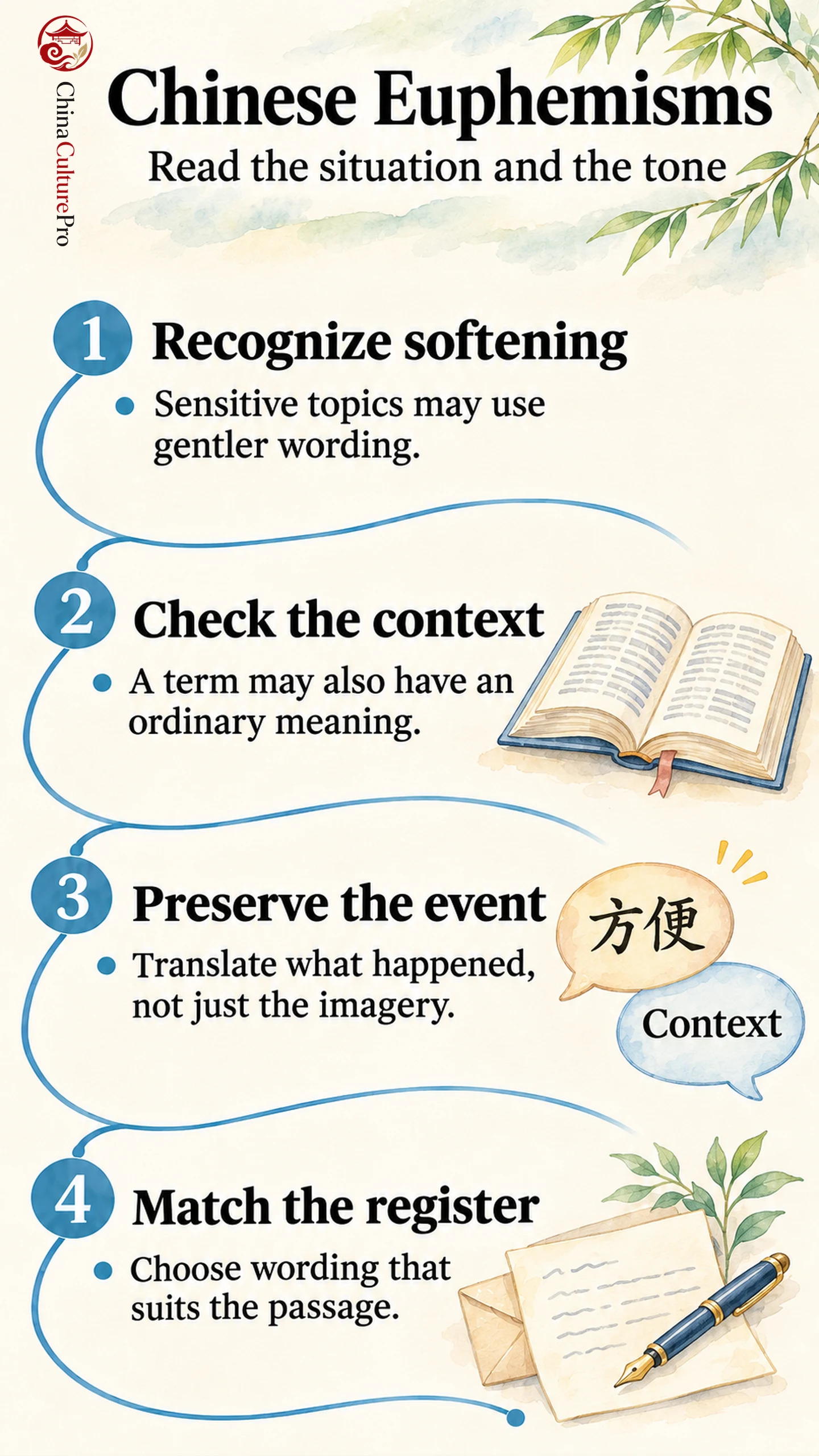
A dictionary gloss can identify an expression’s possible meaning without telling you which meaning is active in a sentence. Read the surrounding event, the relationship between speakers and the tone of the passage.
Common Mandarin Examples
Simplified and traditional forms are paired where they differ. Literal imagery is a reading aid, not a replacement for the conventional meaning.
| Expression and pinyin | Conventional meaning | Reading clue |
|---|---|---|
| 去世, qùshì | To pass away; to die. | Refers to a person’s death, not ordinary travel.[2] |
| 谢世 / 謝世, xièshì | To depart this life; to die. | The “world” imagery belongs to a death expression.[3] |
| 洗手间 / 洗手間, xǐshǒujiān | A washroom or toilet facility. | Literally a handwashing room, but the facility is not restricted to washing hands.[4] |
| 方便, fāngbiàn | Convenience; in a suitable context, to use the toilet. | The ordinary convenience meaning remains available.[5] |
These entries do not make all death expressions interchangeable. Check a dictionary’s usage examples and the register of the passage before replacing one with another.
How Context Changes the Reading
Compare two constructed contexts. A statement that transport is 方便 describes convenience. Someone briefly excusing themselves to go 方便 may be referring to using the toilet. The situation selects the meaning; the word alone does not.[5]
Research on potentially euphemistic terms explicitly distinguishes euphemistic and noneuphemistic occurrences. Its Mandarin dataset illustrates why spotting a term is only the start of interpretation.[1]
If both readings remain plausible, keep that uncertainty. Do not supply an unstated illness, death or refusal merely because the expression could carry one elsewhere.
Choose Meaning and Register Together
For translation, preserve what happened and how the speaker presents it. “Passed away” may suit a softened death reference; translating it as “went away” can leave English readers with the wrong event.
For your own speech, a familiar, clear expression is easier to judge than an ornate phrase copied from an old text. Chinese politeness and apologies involve more than substituting vocabulary. Letter honorifics serve a related but distinct social purpose.
FAQs About Chinese Euphemisms
Does 方便 always mean going to the toilet?
No. It also means convenience. A sentence about convenient transport should not acquire a bathroom meaning just because that alternative exists.[5]
Is every polite phrase a euphemism?
No. Euphemism softens or replaces a potentially uncomfortable expression. A polite greeting or respectful title need not conceal such an expression. Cultural taboos provide context, not an automatic decoding rule.[1]
Are euphemisms always intended to deceive?
No. They can maintain courtesy or reduce discomfort, though they can also conceal uncomfortable facts. Judge the particular utterance rather than assuming a single motive.[1]
出典
[1] Patrick Lee and colleagues. MEDs for PETs: Multilingual Euphemism Disambiguation for Potentially Euphemistic Terms
[2] Ministry of Education. Concised Mandarin Chinese Dictionary: 去世
[3] Ministry of Education. Revised Mandarin Chinese Dictionary: 謝世
[4] Ministry of Education. Concised Mandarin Chinese Dictionary: 洗手間
[5] Ministry of Education. Revised Mandarin Chinese Dictionary: 方便