
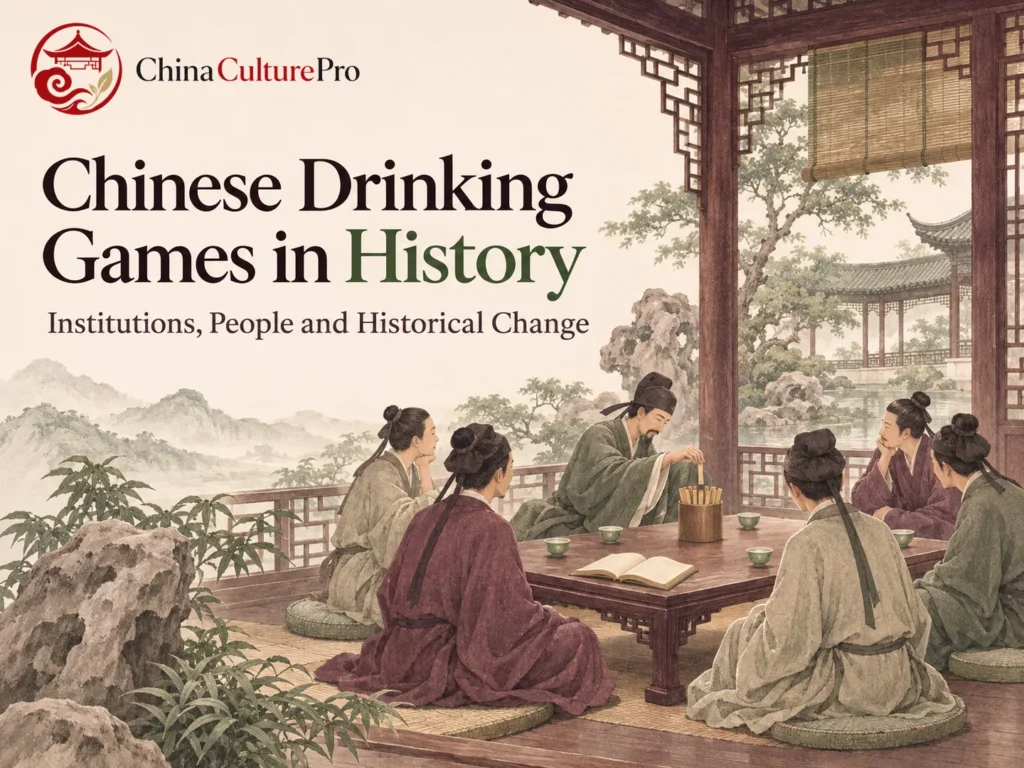

Quick Answer: What Were Chinese Drinking Games?
Historical Chinese drinking games, broadly called jiuling (酒令, jiǔlìng), used rules to decide whose turn it was, who had won or who was assigned a cup. A game might involve a physical contest, drawing lots or responding to a verse. Historical sources describe different forms in different settings.[1][2][3][5]
- Skill: Some games counted successful throws.
- Chance: An inscribed lot could assign a turn or a cup.
- Words: A poem or quotation could give meaning to a prompt.
The source and occasion help identify the version being described.

A classical ritual text, a set of Tang silver tallies and a scene in a Qing novel describe different kinds of play around a meal. Together they show how a throw, a line of verse or a drawn lot could organize a gathering.
Pitch-Pot: A Contest with a Scorekeeper
In pitch-pot (投壶, tóuhú), participants threw arrows by hand toward a vessel. The Record of Rites describes a host inviting a guest, an official counting successful throws with tallies, and a drink assigned to the losing side. Courtesy and roles are part of the description, along with how the contest was scored.[1]
The vocabulary overlaps with ritual archery, including a title for the official overseeing the contest. The actions differ. The pitch-pot player aimed by hand at a vessel, while the ritual archer used a bow. Both practices could give the result a ceremonial role.[1]
What the Tang Analects Tallies Record
A Tang silver hoard excavated at Dingmaoqiao in 1982 contained a gilt-silver tortoise supporting a tall cylindrical container. Zhenjiang Museum records fifty tallies found inside the container. Each joins a line from the Analects to a drinking instruction. The container and tallies show that a quotation could be an integral part of the game equipment.[2][3][4]
The instructions vary. Some tell the holder to drink, some designate another person, and others release someone from drinking. It is possible to study who the rule addressed without knowing the guest list of a particular banquet. The inscriptions preserve the rules. An account of a gathering would be needed to show who used them.[3][4]
Flower Lots and Wordplay in Literature
In chapter 63 of Dream of the Red Chamber, characters celebrating Baoyu’s birthday draw flower lots. Dice help decide whose turn comes next. The drawn lots combine a flower image, verse and an instruction. When Xiangyun draws the flowering crabapple lot, the wording exempts her and assigns a cup to each of the adjacent players.[5]
The participants also tease one another about what the images mean. The scene uses the rules to reveal relationships and personalities. The passage shows how the novelist made play part of characterization. Its people and birthday party belong to the novel.[5]
How to Read a Rule, Object or Scene
A ceremonial text sets out what should happen. An inscribed tally preserves wording someone could use during play. A picture shows what an artist chose to depict. The Metropolitan Museum of Art’s seventeenth-century cloisonné basin, object 29.110.85, depicts an immortal playing pitch-pot. The immortal’s action shows how a recognizable game could appear in an imagined scene.[1][4][6]
Identify the kind of occasion as well. A domestic birthday scene and the official service at a court banquet have different purposes. Similar vessels or actions can appear in both without establishing that they followed the same rules.[1][5][6]
FAQs About Historical Chinese Drinking Games
Is jiuling the name of one game?
Jiuling is a broad term for rules and games associated with drinking. The particular version might use a physical contest, an inscribed tally or a literary prompt.
Is pitch-pot the same as ritual archery?
Pitch-pot involves throwing arrows by hand into a vessel. Ritual archery uses a bow and target. The texts sometimes share terms for keeping score and organizing the participants.
Does a drinking scene in a novel document a real banquet?
It documents how the author depicted play. To establish how a specific event took place, look for contemporary records or other evidence tied to that occasion.
出典
[1] Record of Rites, Wikisource. Liji, Pitch-Pot
[2] Zhenjiang Museum. Gilt-Silver Tortoise and Analects Drinking-Tally Container
[3] Zhenjiang Museum, Jiangsu News. Drinking Tallies and Container from the Tang Hoard
[4] Tang silver hoard catalogue, reproduced by Sina Collection. Tang Silver Hoard from Dingmaoqiao, part 2
[5] Dream of the Red Chamber, Wikisource. Dream of the Red Chamber, chapter 63
[6] Metropolitan Museum of Art. Basin with Scene of Daoist Immortals