


Quick Answer: Who Was Cheng Yanqiu?
Cheng Yanqiu (程砚秋, Chéng Yànqiū, 1904–1958) was a Beijing-born actor of Peking opera (京剧, jīngjù), celebrated for dan (旦, dàn), or female roles. His specialty was qingyi (青衣, qīngyī), the dignified female role type. The Cheng School (程派, Chéng pài) grew out of his deep-toned singing, controlled phrasing and expressive movement.[1][3][7]
- Voice: Listen for a phrase that thins to the edge of silence and gathers strength again.[1][7]
- Words: Cheng fit melodies to lines of unequal length.[1][4]
- Movement: His long costume sleeves helped show a character’s shifting emotions.[1][5]
A recording can bring out the breath and phrasing. A filmed performance lets you see how the same character is built through posture, eyes and cloth.
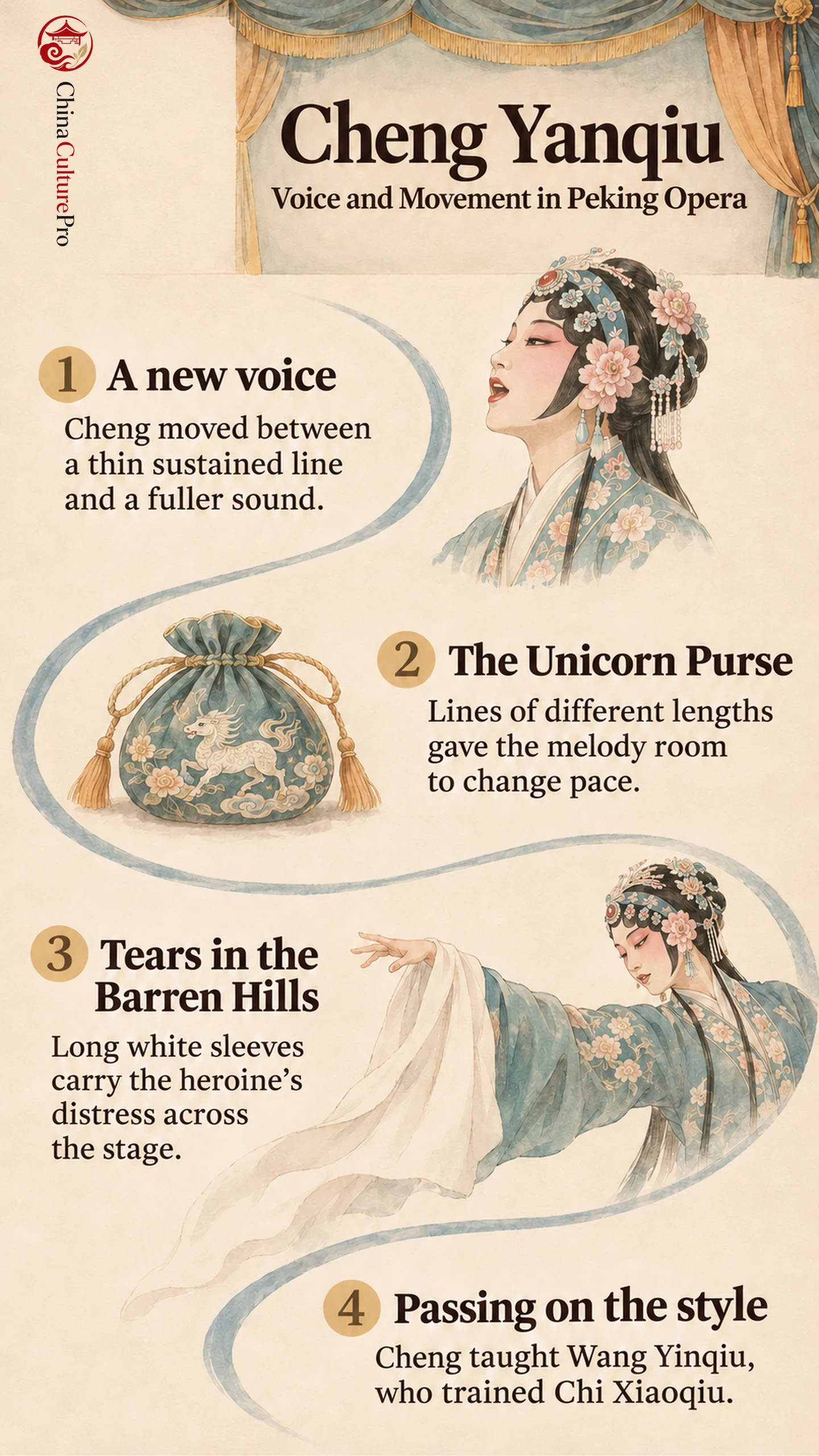
A character who has lost her position can still enter with the bearing of a young woman from a wealthy family. In one of Cheng Yanqiu’s signature works, that tension runs through the heroine’s singing and movement. A second work shows how he could make distress visible across the stage.
How Cheng Yanqiu Found His Voice
Cheng trained from childhood and learned from several artists, including Mei Lanfang (梅兰芳, Méi Lánfāng). Wang Yaoqing (王瑶卿, Wáng Yáoqīng) was a particularly strong influence. Cheng developed a style suited to his own voice, which had a clear, deep timbre. By the late 1920s, his approach was recognizable as a school within Peking opera.[1][3]
For a listener, the striking detail is how far a single line can travel in weight and volume. Cheng could taper a note until it sounded about to break, then connect it to the next syllable. Clear diction kept the words audible through the changes in volume. That control gave a qingyi role room for grief, hesitation and resolve within a formal stage style.[1][2][7]
How The Unicorn Purse Fits Music to Words
In The Unicorn Purse (锁麟囊, Suǒ Lín Náng), Xue Xiangling (薛湘灵, Xuē Xiānglíng) is on the way to her own wedding when she gives a purse to a poor bride. A flood later ruins Xue’s own fortunes. When she takes a job in a wealthy household, she learns that its mistress is the bride she once helped. That reversal changes what the singer has to convey in the two encounters.[4][8]
Playwright Weng Ouhong (翁偶虹, Wēng Ǒuhóng) wrote lines of different lengths, allowing Cheng to vary where a sung phrase could gather speed or hold a note. In the questioning scene, Cheng set a sequence of close-packed lines to music. Listen for how quickly the words can accumulate and where a longer phrase gives the character space to consider what she is saying.[1][4]
What the Sleeves Show in Tears in the Barren Hills
In Tears in the Barren Hills (荒山泪, Huāngshān Lèi), Zhang Huizhu (张慧珠, Zhāng Huìzhū) is left alone after demands for taxes and forced labor help tear her family apart. Cheng’s performance in the 1956 color film shows how his water sleeves (水袖, shuǐxiù), long cloth extensions at the ends of the costume sleeves, carry the character’s distress into the space around her.[1][5][6]
Follow the cloth after the arm changes direction. It can continue moving while the performer has already shifted weight or looked elsewhere. A viewer can compare the moment when the gesture begins with the moment when the fabric settles. The movement can hold the audience’s attention after the hand itself has stopped.[1][2][5]
How the Cheng School Was Passed Down
Cheng’s approach survived through direct pupils and through their own students. Wang Yinqiu (王吟秋, Wáng Yínqiū) learned from Cheng and trained Chi Xiaoqiu (迟小秋, Chí Xiǎoqiū). The 2010 Chinese Opera Festival in Hong Kong programmed Chi in a showcase of the school’s stage and singing techniques.[1][7]
Li Shiji (李世济, Lǐ Shìjì), who received instruction from Cheng, developed her own Cheng School work. She wrote Anecdotes about Empress Wu Zetian (武则天轶事, Wǔ Zétiān Yìshì) in the 1990s and later supervised Li Haiyan (李海燕, Lǐ Hǎiyàn) in rehearsing it. A 2018 Hong Kong program paired the later production with established Cheng School repertoire. The pairing shows how the school’s methods were applied to a play created decades after Cheng’s death.[1][8]
FAQs About Cheng Yanqiu
What was Cheng Yanqiu’s role type?
Cheng specialized in qingyi, a category within female roles in Peking opera. He is remembered alongside Mei Lanfang, Shang Xiaoyun (尚小云, Shàng Xiǎoyún) and Xun Huisheng (荀慧生, Xún Huìshēng) as one of the four great dan performers of his era.[1][3][7]
Is The Unicorn Pouch the same opera as The Unicorn Purse?
Yes. The Unicorn Purse および The Unicorn Pouch are English titles for the Cheng School opera in which the gift of a purse links two women’s lives.[4][8]
Is there a film of Cheng Yanqiu performing?
Yes. The 1956 color opera film Tears in the Barren Hills features Cheng as Zhang Huizhu.[5][6]
出典
[1] China National Peking Opera Company. The Cheng Yanqiu School
[2] UNESCO. Peking Opera
[3] University of Hong Kong Digital Exhibitions. Cheng Yan Qiu
[4] National Centre for the Performing Arts. Shi Yihong Peking Opera Performance
[5] Beijing Daily. Cheng Yanqiu Performs Tears in the Barren Hills
[6] Peking Opera Script Archive. Tears in the Barren Hills
[7] Hong Kong Leisure and Cultural Services Department. The Legacy of Cheng Yanqiu at the 2010 Chinese Opera Festival
[8] Hong Kong Arts Events Databank. A Showcase of Cheng School Classics