

Quick Answer: What Was the Chanyuan Treaty?
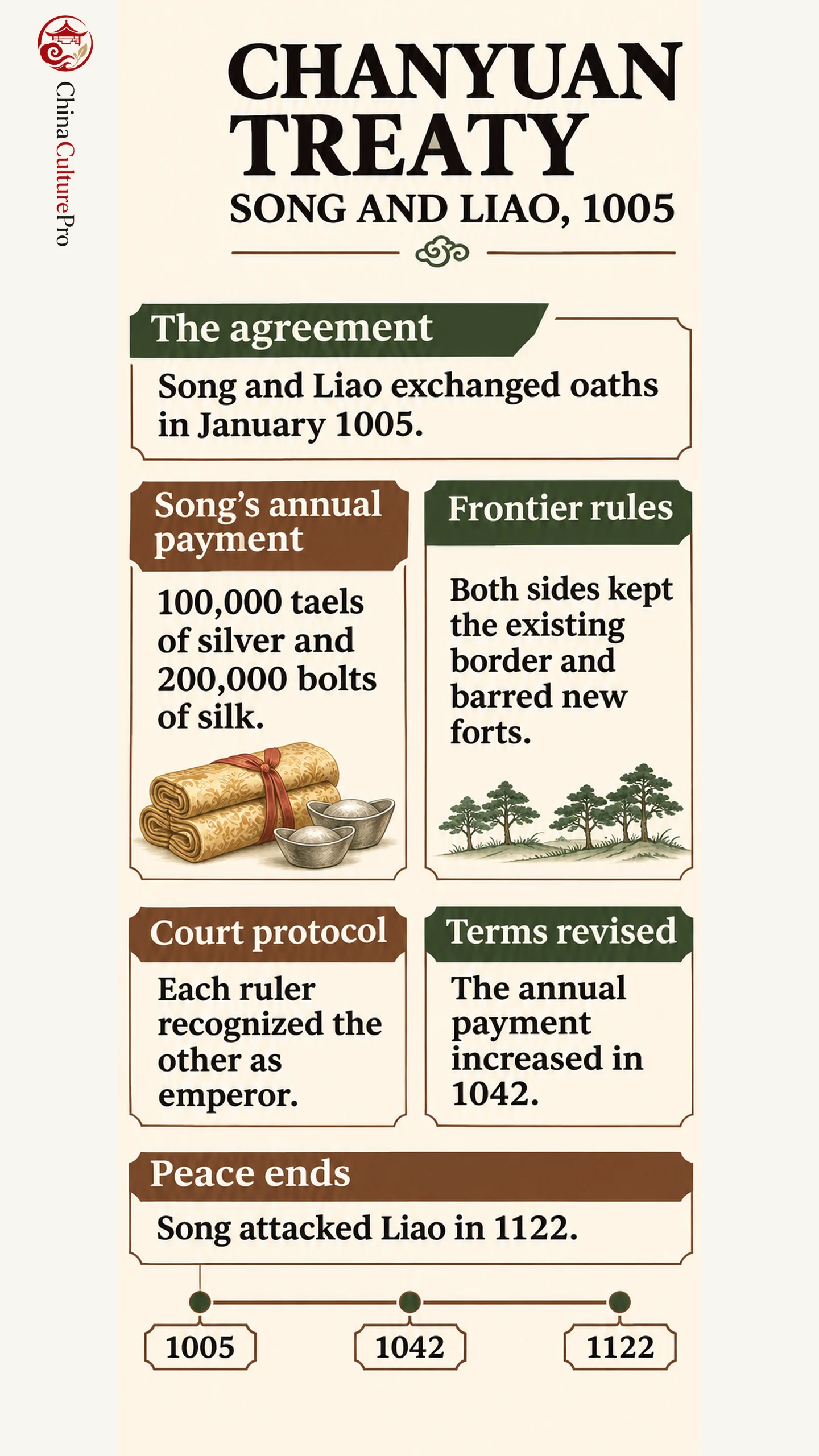
The Chanyuan Treaty (澶渊之盟, Chányuān zhī méng) ended a war between the Northern Song (北宋, Běi Sòng) and the Khitan Liao (辽, Liáo) in January 1005. The Song emperor Zhenzong (真宗, Zhēnzōng) and the Liao emperor Shengzong (圣宗, Shèngzōng) exchanged sworn letters. Song promised annual shipments of silver and silk, and both courts agreed to respect the frontier. [1][2][3]
- Annual payment: Song sent 100,000 taels of silver and 200,000 bolts of silk to Liao.
- Territory: The courts accepted the existing division and limited new works along the border.
- 外交性: Both rulers dealt with each other as emperors. [1][2][3]
The 1005 agreement concerned the Song–Liao frontier. Song later faced separate wars and settlements on its northwestern border. [2]
A finance official delivering silk, an envoy attending a birthday and a border officer planting trees each saw a different side of the same agreement. Their work shows how the two courts kept the peace in practice.
Why the Two Courts Negotiated at Chanzhou
Control of the Sixteen Prefectures (燕云十六州, Yānyún shíliù zhōu), which extended from the area of present-day Beijing west toward Datong, had long divided the courts. Khitan rulers held the prefectures. The Song dynasty tried to recover them in 979 and 986. The Khitan Liao in turn wanted to regain positions farther south that it had lost to the Later Zhou, before the Song was founded. [2][3][4]
A major Liao offensive in 1004 brought the confrontation to Chanzhou (澶州, Chánzhōu) on the Yellow River. Zhenzong went there while talks were under way. The Song chronicle connects the movement of the ruler and the army to the exchange of envoys, showing that negotiations continued while the campaign was still in progress. [1][3][4]
Li Tao’s later chronicle preserves a disagreement among the Song advisers. Some questioned the cost of the annual payment. The minister Bi Shi’an argued that a substantial payment gave the Liao court a reason to keep the agreement. The episode shows how differently officials assessed the same expense while an army was still withdrawing. [1]
What the Oath Letters Required
The Song oath specified how to deliver the annual payment. Officials from its finance administration would carry the silver and silk to Xiongzhou (雄州, Xióngzhōu), where they would be handed over. The wording spared the Song court the need to dispatch a special envoy to Liao for every delivery. The delivery point made the payment a frontier transaction even when the imperial courts communicated through separate embassies. [1][5]
The frontier provisions were mutual. Each side was to keep within its territory, prevent interference with crops, and refuse shelter to fugitives. Existing defenses could be repaired, but the two courts agreed to forgo new fortifications and canals along the frontier. The letters pledged that later generations would observe the agreement. [1][3][5]
Accepting the existing division meant that Song did not recover the Sixteen Prefectures. Liao dropped its claim to Yingzhou and Mozhou, two prefectures south of the passes. The settlement resolved the immediate question of who would administer those places while letting both courts keep their imperial titles. [2][3]
How the Peace Worked on the Frontier
Court protocol gave the agreement a life beyond the exchange of oath letters. Zhenzong was treated as Shengzong’s elder brother in a ceremonial relationship between ruling houses. Embassies marked birthdays and the New Year. A mission could offer condolences after a ruler died. Those recurring contacts gave the courts a way to communicate between crises. [3][5]
The treatment of the Liao empress dowager Chengtian mattered alongside the relationship between the emperors. The diplomatic record preserves the dispatch of a Song envoy for her birthday. That mission recognized the importance of her position in the Liao court, where she had exercised authority during the campaign. [1][5][6]
Frontier officials continued to plan for attacks. At Xiongzhou, Song officials planted elms to close gaps in the wooded defenses. Trees could slow cavalry without resembling the new forts that the treaty forbade. The example also shows why a written prohibition does not describe every way officials could protect a border. [4]
When the Settlement Broke Down
The frontier settlement was durable enough to survive new demands. In 1042, while Song was fighting the Tanguts, Liao pressed for concessions and Song agreed to raise the annual payment to 200,000 taels of silver and 300,000 bolts of silk. The courts bargained over the terms instead of resuming their earlier war. The agreement’s original quantities therefore belong specifically to the settlement reached in 1005. [2][7]
The break came when the Song court joined the rising Jurchen Jin (金, Jīn) against Liao and sent an expedition north in 1122. Song again sought the Sixteen Prefectures. The episode ended more than a century of Song–Liao peace and restored a northern threat in a different form when the Jin turned against Song. [2][4]
FAQs About the Chanyuan Treaty
Was the Chanyuan Treaty concluded in 1004 or 1005?
The offensive and negotiations began in 1004. The two courts exchanged the oath letters in January 1005. The letters are dated to the twelfth lunar month of the regnal year that began in 1004, so some histories refer to a treaty of 1004. [1][2][5][7]
Is the Treaty of Shanyuan the same agreement?
Yes. Shanyuan is an alternative reading used in English-language scholarship for the same place and agreement. Chanyuan Covenant is another English name. [2][6]
Did the silver and silk make Song a vassal of Liao?
Song’s annual payments accompanied diplomatic recognition of both rulers as emperors. The Song letter described its payments as assistance with military expenses, and later court protocol treated the ruling houses as ceremonial relatives. [1][2][3][5]
出典
[1] Li Tao. Extended Continuation of the Comprehensive Mirror for Aid in Government, Volume 58
[2] Paul Jakov Smith. The Fragility of Peace: Song China’s Northwestern Frontier and Erosion of the Chanyuan Paradigm in the Mid-Eleventh Century
[3] Hang Lin. Song China’s Attitude Toward the Khitan Liao
[4] Yuan Julian Chen. Frontier, Fortification, and Forestation: Defensive Woodland on the Song–Liao Border in the Long Eleventh Century
[5] Li E. Supplement to the History of Liao, Volume 7
[6] Hang Lin. Empress Dowagers on Horseback: Yingtian and Chengtian of the Khitan Liao (907–1125)
[7] Kent Deng and Lucy Zheng. Economic Restructuring and Demographic Growth: Demystifying Growth and Development in Northern Song China, 960–1127