
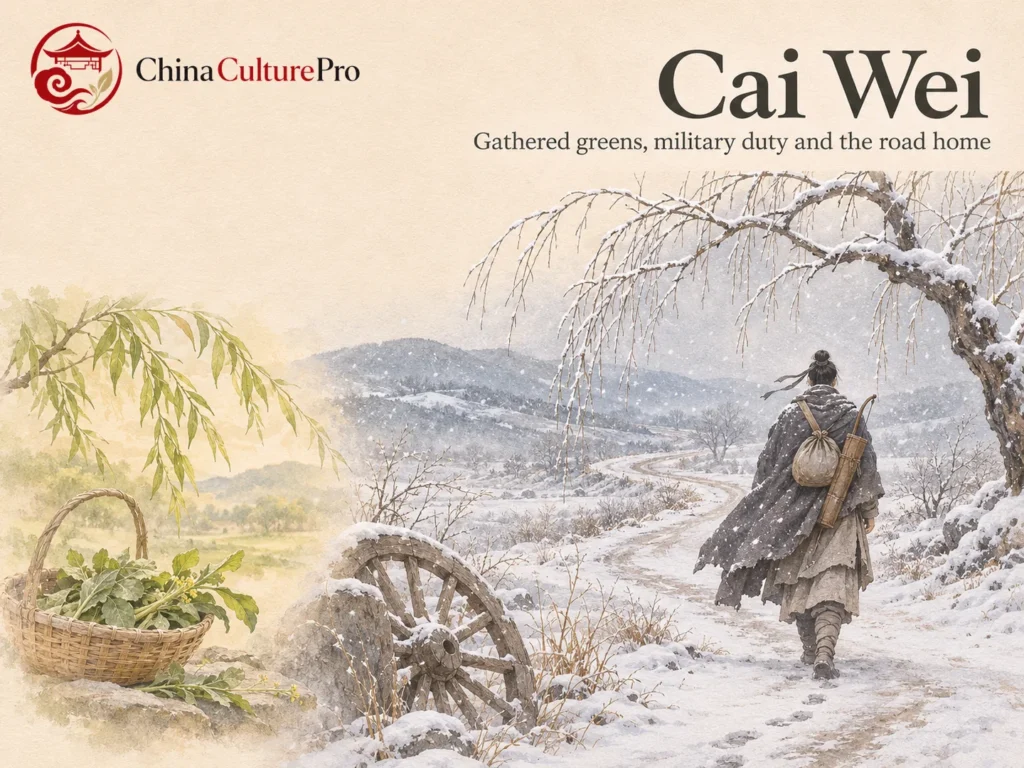

Quick Answer: What Is Cai Wei About?
Cai Wei (采薇, Cǎi Wēi), from the Book of Songs (诗经, Shī Jīng), gives a soldier’s longing for home a repeated refrain. Plants grow and harden, service continues, and military readiness stands beside hunger, anxiety and the wish to return.
- Read the whole poem: The famous willows-and-snow passage is its final stanza, not the complete text.
- Follow changing time: The opening refrain returns while the gathered plants change.
- Keep the ending unsettled: A homeward road still carries thirst, hunger and unrecognized grief.
The poem presents a soldier’s voice without naming an individual author. It should not be treated as a dated personal diary or a complete account of one campaign.
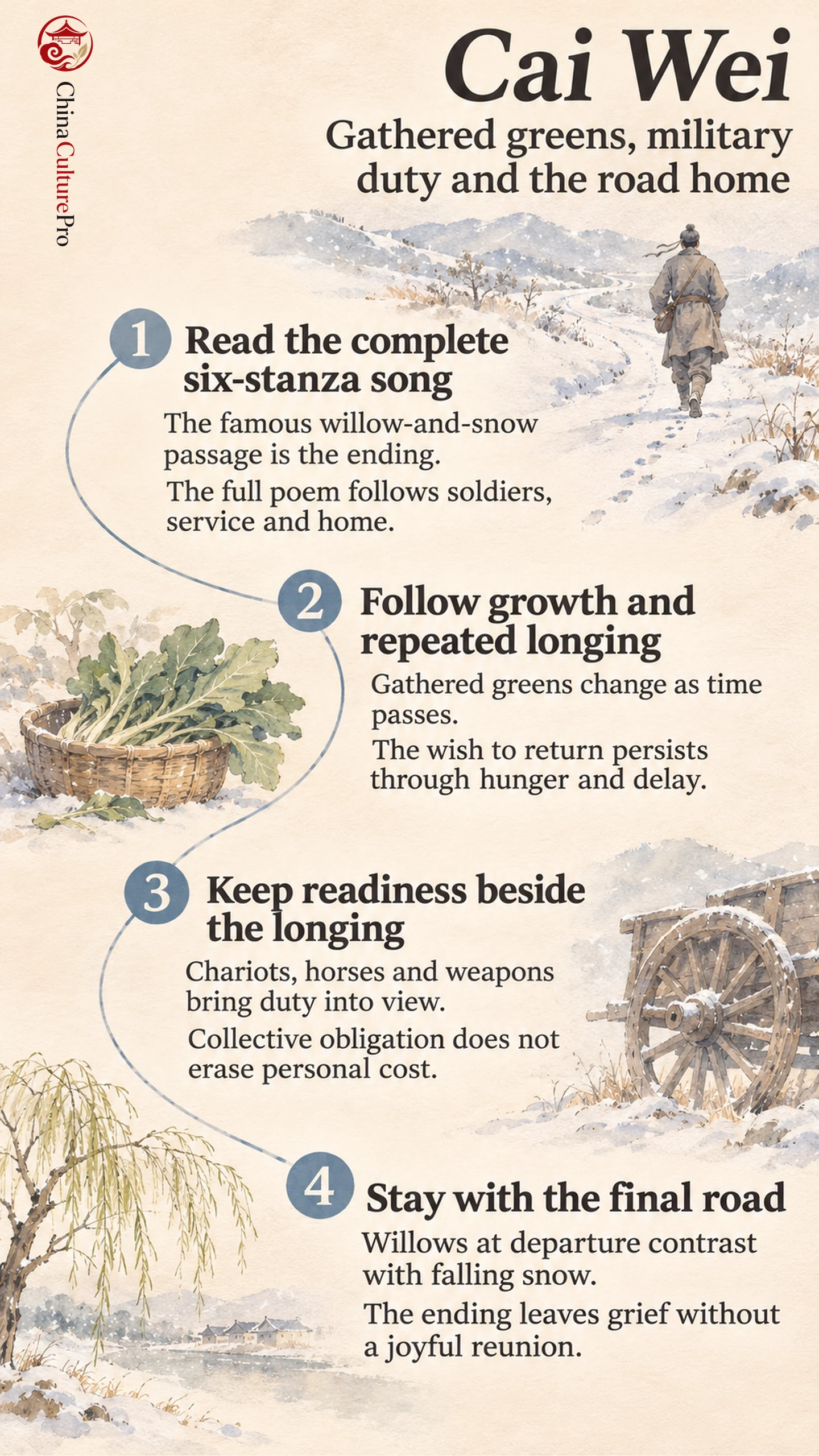
The final contrast between swaying willows and falling snow is memorable on its own. The preceding five stanzas make it heavier: the return has been repeatedly desired, postponed and weighed against the demands of service.
Read All Six Stanzas of Cai Wei
The poem belongs to the Lesser Odes (小雅, Xiǎo Yǎ) section. It has six stanzas of eight four-character lines. The title names gathering wei (薇, Wēi), a plant often rendered as vetch or fern in English; “wei greens” below keeps the plant name open. [1][2]
The Xianyun (玁狁, Xiǎn Yǔn) are the adversary named in the song. The chang tree (常, Cháng) in stanza four also retains its older plant name here. Below is the complete text with an original English rendering; each row contains one stanza. [1]
| Stanza and Chinese text | Plain English rendering |
|---|---|
| 1. 采薇采薇,薇亦作止。曰归曰归,岁亦莫止。靡室靡家,玁狁之故。不遑启居,玁狁之故。 | Gathering wei, gathering wei: the greens are sprouting. “Home again, home again”—yet the year is late. No settled house or home, because of the Xianyun; no leisure to sit or rest, because of the Xianyun. [1] |
| 2. 采薇采薇,薇亦柔止。曰归曰归,心亦忧止。忧心烈烈,载饥载渴。我戍未定,靡使归聘。 | Gathering wei, gathering wei: the greens are tender. “Home again, home again”—yet my heart is anxious. Worry burns fiercely; I hunger and thirst. Our service is unsettled; no one can be sent home to ask after the family. [1] |
| 3. 采薇采薇,薇亦刚止。曰归曰归,岁亦阳止。王事靡盬,不遑启处。忧心孔疚,我行不来。 | Gathering wei, gathering wei: the greens have hardened. “Home again, home again”—the tenth month has come. The king’s business allows no slackening, no leisure to sit or stay. My worried heart aches deeply; I went away and have not returned. [1] |
| 4. 彼尔维何?维常之华。彼路斯何?君子之车。戎车既驾,四牡业业。岂敢定居?一月三捷。 | What is that flourishing? The chang tree’s flowers. What great carriage is that? The commander’s chariot. War chariots are harnessed, four stallions tall and strong. How dare we settle down? Three victories within one month. [1] |
| 5. 驾彼四牡,四牡骙骙。君子所依,小人所腓。四牡翼翼,象弭鱼服。岂不日戒,玁狁孔棘! | Harness those four stallions, powerful and eager. The commander rides; the common soldiers find protection by the chariot. Four stallions move in order; ivory-tipped bows and hide quivers are ready. Must we not stay watchful daily? The Xianyun threat is urgent. [1] |
| 6. 昔我往矣,杨柳依依。今我来思,雨雪霏霏。行道迟迟,载渴载饥。我心伤悲,莫知我哀! | When I went away, the willows swayed softly. Now I come back, with snow falling thickly. The road stretches slowly; I thirst and hunger. My heart is wounded by sorrow; no one knows my grief. [1] |
“Tenth month” uses an older calendar, not automatically modern October. The middle stanzas’ commander and common soldiers describe different roles; they do not simply divide people into morally good and bad. [2]
For the collection, see the Book of Songs guide.
Follow the Refrain through Growth, Hunger and Delay
The first three stanzas begin with nearly the same action, yet the plant changes from sprouting to tender growth and then hardness. The repeated wish for home does not produce an equally swift change in the soldiers’ circumstances. [1]
Repetition therefore does more than make the song easy to remember. It lets a desire persist while time passes around it. The plant gives delay a visible form without requiring the reader to reconstruct an exact month-by-month diary.
Hunger, thirst and the lack of a messenger make separation bodily and practical. Home is not merely a pleasant landscape recalled from afar. It includes people whose well-being cannot readily be checked. [1]
The poem’s natural imagery stays tied to that human task. The nature poetry guide offers other ways of reading landscape and lived experience together.
Keep Military Readiness beside the Desire for Home
The middle stanzas shift attention toward chariots, strong horses, bows and quivers. Military action becomes present through equipment and readiness, rather than through a graphic description of combat. [3]
That shift matters. The soldiers’ suffering does not erase the urgent threat, and the display of strength does not cancel their suffering. The text holds collective obligation beside personal cost. Calling it only a triumphant military song or only a rejection of all war would flatten that tension.
The flourishing flowers at the opening of stanza four also change the imagery’s scale. Earlier plant growth marked waiting; now the eye moves toward a splendid martial formation. The final stanza will contract that collective display into one voice’s vulnerable journey. [1]
Compare Du Fu’s Ballad of the Army Carts for a later poem that connects military service with what it takes from ordinary lives.
Read Willows and Snow through the Final Unheard Grief
The last stanza sets departure and return beside different landscapes. Softly moving willows belong to the remembered departure; thick snow accompanies the homeward movement. The contrast makes absence felt through what has changed outside the speaker. [1]
The return need not be read as an authenticated moment in a soldier’s diary. Traditional commentary also understands the ending as an imagined or anticipated account of coming back. In either reading, the difficult road remains central. [2]
The poem does not show a household reunion. It leaves the speaker hungry, thirsty and grieved, with no one recognizing that grief. Reaching toward home has not automatically restored a sense of belonging.
Read that last line after the repeated wish to return. The desired movement has become possible in the poem’s closing perspective, but the longed-for emotional release has not arrived. This is why the ending speaks beyond a simple contrast of spring and winter.
For its wider place among forms and periods, continue with the Chinese poetry guide.
FAQs About Cai Wei
Is Cai Wei only the stanza about willows and snow?
No. That passage is the sixth and final stanza. The complete poem has forty-eight four-character lines.
Does rain and snow mean two kinds of weather here?
In the final stanza, the character normally read as “rain” functions as a verb meaning to fall. The phrase describes falling snow.
Does the poem end with a happy homecoming?
It ends on a difficult homeward road, with hunger, thirst and grief that no one recognizes. A joyful family reunion is not shown.
出典
[1] Anonymous, via Wikisource. Book of Songs: Cai Wei, Complete Six-Stanza Text
[2] Zhu Xi, via Wikisource. Collected Commentaries on the Book of Songs, Volume 4: Cai Wei
[3] Daymon Joseph Macmillan, University of Victoria. Traversing the Periphery: Focalization in Cen Shen’s Frontier Settings within the Context of Chinese Frontier Poetry