
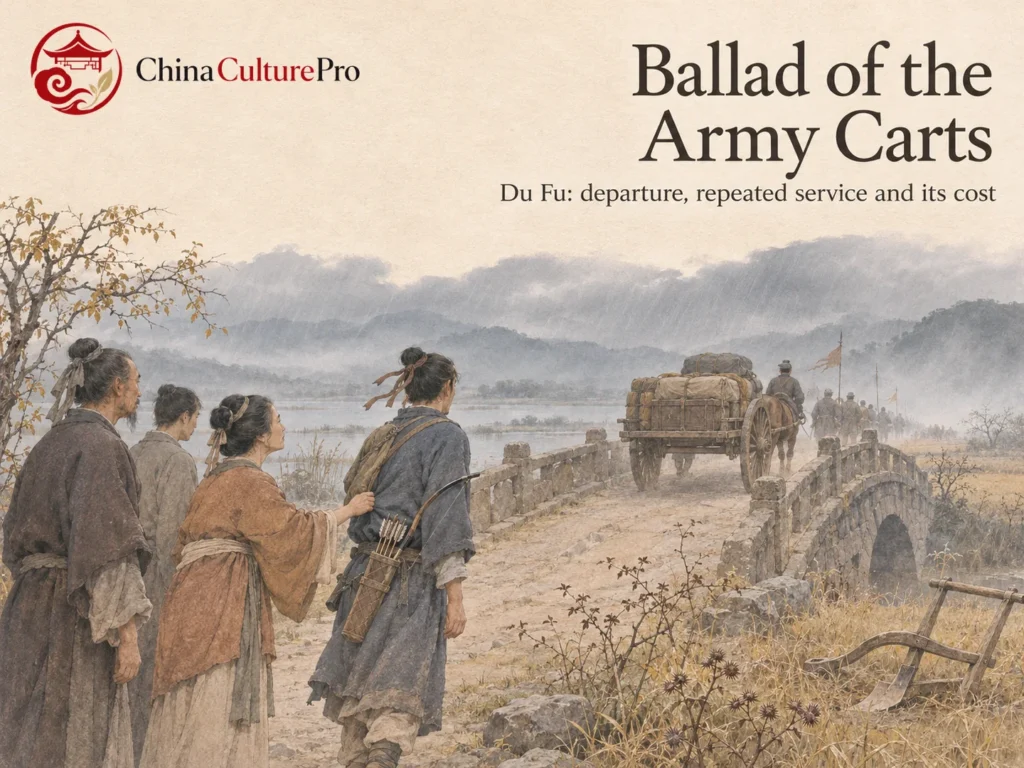

Quick Answer: What Does Ballad of the Army Carts Criticize?
Ballad of the Army Carts (兵车行, Bīng Chē Xíng) by Du Fu (杜甫, Dù Fǔ) exposes the human cost of repeated military service and relentless expansion. A noisy departure opens into a conscript’s account of exhausted families, neglected farming and demands for taxes.
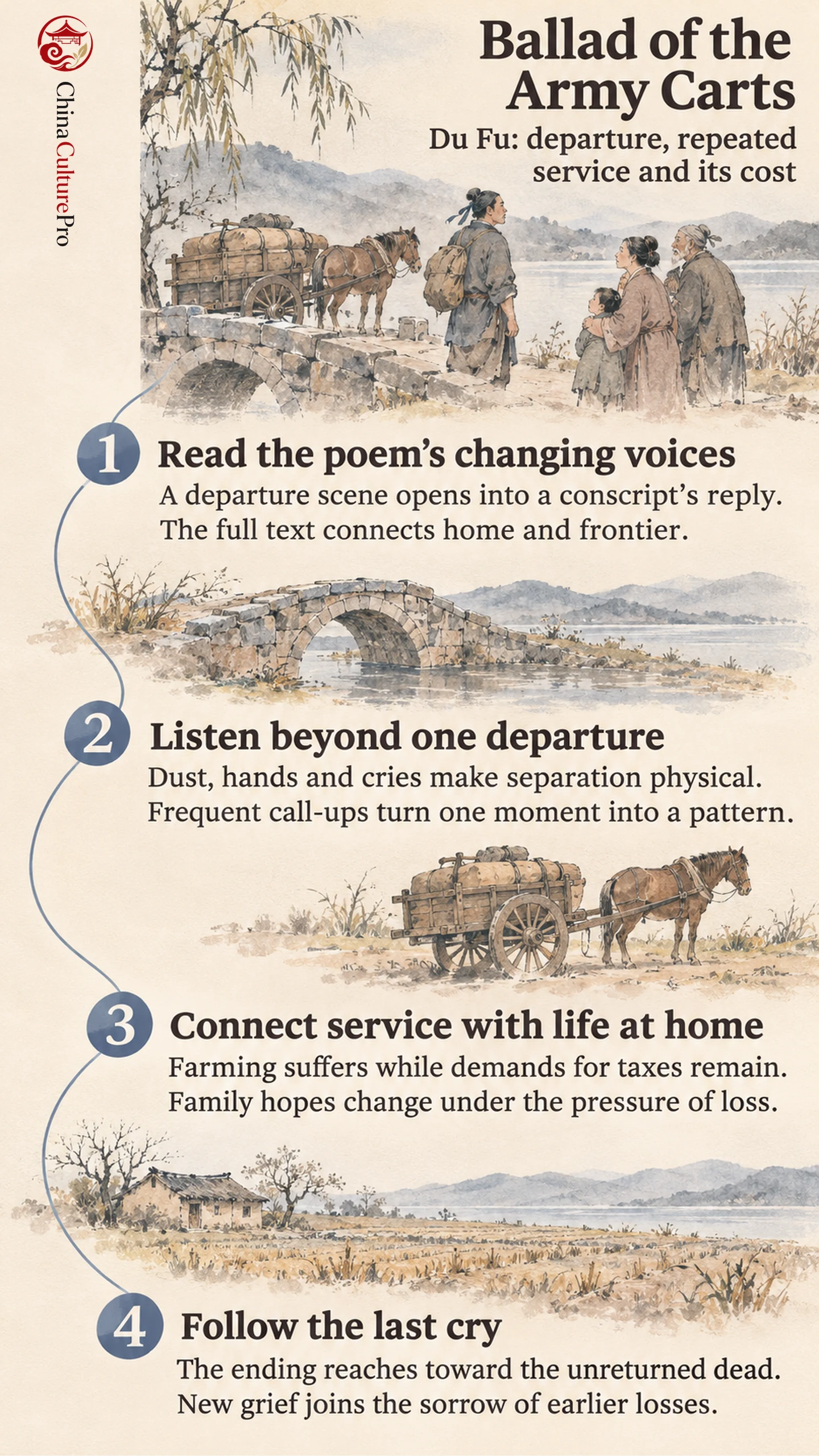
- Listen for the change of voice: An outward scene gives way to a question and a conscript’s reply.
- Connect home and frontier: The losses affect fields, households and the men sent away.
- Follow the final sound: The crying of living relatives returns as the crying of the dead.
Its historical names and heightened images serve a Tang-period critique. The poem is not a statistical report or a transcript of one verified roadside interview.
The carts promise movement, but the poem keeps asking what that movement takes from people. Its force comes from allowing those left behind and those being sent away to occupy the same field of attention.
Read the Complete Poem and Its Changing Voices
The following original English rendering covers the full poem. Its opening has short, abrupt sound phrases; later questions and changes of line length keep the account from settling into an even narrative pace. [1]
The names include Xianyang Bridge (咸阳桥, Xián Yáng Qiáo), Emperor Wu (武皇, Wǔ Huáng), Shandong (山东, Shān Dōng), Guanxi (关西, Guān Xī) and Qinghai Lake (青海, Qīng Hǎi). Historical Shandong means lands east of the mountains, not simply today’s province; Guanxi means west of the passes. [2]
| Chinese text | Plain English rendering |
|---|---|
| 车辚辚,马萧萧,行人弓箭各在腰。 | Carts rattle, horses neigh; each departing man has bow and arrows at his waist. [1] |
| 耶娘妻子走相送,尘埃不见咸阳桥。 | Parents, wives and children run to see them off; dust hides Xianyang Bridge. [1] |
| 牵衣顿足拦道哭,哭声直上干云霄。 | They pull at clothes, stamp their feet, block the road and weep; their cries rise straight into the clouds. [1] |
| 道傍过者问行人,行人但云点行频。 | A passerby asks a departing man; he says only that call-ups come often. [1] |
| 或从十五北防河,便至四十西营田。 | Some guard the river in the north from fifteen, then farm for the army in the west until forty. [1] |
| 去时里正与裹头,归来头白还戍边。 | The village head wrapped their headcloth when they left; they return white-haired, yet still guard the frontier. [1] |
| 边庭流血成海水,武皇开边意未已。 | Frontier blood flows into a sea, while Emperor Wu’s wish to extend the borders never ends. [1] |
| 君不闻汉家山东二百州,千村万落生荆杞。 | Have you not heard? Across the Han realm’s two hundred prefectures east of the mountains, countless villages grow thorn and brush. [1] |
| 纵有健妇把锄犁,禾生陇亩无东西。 | Even with strong women holding hoe and plough, crops grow in fields whose boundaries are lost. [1] |
| 况复秦兵耐苦战,被驱不异犬与鸡。 | And Qin’s soldiers, able to endure hard fighting, are driven about like dogs and chickens. [1] |
| 长者虽有问,役夫敢申恨? | Though you, respected elder, ask, how could a conscript dare voice his resentment? [1] |
| 且如今年冬,未休关西卒。 | Take this winter: the soldiers west of the passes still have no release. [1] |
| 县官急索租,租税从何出? | Officials urgently demand the dues; where can the taxes come from? [1] |
| 信知生男恶,反是生女好。 | Truly, having a son is bitter; having a daughter is better instead. [1] |
| 生女犹得嫁比邻,生男埋没随百草。 | A daughter can still marry nearby; a son lies lost among the grasses. [1] |
| 君不见青海头,古来白骨无人收。 | Have you not seen beside Qinghai Lake? Since long ago, white bones have lain uncollected. [1] |
| 新鬼烦冤旧鬼哭,天阴雨湿声啾啾。 | New ghosts grieve in wrong, old ghosts cry; beneath a dark, rain-soaked sky their thin wailing continues. [1] |
The Du Fu guide places this public concern beside other subjects in his work.
Hear the Departure before Listening to the Conscript
The opening makes separation physical. Dust obscures the bridge while hands catch clothing and feet stamp the ground. The relatives do more than watch an orderly procession: they try to hold it back. [1]
The passerby’s question then changes the poem’s scale. What looked like one departure becomes a pattern of frequent call-ups. The account runs from youth toward white hair, making service feel capable of consuming a life rather than occupying one short interval. [1]
The poem names an anonymous passerby, not an authenticated interviewer. Read the encounter as a crafted means of giving the conscript a voice. His claim that he hardly dares speak makes the complaint more charged, not less articulate.
“Emperor Wu” and “Han” give the critique an older historical vocabulary. Traditional commentary reads them against Tang expansion under Xuanzong. Likewise, “Qin’s soldiers” refers to men of the capital region here; it does not relocate the entire poem to the Qin dynasty. [2]
Connect Repeated Service with Fields, Taxes and Family
The abandoned villages show a cost that a battlefield scene alone would miss. Men are away; women continue the work; cultivation suffers. The next demand for taxes exposes the contradiction: the authorities require payment from households whose productive labor has been taken. [1][2]
The language magnifies that pressure. Blood becoming seawater and villages counted in thousands are images of overwhelming loss, not measurements to convert into casualty totals or a precise agricultural survey. [1]
The preference for daughters is another measure of distress. A daughter might remain nearby through marriage; a son may disappear into distant death. The line makes ordinary family hopes collapse under the demands of war. It is not advice to rank children’s worth by sex. [1]
For its wider poetic setting, continue with the Tang poetry guide.
Follow the Last Cry toward the Unburied Dead
The ending reaches beyond those leaving now to those already lost. New ghosts join old ones, so the current departure belongs to an accumulating history of suffering. Uncollected bones deny the scene a consoling image of honorable return. [1]
The closing cries also answer the relatives’ cries near the bridge. The poem begins with living people resisting separation and ends where separation has become permanent. Traditional commentary identifies this passage from human weeping to ghostly weeping as part of its structure. [2]
That ending sustains a criticism of relentless campaigning; it does not supply a rule about every possible use of force. Nor does the ghost imagery require belief in actual spirits. Its immediate work is to let the unreturned dead remain audible.
Compare Lu Lun’s frontier song or Cen Shen’s snow farewell. Each selects a different moment of military life and asks the reader to hear it differently.
FAQs About Ballad of the Army Carts
Is the poem about the Han dynasty or the Tang dynasty?
Its Han names form part of a critique traditionally understood in relation to Tang campaigning. They should not turn the whole scene into a literal Han-period chronicle.
Does Shandong mean the modern province?
Here it names lands east of the mountains in an older geographical usage, rather than simply the present province.
Why does the speaker say daughters are better than sons?
He contrasts a daughter who might marry nearby with a son lost to war. The reversal expresses the damage that repeated service does to family hopes.
出典
[1] Du Fu, via Wikisource. Ballad of the Army Carts: Complete Chinese Text
[2] Qiu Zhao’ao, via Wikisource. Detailed Commentary on Du Fu’s Poems, Volume 2: Ballad of the Army Carts