

Quick Answer: Which Like a Dream Did Li Qingzhao Write?
Li Qingzhao (李清照, Lǐ Qīngzhào) wrote two well-known lyrics to Like a Dream (如夢令, Rú Mèng Lìng), a ci (詞, cí) tune pattern rather than a unique descriptive title. Identify them by their opening lines.[1][2][3]
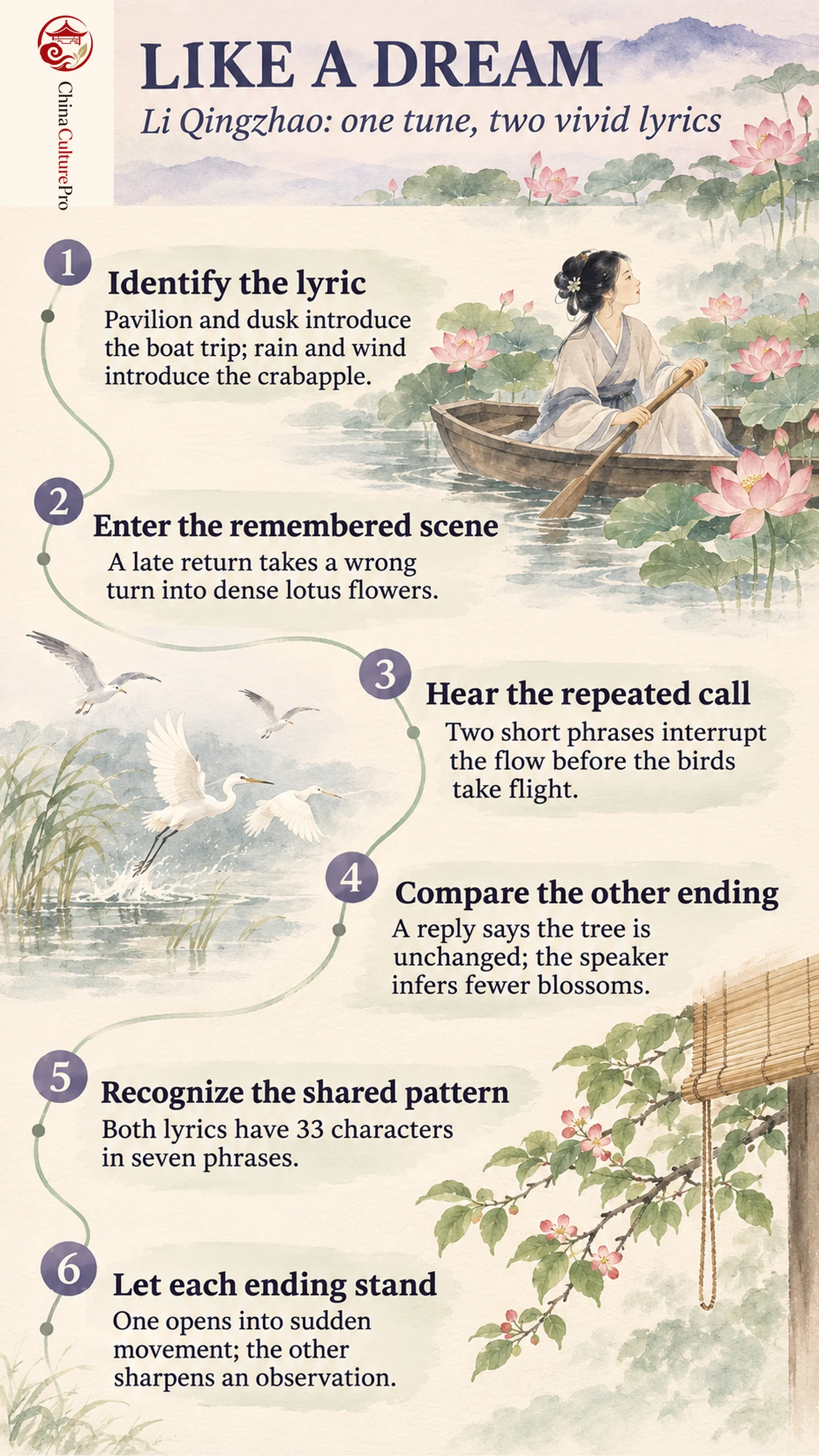
- The boating lyric: “I often remember the streamside pavilion at dusk” recalls a late return, a wrong turn among lotuses and startled waterbirds.
- The crabapple lyric: “Last night, scattered rain and sudden wind” leads to a conversation about flowers and the changing balance of leaves and blossoms.
- The shared form: Both have 33 Chinese characters in seven phrases, including a repeated two-character phrase near the end.
This guide centers on the boating lyric and includes the other complete text for comparison. Neither tune title requires an actual dream.[1][2]
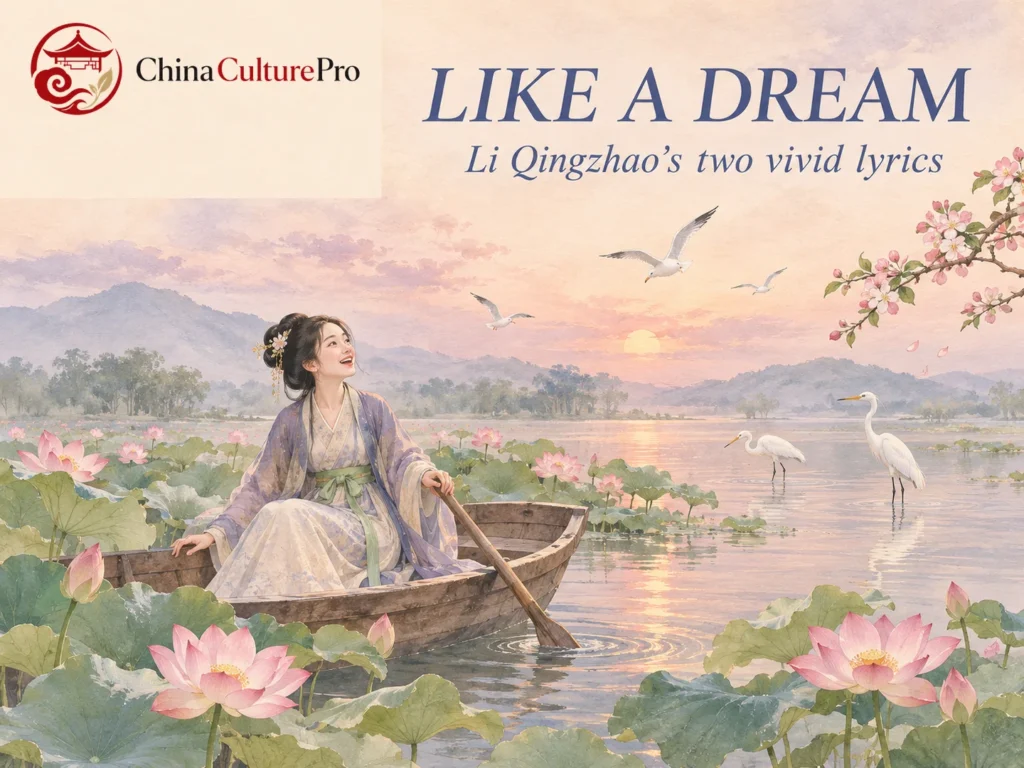
A boat slips into dense lotus flowers; a sudden disturbance sends birds into the air. This lively remembered outing fills a short song lyric. Another begins after a night of rain and wind. Their shared title can hide how differently the two lyrics work.
The Boating Lyric: Complete Chinese Text and English Meaning
The following sense translation is made for this guide from the Chinese text. Its “I” makes the English readable; the Chinese does not specify who is aboard.[1]
| Chinese text | 意味 |
|---|---|
| 常記溪亭日暮, | Often I remember dusk at the pavilion beside the stream, |
| 沉醉不知歸路。 | deeply drunk, unable to tell the homeward way. |
| 興盡晚回舟, | When the pleasure was spent, I turned the boat home late, |
| 誤入藕花深處。 | and strayed into the depths of lotus blossoms. |
| 爭渡, | Find a way through! |
| 爭渡, | Find a way through! |
| 驚起一灘鷗鷺。 | Up flew the gulls and egrets from an entire stretch of shallows. |
This text uses 一灘, a stretch of waterside shallows. An edition of her collected lyrics instead has 一行, a line or row, in that place. The version above keeps one received wording throughout.[1][4]
How the Boat Trip Becomes a Remembered Adventure
The opening places the scene inside recollection. The speaker remembers being at a streamside pavilion as daylight faded, then returning by boat after drinking. “Not knowing the homeward way” establishes the practical confusion before the boat enters the flowers.[1]
The lotuses create depth and obstruction. They are not just a pretty object beside the boat: the traveler goes into their thick growth. The wrong turn gives the repeated call its urgency. This English version hears the call as an attempt to find a passage, preserving the difficulty of moving through the plants.[1]
At the end, attention leaves the human traveler. The birds suddenly take flight, opening the tight space around the boat into movement across the water. The poem stops at that surprise. It does not narrate a safe arrival home, an accident or a punishment for drinking. The final image preserves the confusion and excitement of the excursion rather than resolving its route.[1]
For the writer behind this energetic speaking voice, the Li Qingzhao guide gives the broader literary and historical setting.
The Other Like a Dream: Rain, Wind and Crabapple Blossoms
The second lyric is recognizable from its first weather report. Its haitang (海棠, hǎitáng) is a flowering crabapple; the closing colors refer to leaves and flowers.[2][3]
| Chinese text | 意味 |
|---|---|
| 昨夜雨疏風驟, | Last night, scattered rain and sudden wind; |
| 濃睡不消殘酒。 | even a heavy sleep has not cleared the lingering wine. |
| 試問卷簾人, | I try asking the person lifting the blind, |
| 卻道海棠依舊。 | who answers, “The crabapple is unchanged.” |
| 知否, | Do you know? |
| 知否, | Do you know? |
| 應是綠肥紅瘦。 | Surely the green is fuller, the red more scant. |
These are new sense translations, not quotations from an existing English version. Where the boat lyric remembers an event directly, this speaker questions someone else’s report. “Surely” matters: the final line infers what the weather should have done, rather than describing the speaker walking outside to inspect the tree.[1][2]
The fullness of green and thinness of red make seasonal change bodily and immediate. More leaves and fewer blossoms answer the casual assurance that everything is the same. Broader crabapple symbolism in Chinese art provides another context, but the local meaning here comes from weather, foliage and diminishing bloom.[2][3]
One Tune Pattern, Two Different Turns
The sequence of phrase lengths in both texts is 6, 6, 5, 6, 2, 2, 6. The repeated short phrase interrupts the longer phrases immediately before the final image. In the boat lyric, the repeated call precedes sudden outward action; in the crabapple lyric, the repeated question sharpens an inward correction.[1][2]
A tune name identifies the pattern that a lyric follows. It does not mean the two scenes form one continuous story. The Song ci poetry guide explains how different lyrics could share a musical and metrical model.[3]
Wine also takes different roles across Li’s poems. Here it clouds direction or lingers after sleep; in Drunken Flower Shade, drinking belongs to another seasonal and emotional setting. A repeated object does not automatically carry the same feeling in every lyric.
How to Read the Lyrics without Confusing Them
- Identify the opening: Match the pavilion and dusk to the boat lyric, or rain and wind to the crabapple lyric.
- Follow the information: Separate a remembered outing from a conversation and an inference about unseen flowers.
- Hear the repeated phrase: Notice how two short calls or questions prepare the longer closing image.
- Stop at the ending: Read the birds’ flight or changing colors before supplying a biography or a moral.
FAQs About Like a Dream by Li Qingzhao
Does Like a Dream describe an actual dream?
The title is a tune name. One lyric recalls a boat trip; the other moves from last night’s weather to a waking conversation. Neither text explicitly narrates a dream.
Was Li Qingzhao alone in the boat?
The Chinese does not give a reliable passenger list. An English translator may supply “I” or “we,” but that grammatical choice cannot establish who accompanied the historical poet.
Are the lotus flowers a Buddhist symbol here?
The immediate function is physical: dense flowers surround the boat and complicate its passage. A Buddhist reading would need evidence beyond the appearance of a lotus.
Do we know the exact year of the boating lyric?
The poem gives no composition year or exact age. Its remembered outing should not be treated as a dated diary entry solely because later presentations assign it to Li Qingzhao’s youth.
出典
[1] Li Qingzhao. Ru Meng Ling: “Chang ji xi ting ri mu”
[2] Li Qingzhao. Ru Meng Ling: “Zuo ye yu shu feng zhou”
[3] Global Medieval Sourcebook, Stanford University. To the Tune “As If in a Dream”—“Last Night the Rain Was Sparse”
[4] Li Qingzhao. Shuyu Ci, Siku Quanshu Edition