

Quick Answer: What Is Big Breasts and Wide Hips About?
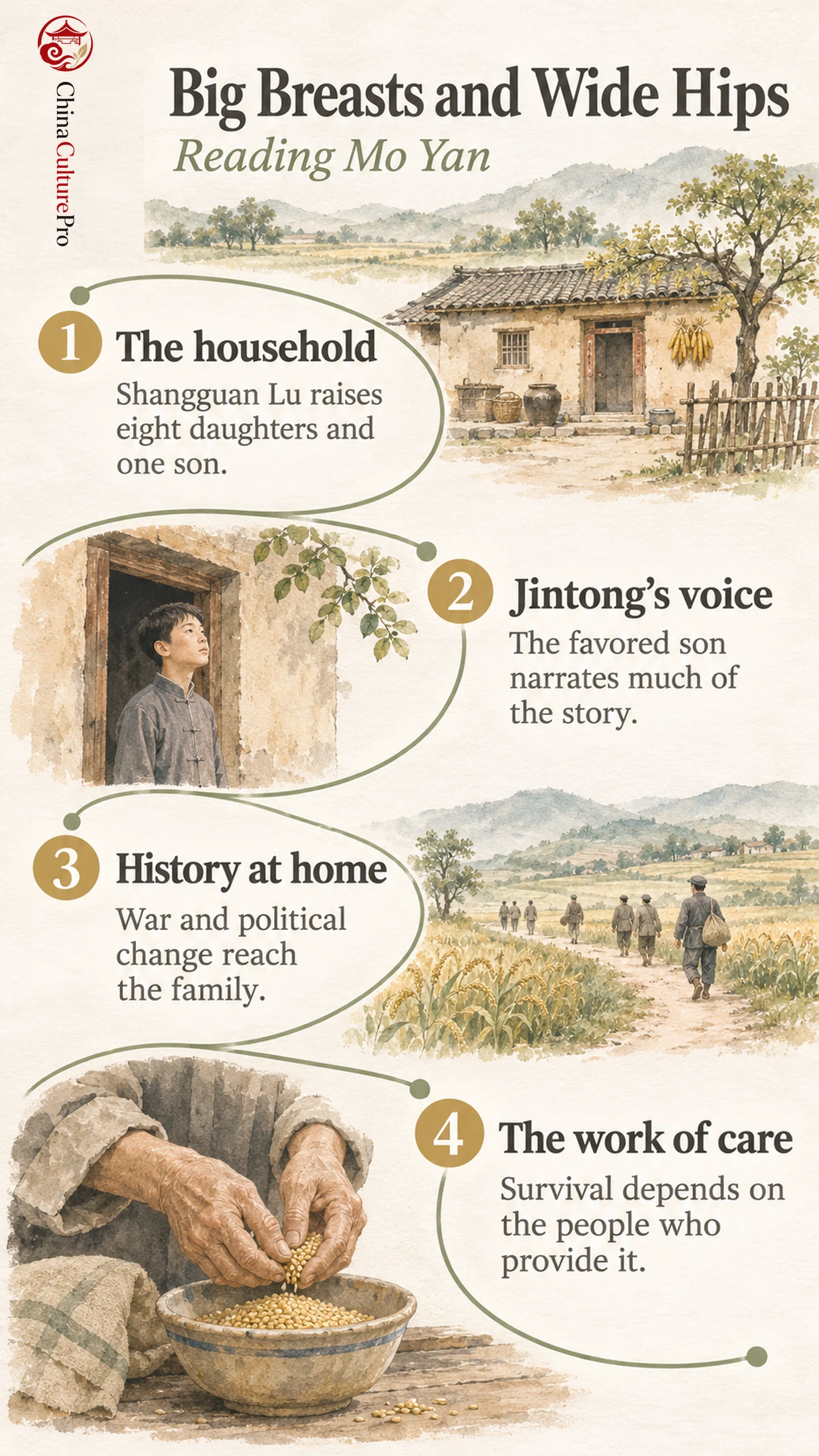
*Big Breasts and Wide Hips* (丰乳肥臀, Fēngrǔ Féitún) is a family saga by Mo Yan (莫言, Mò Yán). Shangguan Lu (上官鲁氏, Shàngguān Lǔ Shì) raises eight daughters and one son in a fictionalized part of rural Shandong. The son, Shangguan Jintong (上官金童, Shàngguān Jīntóng), narrates much of the novel, which follows the family through war and later political and economic upheaval.[1][2][3][5]
- The mother: Lu works to keep her children and grandchildren alive through successive dangers.
- The children: The daughters take different paths, while the favored son remains unusually dependent.
- The history: Changes in public power enter the household through food, work, safety and family loyalties.
The story looks different if you follow the mother’s work alongside her son’s account.[2][3]
The family wants a boy. When it finally gets one, the boy’s account shows how much his survival depends on the women whose lives the household has valued less.
What the Opening Birth Scene Establishes
Shangguan Lu has seven daughters when the novel opens. She is about to give birth again, and the family’s donkey is also in labor. The older woman of the household devotes her attention to the animal. The parallel gives a practical measure of Lu’s status. She bears the risks of childbirth, but the household has other priorities. The twins, a daughter and the much-desired boy, enter the story amid that imbalance.[3][5]
The book returns to these questions on a much wider scale. Who can offer food, who needs protection, and whose loss matters most are matters of survival. The opening gives these questions a setting in the household before changes in power and politics give them a setting outside it.
The opening also sits against the Japanese invasion. The local loss of life includes Lu’s husband. The births and the deaths have very different causes, yet the family has to deal with them together. As the narrative looks back to Lu’s youth, we can see how little the son born in this scene knows about the life his mother had before him.[2][5]
Why Jintong’s Point of View Matters
Jintong and his twin sister enter the world together. Being the only son gives him a place that none of his sisters shares. Yet having that place gives him little of the independence the household might have expected from a boy. His dependence on his mother lasts into childhood and shapes what he notices about women around him.[3][5]
Jintong’s position limits the view we get of his sisters. He can recall the family with intimacy, while his own needs affect how much he understands about their choices. Notice when a sister’s action has a consequence he has to live with. Those moments help the reader keep track of people who may receive less space in his account than they occupy in the history of the household.
How History Enters the Shangguan Household
Northeast Gaomi Township (高密东北乡, Gāomì Dōngběixiāng) is Mo Yan’s fictionalized home terrain. The novel’s decades carry the family through wartime upheaval, the Cultural Revolution and later changes in how people make a living. The effects arrive through relationships and scarce resources, as well as through explicit talk about politics.[1][2][3][5]
The chronology becomes easier to follow if you hold on to the question the family faces in each period. The daughters’ ties to people outside the family matter to how they endure political changes. Jintong remains vulnerable even when the economy offers new ways to make money. Two of the daughters’ marriages connect the household to men associated with opposing sides of the civil war. That gives public allegiances a place at the family table. Lu has to think about the people her daughters live with and the risks they bring, even when a larger political story would simply put the men in separate camps.[5] Mo Yan’s Red Sorghum returns to related Gaomi terrain, with a stronger concentration on wartime family memory.
What the Title Means in the Novel
The title puts the body in the foreground. Childbirth and nourishment are essential to the survival of the family, even when the family gives more attention to whether a child is a boy than to what his mother needs. Jintong’s fascination with breasts also gives the title a more uncomfortable meaning. What allows him to grow becomes an object on which he fixes his attention.[2][3][5]
Meng Jiao’s Wandering Son’s Song gives a much shorter account of a son’s debt to his mother, with her work visible in the stitches of a garment. In Mo Yan’s novel, a son can depend on care for years and still see it only in part. Readers interested in another way Mo Yan makes reproductive life a subject of fiction can turn to Frog, whose focus is medical authority and population policy.
FAQs About Big Breasts and Wide Hips
Did Mo Yan base Shangguan Lu on his own mother?
Mo Yan said in his Nobel lecture that he used material from his mother’s life after her death. He described the fictional mother’s emotional life as invented or drawn from several women in the region. The dedication reflects a personal loss, and Lu belongs to the fiction.[1]
Who translated Big Breasts and Wide Hips into English?
Howard Goldblatt translated the novel from Chinese. Arcade Publishing issued the English edition in New York in 2004. The title is also catalogued with an ampersand.[2][4]
出典
[1] Nobel Prize. Mo Yan’s Nobel lecture on storytelling
[2] Skyhorse Publishing. Big Breasts and Wide Hips, Arcade edition
[3] Publishers Weekly. Review of Big Breasts & Wide Hips
[4] Chinese University of Hong Kong. Mo Yan, bibliography of works available in English
[5] Kirkus Reviews. Big Breasts and Wide Hips by Mo Yan