

Quick Answer: What Is The Wandering Son’s Song About?
The Wandering Son’s Song (游子吟, Yóuzǐ Yín) is a six-line Tang poem by Meng Jiao (孟郊, Mèng Jiāo). A mother sews before her son leaves. The image of grass in spring light asks how a child can repay the care he receives.[1][2]
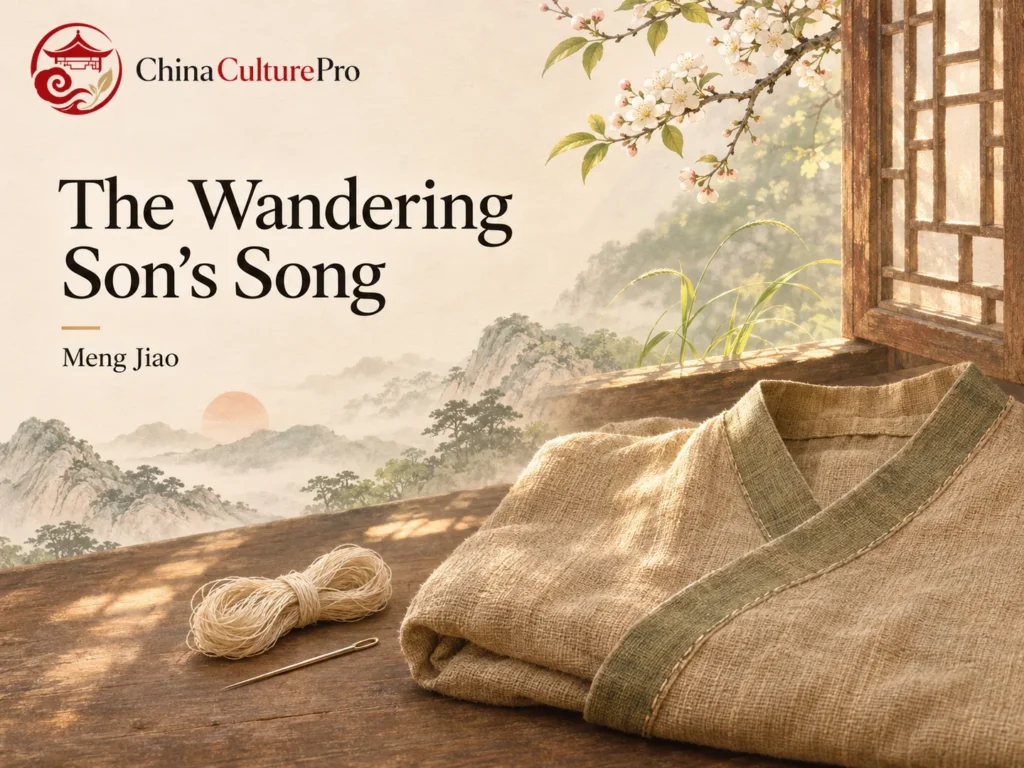
- Thread: The opening puts the thread in her hand and the garment on his body.
- Stitches: She sews close stitches because she fears his return may be slow.
- Spring light: The final question asks how such a small thing could repay all that sustains it.[1]
The poem gives gratitude a concrete starting point in the work of preparing someone to leave.[1]

The poem lets us see the thread before we hear about the journey. The poem stays with that small movement long enough to tell us what the mother fears. Then it leaves the room entirely and asks a question about grass in the sun.
The Wandering Son’s Song in Chinese, Pinyin and English
The poem has six lines of five characters. This version follows the reading 谁言, “who says,” in the fifth line. The pinyin gives a modern Mandarin reading.[1]
| 中国語 | 拼音 | 意味 |
|---|---|---|
| 慈母手中线 | Címǔ shǒu zhōng xiàn | Thread in a caring mother’s hand. |
| 游子身上衣 | Yóuzǐ shēn shàng yī | A garment on the son who travels. |
| 临行密密缝 | Lín xíng mìmì féng | Before he leaves, she sews stitch close to stitch. |
| 意恐迟迟归 | Yì kǒng chíchí guī | She fears he will be long in coming home. |
| 谁言寸草心 | Shéi yán cùn cǎo xīn | Who could say the heart of a tiny blade of grass |
| 报得三春晖 | Bào dé sān chūn huī | Can repay the light of all spring? |
The opening names the thread and the garment before describing any action. That relationship is visible in how the two lines fit together. The last two lines instead make a single question whose answer is left to the reader.
What the Thread and Tight Stitches Show
The poet puts the mother’s hand next to the traveller’s body before he tells us either person’s thoughts. Her action reaches him through something he can take with him. The closeness of the sewing is all the poem says about the garment’s construction. It is enough to make the reader notice how she uses the time she still has with him.[1]
The doubled words 密密 and 迟迟 do different work. The first keeps the eye on stitches set close together. The second stretches the anticipated absence. The poem gives a physical answer to a worry she cannot settle. There is no way for her to sew a quicker return, but she can make the next stitch.[1]
How the Grass and Spring Sun Change the Scale
A little blade of grass and the light of three months of spring bring different kinds of scale into the question. The phrase 三春 spans the season here. The comparison sets one small living thing against all the light it receives while it grows. The grass can grow because it receives the light. That growth cannot give the sunlight back. The poem’s final image puts a child’s response to care in an image of what one small thing receives from a much greater source.[1][2]
The word 心 can be heard as the heart of the grass and the grateful heart of the child. The later expression cuncao chunhui (寸草春晖, cùncǎo chūnhuī) brings the images together. It is used for the depth of parental kindness and the difficulty of repaying it. The idiom can refer to parents generally, while the poem has given us one mother and one son.[1][2]
What We Know About Meng Jiao’s Occasion
A note transmitted with the poem connects it with welcoming Meng Jiao’s mother, and records associate the note with Liyang. The details of the note differ across sources. The verse names no town or date. Its opening scene can be read closely without deciding whether it records a particular morning or reimagines a familiar departure.[1][3]
The rest of Meng Jiao’s poetry provides a wider setting for this spare way of writing. Another short poem about kinship across distance, Thinking of My Brothers on Double Ninth, makes absence visible through a family group with one person missing. Meng’s poem makes it visible through a task someone can do before the separation begins. In Du Fu’s Moonlit Night, the speaker imagines what his family is doing far away. Meng keeps mother and son close together, while her thoughts are already on the distance between them.
FAQs About The Wandering Son’s Song
What does youzi mean in the title?
Youzi (游子, yóuzǐ) is someone away from home or setting out to travel. In this poem it is the mother’s son. The title does not say where he is headed.[1]
Why do some editions read ‘hard to repay’?
The received text records 难将 as an alternative to 谁言 at the start of line five. One version leads into a question and the other more directly presents the difficulty of repaying the spring light.[1]
出典
[1] Meng Jiao. The Wandering Son’s Song
[2] Ministry of Education, Taiwan. 寸草春暉
[3] Shidian Ancient Books. Chronology of Meng Jiao of the Tang