


Quick Answer: What Are the Three Words?
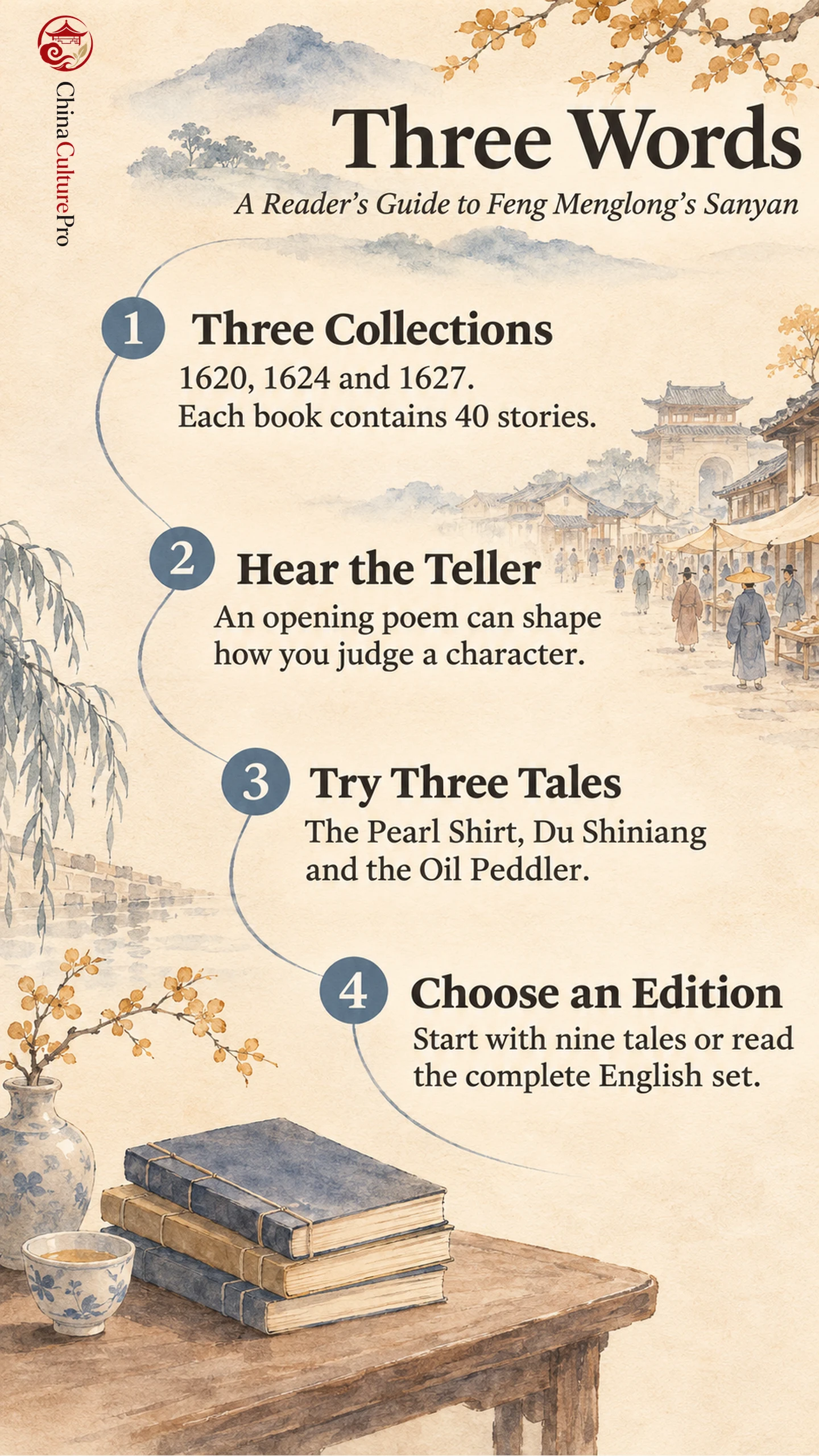
The Three Words (三言, Sānyán) are three late-Ming collections of vernacular short fiction compiled and edited by Feng Menglong (冯梦龙, Féng Mènglóng). Issued in 1620, 1624 and 1627, they contain 40 stories apiece, for a total of 120.[1]
- Range: The stories follow merchants, courtesans, officials, matchmakers and others through bargains, reversals and disputes.[5]
- Voice: A narrator can address readers as if they were an audience gathered to hear a story.[1]
- English editions: Shuhui Yang and Yunqin Yang translated all three collections. Their shorter Sanyan Stories contains nine unabridged tales.[5]
The collection names help you find an individual tale. Each story stands on its own, so the full set can be read in whichever order fits your interests.
A shirt changes hands, a woman opens a jewel box and a peddler saves for a visit. Each action alters what someone knows about a relationship. One way to get into the Three Words is to follow who gets to decide what an object is worth.
The Three Collections in Publication Order
The table gives the three complete English edition titles. Use the Chinese title and story number when a catalog gives a different translation of a title.
| First publication | English edition and Chinese title | Tales |
|---|---|---|
| 1620 | Stories Old and New (古今小说, Gǔjīn Xiǎoshuō) | 40 |
| 1624 | Stories to Caution the World (警世通言, Jǐngshì Tōngyán) | 40 |
| 1627 | Stories to Awaken the World (醒世恒言, Xǐngshì Héngyán) | 40 |
Stories Old and New was first printed as Gujin Xiaoshuo and is also known as Yushi Mingyan (喻世明言, Yùshì Míngyán). A catalog search for the first book may turn up either Chinese title.[2]
The group belongs to the publishing culture of the late Ming dynasty. The Yang editions make it possible to compare editorial features, such as commentary, as well as the plots that might already be familiar from later retellings.
How the Narrator Addresses an Audience
The term huaben (话本, huàběn) is associated with storytelling scripts and vernacular fiction that imitates an oral storyteller’s manner. A narrator in these collections can address listeners, start with a short preliminary tale, offer a poem or pause to comment on what a character has done. The sense of an audience is part of how the printed fiction works.[1][9]
Read a beginning and an ending together. An opening verse can invite readers to judge a character before they meet them. The main story then gives readers details and motives that complicate that judgment. The closing poem may redirect attention to a consequence that seemed secondary while the plot was unfolding.[6]
The difference between a teller’s comment and a character’s voice also matters in adaptations. The Western Wing offers an example of how a staged drama can give competing judgments to different speakers. The Three Words often lets a narrator share that work with the characters.
Three Tales to Try First
The Pearl Shirt and a Family Secret
Start with the first tale in Stories Old and New. Jiang Xingge (蒋兴哥, Jiǎng Xīnggē) leaves his ancestral pearl shirt in the care of his wife. She gives it to another man. The shirt passes through different hands and eventually returns to the household.[2][6]
An heirloom entrusted to a spouse becomes evidence of a secret relationship. Track each owner’s reason for keeping it or giving it away. You can see how the story builds its coincidences around decisions readers have already watched characters make.
Du Shiniang and the Jewel Box
Story 32 in Stories to Caution the World follows the courtesan Du Shiniang (杜十娘, Dù Shíniáng) and the man she hopes to live with after leaving the brothel. After he agrees to give her up in exchange for money, she opens a box to reveal what she has kept from him.[3][7]
The disclosure exposes the gap between what the men think they are bargaining over and what Du knows about her own situation. Read the negotiation and the opening of the box together to see who controls the information in each scene.
The Oil Peddler and the Queen of Flowers
Story 3 in Stories to Awaken the World follows an oil peddler, Qin Zhong (秦重, Qín Zhòng), and a celebrated courtesan. What begins as a paid visit gives Qin a chance to show kindness when the woman needs care.[4][8]
Pair it with Du Shiniang’s story to see how two tales can bring love and money into the same room and ask different questions. In one, a transaction exposes betrayal. In the other, conduct during a transaction gives the reader a reason to look past the price.
Which English Edition Should You Choose?
For a short start, use Sanyan Stories: Favorites From a Ming Dynasty Collection, ISBN 9780295994222. Its nine tales include all three discussed above. The translations of the selected stories retain poems and Feng’s interlinear and marginal comments.[5]
For all 120, look for the three volume titles in the table under the names Shuhui Yang and Yunqin Yang. Readers following the White Snake legend can start with story 28 in the second volume and compare its ending with later versions.[3]
For more Chinese folk tales and vernacular collections, look next at Ling Mengchu’s (凌濛初, Líng Méngchū) Two Slaps (二拍, Èrpāi). A broader guide to Chinese classic books can help you choose between independent stories, plays and chapter novels.[9]
FAQs About the Three Words
How many stories are in the Three Words?
There are 120 in the full set. Each of the three collections has 40.[5]
Did Feng Menglong write all the stories?
Feng was the compiler and editor. Many stories draw on earlier texts and storytelling traditions, and his involvement as a writer or reworker varies from tale to tale.[1][9]
Are the Two Slaps part of the Three Words?
The Two Slaps are separate collections associated with Ling Mengchu. The familiar grouping Three Words and Two Slaps refers to all five books by the two compilers.[9]
出典
[1] Shuhui Yang and Yunqin Yang. Introduction to Stories Old and New
[2] University of Washington Press. Stories Old and New
[3] University of Washington Press. Stories to Caution the World
[4] University of Washington Press. Stories to Awaken the World
[5] University of Washington Press. Sanyan Stories: Favorites From a Ming Dynasty Collection
[6] Hong Kong Education Bureau. Reading the Three Words
[7] Chinese Text Project. Du Shiniang Sinks Her Jewel Box in Anger
[8] University of Washington ResearchWorks. The Innovative Representation of Romantic Love
[9] Academy of Chinese Studies. Three Words and Two Slaps