

Quick Answer: What Is Ban Tian Yao Oolong?
Ban Tian Yao(半天妖,Bàntiān Yāo)is a traditional named Wuyi oolong, associated with a clonally propagated tea selection from Fujian. Its cultivar account also records the written forms 半天夭 and 半天腰.[1]
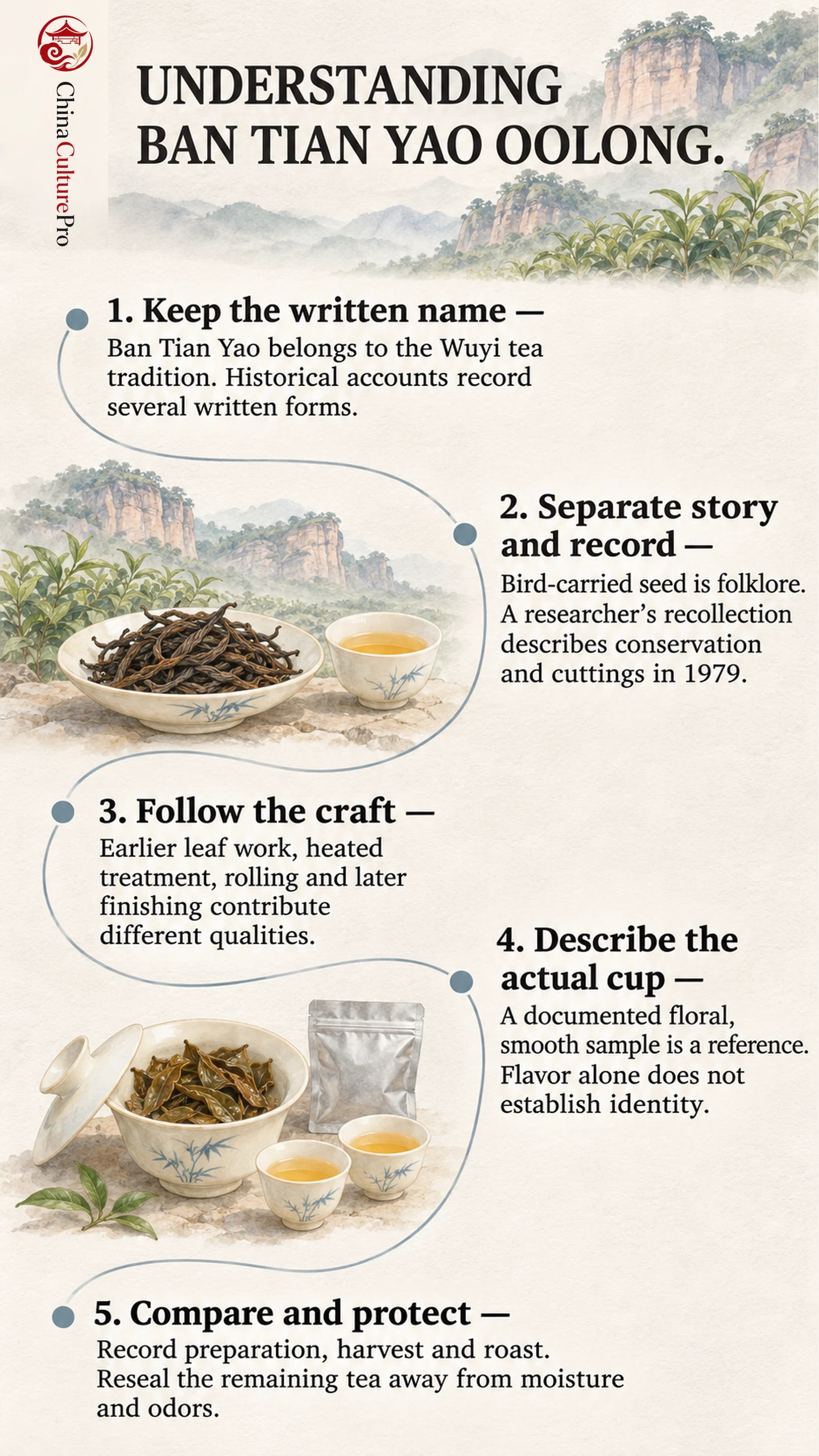
- Identity: A named tea selection within the Wuyi tradition.
- Manufacture: Leaf working, repeated heating and rolling, drying and finishing all matter.
- Cup: Judge fragrance, taste and texture in the actual lot.
The name does not specify one roast level or guarantee that every packet comes from the original cliff site. Keep the cultivar’s history, the growing location and the finished product separate when reading a label.
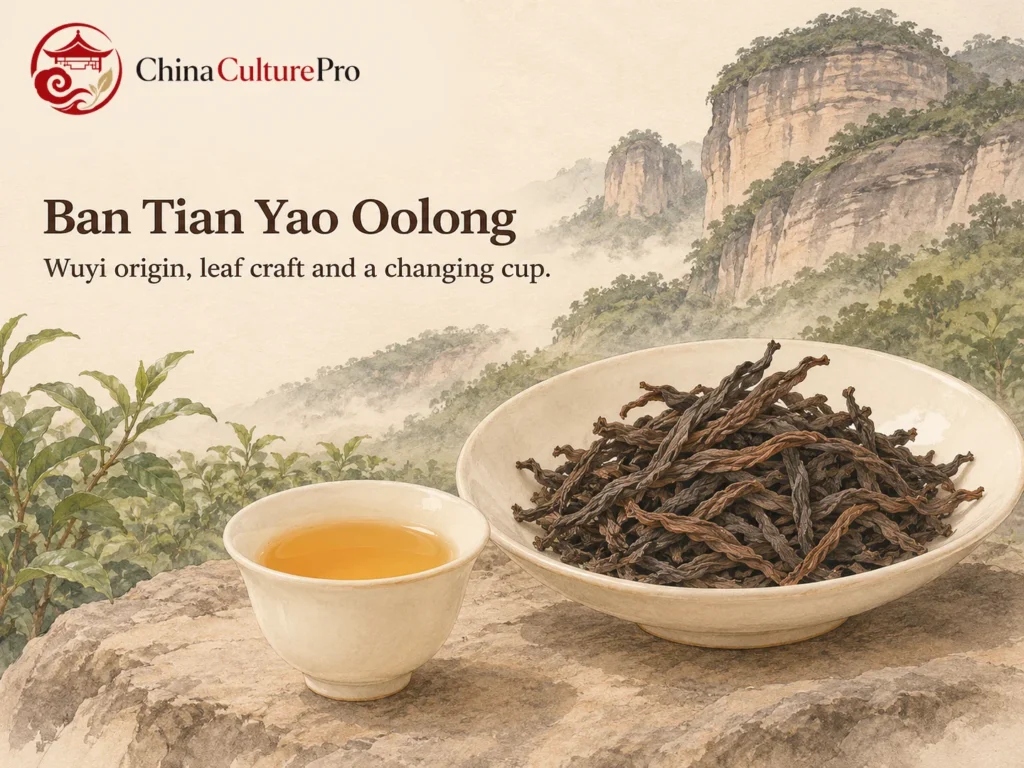
Long twisted leaves and a clear infusion introduce Ban Tian Yao oolong. The tea’s cliff-side associations are memorable, but they explain only part of its story. The maker’s work and documented tasting examples help explain the cup.
A Named Wuyi Tea with Several Written Forms
Ban Tian Yao belongs to the named Wuyi selections discussed as mingcong(名丛,míngcóng). Agronomist Luo Shengcai’s cultivar account records it as a clonally propagated selection within Wuyi’s tea-tree resources.[1]
The larger family is Wuyi rock tea(武夷岩茶,Wǔyí yánchá). China’s intellectual-property authority describes this as oolong produced in Wuyishan, Fujian, using suitable tea varieties and the region’s manufacturing tradition.[2] The family name and the name of a particular tea selection therefore operate at different levels.
Written variants are part of Ban Tian Yao’s history. Retain the characters on a packet when asking about its producer and plant material. English renderings such as “Halfway to the Sky” convey an interpretation of the name; they do not settle the growing location or the history of a particular harvest.
Cliff-Site Stories and Modern Conservation
Luo’s account associates the original tea with a cliff on Sanhua Peak. It also labels the story of a bird carrying and dropping tea seed as a tradition handed down, rather than an observed planting event.[1] The story belongs to the tea’s cultural setting; it does not establish a botanical pedigree or an exact invention date.
A different kind of evidence comes from tea researcher Chen Dehua’s own recollection. Writing in 2016, he describes a 1979 investigation while working at the Chong’an County tea research institute. His account includes the difficult approach to the bushes, taking cuttings from a healthy plant, and choosing 半天腰 for an inscription above the site.[3]
This records a modern conservation and propagation episode. It is not a claim that the tea first came into existence in 1979. Likewise, a packet bearing the name is not automatically a harvest from those original bushes. Ask for the actual garden information when a seller makes a specific site claim.
Leaf Working, Rolling and the Finishing Roast
Ban Tian Yao made as Wuyi rock tea follows a manufacturing tradition that treats several stages as essential. The national heritage account highlights complex withering, responsive leaf handling, repeated pan-firing and rolling, and extended roasting.[4]
Zuoqing(做青,zuòqīng)belongs to the earlier leaf work. Fixation(杀青,shāqīng)is a heated treatment, while rolling develops the leaf’s form. Later drying and finishing should not be collapsed into that one earlier heating operation. The regional product description also distinguishes initial manufacture from refinement of the finished tea.[2]
This helps explain why a cultivar name cannot specify the entire finished cup. The maker must work with the actual leaf and intended result. For a comparison, ask about the roast and finishing history as well as the harvest.
Our guide to tea oxidation versus fermentation explains the terminology used for oolong. Makers adapt the work to the leaf and intended finish.
Flavor References and the Limits of Identification
A 2021 tasting report provides a concrete example. Its Ban Tian Yao sample came from a set of named Wuyi teas assessed under the guidance of tea researcher Chen Rongbing. The report describes tight, fairly even dark-brown strips, a clear pale orange-yellow liquor, a long floral fragrance, and a sweet, smooth, fresh taste. The infused leaves were soft and bright, with visible red points.[5]
Those observations describe that sample. They do not require every harvest to have the same liquor color or every cup to taste smoky. Keep the notes attached to the tea actually assessed.
Record the cup in separate dimensions:
- 香り: Describe what you smell before and after pouring.
- 味わい: Separate sweetness and bitterness from fragrance.
- Texture: Note fullness, smoothness and drying sensations.
- Finish: Record what remains after swallowing, including how it changes.
Taste can be informative without proving identity. Chen Dehua recalls mistaking Ban Tian Yao for another Wuyi tea, Rougui, before colleagues corrected him.[3] This is an instructive anecdote, not a controlled identification experiment. Our Chinese tea aroma vocabulary helps turn an impression into a description without treating it as a certificate.
Brewing and Keeping a Ban Tian Yao Lot
Begin with the actual product’s directions. A 蓋碗または急須 that lets you drain the infusion makes it easier to change the next steep deliberately. Keep the leaf amount, actual water and contact time together when adjusting strength.
Compare two lots under consistent conditions and write down their producer, growing information, harvest and roast. If the cup differs from a reference description, compare the preparations before looking for every listed fruit or nut note.
Protect the remaining dry tea from moisture and foreign odors. The Tea and Beverage Research Station explains that tea readily absorbs both, and that aroma components can change during storage.[6] Reseal the packaging and follow its storage instructions. The wider guide to storing Chinese tea covers everyday handling without assigning every tea one shelf life.
FAQs About Ban Tian Yao Oolong
Why does Ban Tian Yao have different Chinese spellings?
The name circulated in several written forms. Chen Dehua recalls choosing 半天腰 for the conservation-site inscription. Keep the packet’s actual characters.
Does all Ban Tian Yao come from the original cliff site?
No. The named selection and its propagation history are broader than the original bushes. A specific garden claim needs its own supporting information.
Is Ban Tian Yao necessarily smoky?
No. Smoke is not a compulsory identifying feature. Compare the actual aroma and ask about the lot’s processing and roast.
Can its flavor identify the cultivar?
Flavor can suggest comparisons, but it does not independently establish the plant material or growing location.
出典
[1] Luo Shengcai. 《武夷茶经》武夷山茶树的来源及种类, Ban Tian Yao entry
[2] China National Intellectual Property Administration. Wuyi Rock Essence Tea
[3] Chen Dehua. 武夷名枞“半天腰”题刻可考, reproduced from Minbei Daily
[4] 中国無形文化遺産ネットワーク. Wuyi Rock Tea Making Techniques
[5] Tea Dao Media. 你可知武夷“花名”?一次品鉴十八名丛!嗝……
[6] Tea and Beverage Research Station. 茶葉之包裝貯藏