


Quick Answer: What Is Bai Ya Qilan Oolong?
Bai Ya Qilan(白芽奇兰,Báiyá Qílán)is a tea cultivar developed in Pinghe County, Fujian, and the name of an oolong made from it. The reference describes an orchid-like oolong fragrance.[1]
- 産地: Closely associated with Pinghe in southern Fujian.
- Manufacture: Leaf working, heat treatment, rolling and finishing produce the oolong.
- Cup: Assess fragrance, liquor and mouthfeel alongside the lot’s roast information.
“White bud” is part of the name, not a classification as white tea. Likewise, an orchid-like aroma is not an ingredient declaration. Check any additional scenting separately from the named cultivar.
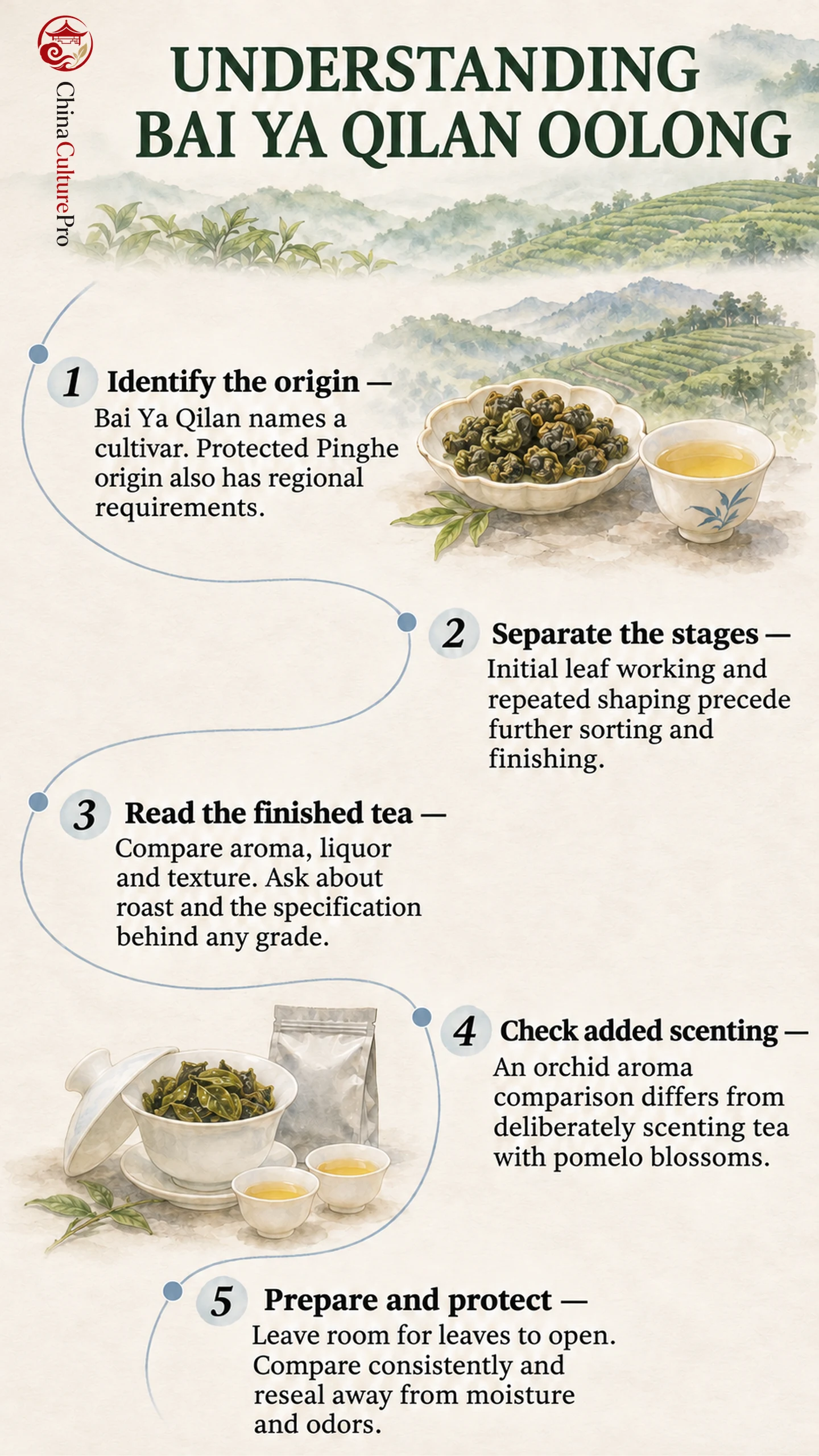
Rounded greenish-brown leaves open in the brewing vessel, releasing a golden infusion and a floral fragrance. Bai Ya Qilan offers a distinct way into southern Fujian oolong. Its appeal becomes easier to understand when the plant’s modern selection, the leaf-shaping work and the finished tea’s aroma are considered separately.
Pinghe Origin and the Cultivar’s Modern Selection
Bai Ya Qilan was selected from a local tea population through work by Pinghe County’s agricultural tea station and Pengxi Tea Farm in Qiling. The International Camellia Register records selection during 1981–1995 and Fujian provincial approval in 1996.[1] These dates document modern cultivar selection, rather than the beginning of all tea growing in Pinghe.
The register also records cultivation in Fujian and eastern Guangdong.[1] Plant identity and a protected regional product therefore need separate attention. Cultivar identity does not by itself establish protected regional origin.
The Pinghe Bai Ya Qilan geographical-indication requirements specify nine towns and townships within Pinghe, Zhangzhou, local clonally selected material and growing-site conditions.[2] These requirements apply to the protected regional product.
The Pinghe Bai Ya Qilan Tea Association’s 2026 standard links the name to conspicuous white hairs on the shoots and the finished tea’s orchid-like fragrance.[3]
For a packet, look for both the full tea name and the growing information. A broad “Fujian oolong” label alone does not identify the particular locality or producer.
How the Rounded Oolong Is Made
The Pinghe product requirements distinguish initial manufacture from refining.[2] The main operations fall into the following groups.
| Manufacturing group | Representative operations | 注目したい点 |
|---|---|---|
| Early leaf work | Holding, withering and zuoqing(做青,zuòqīng) | The leaf is worked before its later heated treatment |
| Forming the initial tea | Fixation(杀青,shāqīng), rolling, heating and repeated wrapped shaping | The rounded form develops through several operations |
| 精製 | Blending, screening, sorting and further heating | Initial manufacture is followed by finished-product work |
The county tea association’s 2026 group standard likewise separates initial and refined processing.[3] Its sequence is a concrete reference for the regional product. An abbreviated description showing only screening and packing would leave out the earlier transformation of fresh leaves.
Orchid Fragrance, Roast and Quality Descriptions
Orchid-like fragrance is a useful reference for Bai Ya Qilan, not a promise that every lot will have the same perfume. The cultivar record describes a brownish-green oolong with a fine, lingering fragrance and a full, sweet-fresh taste.[1] The protected product description adds substantial rounded leaves, a bright golden liquor and red-edged infused leaves.[2]
Compare those features as separate observations. Liquor brightness describes appearance; sweetness describes taste. Aroma and mouthfeel need separate notes. Our Chinese tea aroma vocabulary can help you record these distinctions.
Roast information belongs beside those notes. Ask how the lot was finished before expecting its character to match another harvest or a lightly finished sample.
Grade names also need context. The 2026 association document lists five grades, from extra grade through grades one to four.[3] This is an association group standard, not a single mandatory global grading vocabulary. When a packet claims a grade, ask which specification it follows rather than interpreting a decorative star or an English adjective as an equivalent grade.
Pomelo-Scented Tea Is a Separate Product Choice
A floral cultivar description and deliberate flower scenting are different. A 2025 field report from Pinghe describes producers making a newer pomelo-scented product using fresh pomelo blossoms and refined Bai Ya Qilan. The reported work includes preparing flowers, mixing them with the tea, managing the scenting process and removing the flowers.[4]
The 2026 association standard describes a tea without added non-tea substances.[3] The reported pomelo-flower product involves an additional scenting treatment. It should not become a claim that all Bai Ya Qilan contains flowers, or that neighboring pomelo trees automatically perfume every tea garden’s leaves.
Read the ingredients and processing description when comparing a plain oolong with a scented version. Added scenting can account for differences between the cups. The wider guide to Chinese tea scenting explains how this additional stage differs from a natural aroma comparison.
Brewing, Comparing and Storing the Tea
Start with the actual packet’s directions. Choose a 蓋碗または急須 with room for the rounded leaves to open, and drain the infusion when it reaches the strength you want. Keep leaf amount, actual water and contact time together when adjusting the next cup.
For a comparison, keep preparation consistent and record the harvest, roast and any added scenting. Change one brewing variable at a time rather than changing every condition and then assigning the result to quality.
Storage matters as well. The Tea and Beverage Research Station explains that dry tea readily absorbs moisture and foreign odors, while its aroma components can dissipate or change during storage.[5] Reseal the packet and protect it from kitchen steam, strong smells and unsuitable storage conditions. Follow its label rather than assigning all roast styles one refrigeration rule or shelf life. See how to store Chinese tea for everyday handling.
FAQs About Bai Ya Qilan Oolong
Is Bai Ya Qilan a white tea?
The oolong discussed here is not white tea. “White bud” belongs to its cultivar name; processing determines the finished tea category.
Does its orchid aroma mean flowers were added?
No. An aroma comparison is not an ingredient list. Deliberately scented products need checking separately.
Is Bai Ya Qilan the same as Tieguanyin?
No. Bai Ya Qilan is a named cultivar in its own right. A similar rounded oolong presentation does not make the two names interchangeable.
Does every Bai Ya Qilan have the same roast?
The name alone does not specify a finishing roast. Check the actual lot and compare it under consistent brewing conditions.
出典
[1] International Camellia Register. Baiya Qilan
[2] China National Intellectual Property Administration. Pinghe Bai Ya Qilan Geographical Indication Product Requirements, entry 569
[3] Pinghe Bai Ya Qilan Tea Association. Bai Ya Qilan Tea, T/BYQL 002–2026
[4] Fujian Daily, reproduced by Fujian Provincial Government. 一片绿叶富一方
[5] Tea and Beverage Research Station. 茶葉之包裝貯藏