


Quick Answer: What Does Bai Culture Include?
Bai(白族,Báizú)culture is closely associated with Yunnan’s Dali(大理,Dàlǐ)region, while Bai communities also live elsewhere in China.
- Language: Regional speech varieties and several writing practices carry cultural knowledge.
- Homes: Courtyard buildings combine living space, decorated walls and family meanings.
- Craft: Tied and stitched cloth reveals patterns through resistance to dye.
- Hospitality: A sequence of contrasting teas gives flavor a social and symbolic role.
- Belief and gathering: Local guardian traditions and public festivals connect people to particular places.
These are useful cultural examples, not a checklist followed by every Bai person. A regional introduction needs to distinguish historical evidence, local practice and individual participation.
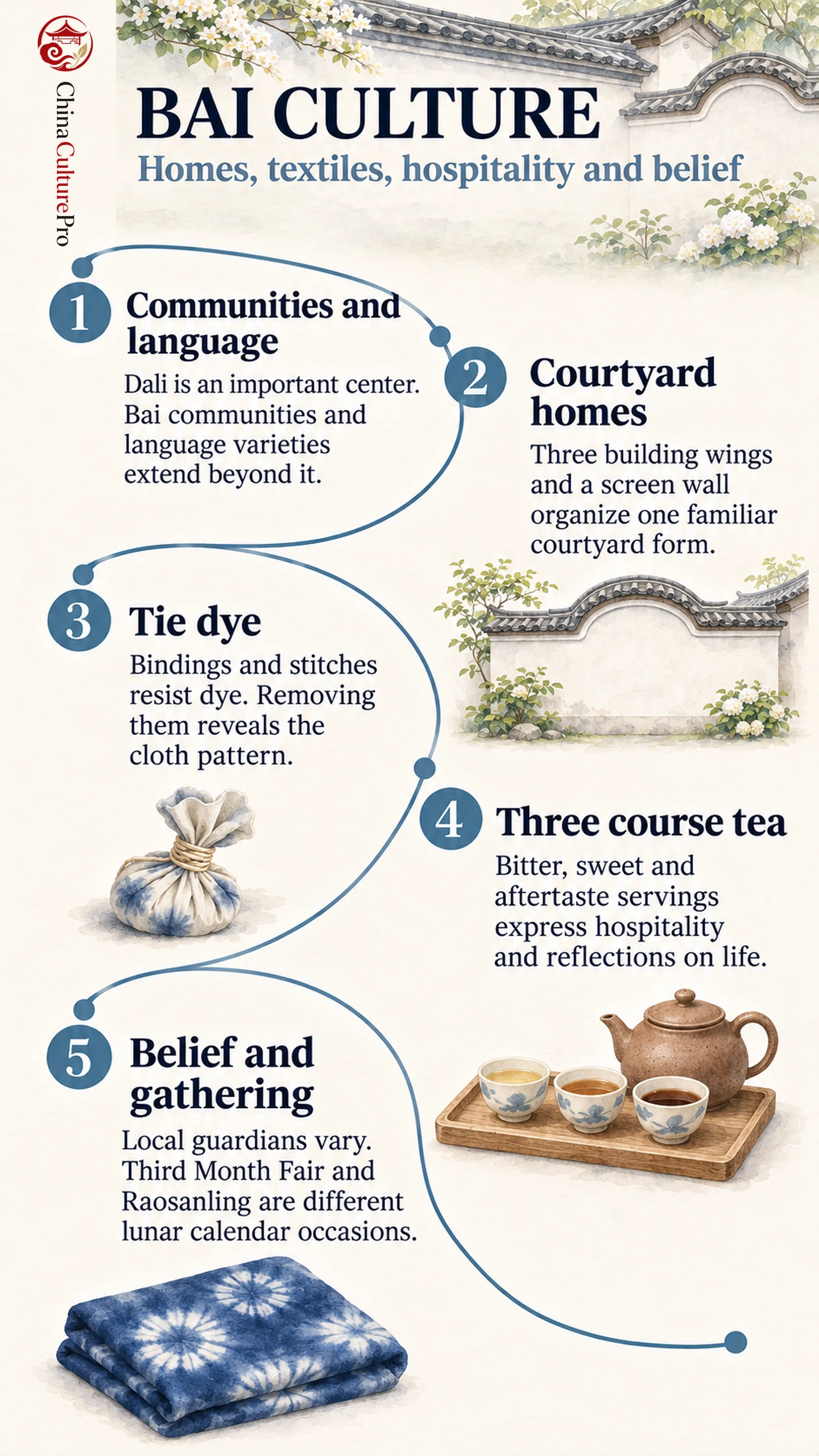
White courtyard walls, blue patterned cloth and small tea cups are familiar images of Bai culture. Each becomes more informative when its use is explained: how a courtyard is organized, how a cloth pattern forms, or why successive servings of tea taste different.
Bai Communities, Language and Dali’s Historical Setting
Bai communities are concentrated in Yunnan, with others in Guizhou, Hunan and elsewhere. [1] Dali is an important cultural center, but it is not the only Bai homeland or an ethnically uniform place. Chinese ethnic categories and regional geography answer different questions.
The Bai language(白语,Báiyǔ)has regional varieties. Historical writing adapted Chinese characters, while a Latin-based scheme was proposed in 1958 and revised in 1982. [1] A dictionary project launched in 2020 explicitly considered Dali, Jianchuan and Nujiang varieties and two writing systems—a concrete example of why language documentation needs more than one local reference point. [2]
The Nanzhao(南诏,Nánzhào)and Dali kingdom(大理国,Dàlǐguó)provide important historical context for the region’s political and cultural role. [3] Their history belongs within the wider development of Yunnan culture, rather than proving that every ancient resident held an unchanged modern ethnic identity.
Courtyard Houses and the Screen Wall
Sanfang yi zhaobi(三坊一照壁,sānfāng yī zhàobì)describes a courtyard arrangement with a main building, two side wings and a screen wall. The “three” refers to building ranges around the courtyard, not simply three individual rooms. A documented Binchuan residence illustrates the arrangement through its main hall, northern and southern wings and enclosing wall. [4]
Decorated screen walls, carved doors and painted surfaces give domestic architecture a visual and social role. Around Xizhou, the screen wall can brighten the courtyard through reflected light, while architectural painting contributes to the household setting. [5]
This recognizable layout is one among several. It should not be assigned to every mountain dwelling or contemporary apartment occupied by a Bai family. Dress also varies locally and by age or occasion; white garments are one association, not an all-white uniform. [8] Buildings and clothing both require a specific setting before their details can be interpreted.
Zhoucheng Tie-Dye: Pattern through Resistance
Zhoucheng(周城,Zhōuchéng)is a prominent center of Bai tie-dye(扎染,zārǎn). Cloth is tied or stitched before dyeing, restricting where color penetrates. Removing the bindings reveals the pattern. Cotton and cotton-linen cloth, plant indigo and blue-and-white designs are important documented materials and appearances. [6]
The pale shapes are therefore not necessarily printed on afterward. Binding choices and dyeing skill affect the result. This technical distinction is more useful than assuming that every blue-and-white fabric sold in Dali was made by the same method.
To interpret a particular cloth, identify its maker, method and motif context as well as its palette.
Three-Course Tea and Regional Foods
Three-course tea(三道茶,sāndào chá)is a hospitality practice associated with Dali, organized around changing flavors rather than three identical refills. One documented sequence illustrates these contrasts. [7]
- First course: Roasted tea produces a pronounced bitter taste.
- Second course: A sweet serving may include red sugar and walnuts; honey is another documented addition.
- Third course: A reflective “aftertaste” serving combines tea with ingredients such as honey, Sichuan pepper and cinnamon.
The sequence is interpreted through life’s difficulties, sweetness after hardship and later reflection. These are cultural meanings conveyed through hospitality, not a prediction of the drinker’s future. Ingredient combinations differ, so the flavor sequence is more dependable than one supposedly universal recipe. [7]
Tea is only one part of Chinese food culture in the region. Rushan(乳扇,rǔshàn)is a pale, thin dairy food formed in sheets, offering a different example from grains, fish and other dishes. [8] A name or ceremonial setting does not establish whether a serving contains milk, nuts or other ingredients; those belong to the actual preparation.
Benzhu Worship and Community Festivals
A benzhu(本主,běnzhǔ)is a local guardian associated with a village or community. Such guardians may be identified with historical or legendary figures and natural powers, rather than one identical deity everywhere. Communities understand these guardians through protective roles expressed in worship and local narratives. [9]
Benzhu traditions can incorporate figures connected with Buddhist and Daoist worship as well as local histories. [12] That overlap belongs within the diversity of religion in China; it does not mean every Bai person follows one religion.
Two occasions around Dali illustrate different kinds of gathering:
| 行事 | Calendar and principal activities |
|---|---|
| Raosanling(绕三灵,rào sānlíng) | The twenty-third to twenty-fifth days of the fourth lunar month; ritual visits, music and dance around the Cangshan-Erhai area. [10] |
| Third Month Fair(三月街,sānyuè jiē) | The fifteenth to twenty-first days of the third lunar month; markets, cultural performances and social exchange in Dali. [11] |
Raosanling includes visits to local guardian shrines and Buddhist sites, showing how ritual connections can cross neat categories. [10] The broader Chinese Buddhist tradition provides context without replacing the occasion’s local meanings.
Lunar dates are not fixed Gregorian dates: “Third Month” does not simply mean March. The two gatherings also have different purposes, even when both include performance. Local participation and interpretations should not be inferred from the festival name alone.
FAQs About Bai Culture
Do All Bai People Live in Dali?
No. Dali is a major cultural center, but Bai communities also live elsewhere in Yunnan and in other provinces.
Is Blue-and-White Tie-Dye Printed Cloth?
Tie-dye forms patterns by restricting dye with bindings or stitches. Appearance alone cannot distinguish every resist-dyed fabric from a printed imitation.
Are the Three Tea Courses Identical?
No. Contrasting bitter, sweet and aftertaste servings carry the sequence. Specific ingredients may vary between preparations.
Do All Bai People Follow One Religion?
No. Local guardian worship, Buddhist connections and other traditions do not establish identical beliefs or participation for every individual.
出典
[1] National Ethnic Affairs Commission. Bai: overview
[2] National Ethnic Affairs Commission. New Bai-Chinese dictionary compilation launched
[3] Dali Municipal People’s Government. Cangshan-Erhai cultural relics protection demonstration area plan
[4] Binchuan County People’s Government. Former Long March site in Binchuan
[5] Dali Municipal People’s Government. Bai residential decorative painting
[6] China Intangible Cultural Heritage Network. Bai tie-dyeing techniques
[7] China Intangible Cultural Heritage Network. Tea customs: Bai three-course tea
[8] National Ethnic Affairs Commission. Bai customs
[9] Eryuan County People’s Government. Xihu benzhu festival
[10] China Intangible Cultural Heritage Network. Bai Raosanling
[11] China Intangible Cultural Heritage Network. Dali Third Month Fair
[12] Minzu University of China, National Language Resources Monitoring and Research Center. Bai customs