
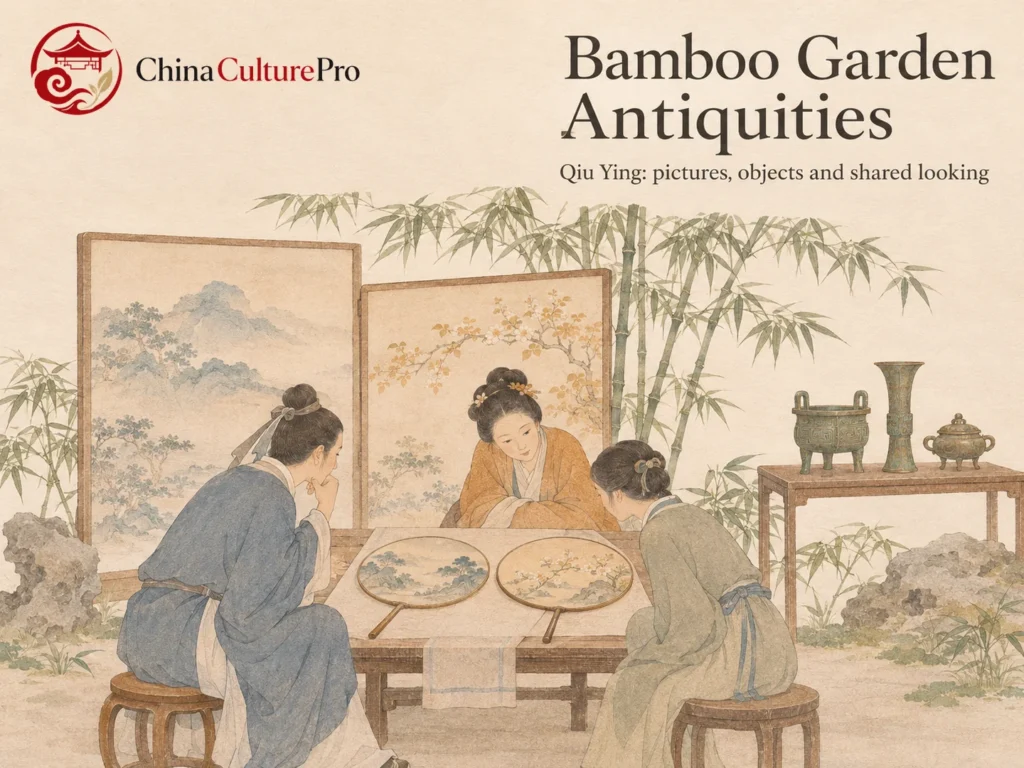

Quick Answer: What Does Qiu Ying’s Bamboo Garden Show?
Appreciating Antiquities in the Bamboo Garden (竹院品古, Zhú Yuàn Pǐn Gǔ) by Qiu Ying (仇英, Qiú Yīng) depicts cultivated leisure around collected artworks. It is an album leaf in the Palace Museum, Beijing.
- Main activity: Men study pictures at a table, with vessels displayed nearby.
- Spatial device: Two painted screens separate the gathering from the bamboo garden.
- Human setting: Attendants carry and prepare objects around the seated viewers.
The scene presents an ideal of connoisseurship; it does not identify a securely documented meeting.
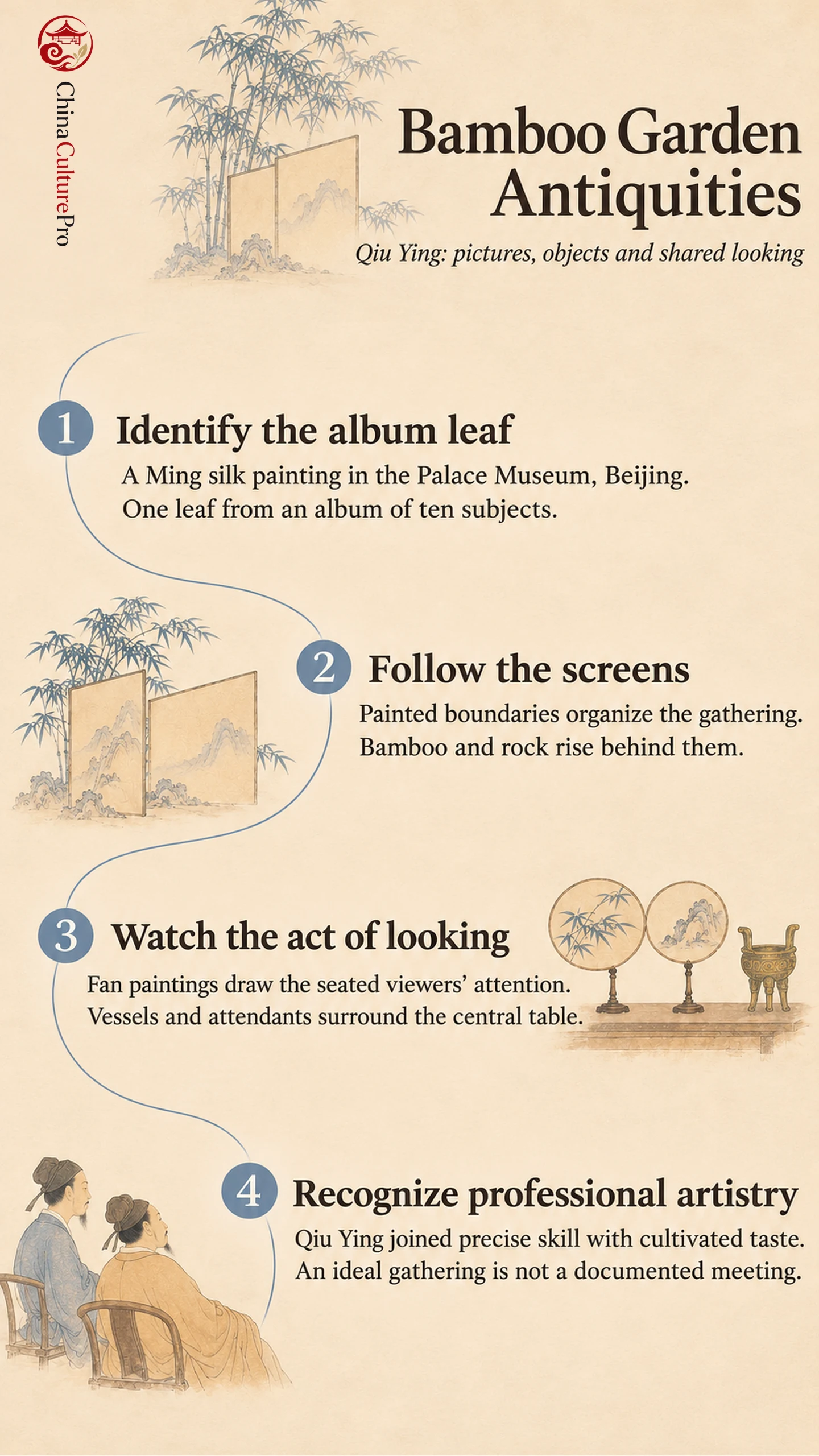
Three seated men gather around a patterned table covering. Round pictures lie before them, while vessels occupy neighboring tables and the foreground. Above the gathering, bamboo and an ornamental rock rise behind painted screens. The screens, tables and gestures connect these areas into one scene of shared looking.
Identify the Album Leaf and Its Collection
This work belongs to Qiu Ying’s Album of Figures and Stories, a ten-leaf Ming-dynasty album of historical, literary and anecdotal subjects. The Palace Museum’s collection record lists silk with color and gives each leaf as 41.4 cm high by 33.8 cm wide. The album’s registration number is 新00119160. [1]
An album leaf offers a compact field for close attention. It differs from a long handscroll that unfolds through successive sections or a hanging scroll intended for vertical display. The scroll-format guide explains those distinctions. Here, keep the whole leaf visible before enlarging a particular table or figure.
English titles vary, including Examining Antiquities in a Bamboo Court. Use the Chinese title and album identity to keep references aligned. A shared garden subject or a translated title alone is a weak basis for assigning dimensions from one record to another.
The museum describes the album’s detailed figures, architecture and objects as part of a carefully worked, richly colored style. That description concerns the album’s execution; it is not evidence that every depicted event happened exactly as painted. [1]
See How the Screens Organize the Garden
Begin with the two screens. One runs broadly across the composition, while the other recedes diagonally down the right. Their blue-green borders establish an enclosure around the central gathering. Above them, the bamboo and large rock occupy another zone; below them, furniture and figures crowd the foreground.
The screens are also painted surfaces inside the painting. Their quieter imagery contrasts with the people, vessels and textiles immediately before them. Look for the difference between a screen’s straight border and the irregular edge of the rock rising behind it. The rock’s irregular outline breaks the screen’s straight upper boundary.
This is an effective entry into Chinese garden design: built boundaries and planted areas can be considered together. The image supplies a composed view of that relationship, not a measured plan from which to reconstruct a particular garden.
At upper right, a figure prepares a board-game table. Elsewhere in the upper garden are small dogs and a crane partly concealed near the rock. The museum-hosted interpretation connects these subsidiary activities and garden features with an atmosphere of cultivated leisure. [2]
The guide to scholar’s rocks explains the wider collecting context. In this image, first notice the rock’s placement: it rises above the screen and links the enclosed gathering visually with the bamboo behind it.
Compare the Pictures, Vessels and People
The center of attention is an album of round fan paintings, even though numerous bronze vessels surround it. Other objects include a zither and ceramics presented by an attendant. Some vessel forms could be adapted for incense use; identifying a painted form does not establish the excavated origin or kiln of a real surviving object. [2]
Compare the two round pictures on the central table with the tall and squat vessels nearby. The pictures invite attention to a flat surface; the vessels make their silhouettes conspicuous. The arrangement lets different kinds of collecting coexist without giving them equal visual roles.
The bronze-vessel guide provides background on shapes and ritual associations. The scholar’s study guide broadens the domestic context. Neither requires treating this painted collection as an inventory of authenticated antiquities.
Shared looking is part of the subject. The viewers’ inclined heads and bodies make their attention visible, while attendants enable the occasion by bringing or handling objects. Academic interpretation treats such images as representations of ideal viewing circumstances and social exchange, rather than documentary proof of a particular meeting. [3]
That distinction changes how the figures should be read. Start with their relationships: who sits, who approaches, who presents an object, and where their attention converges. Assigning names to the men would require additional evidence; hats and robes alone do not establish individual identities.
- Attention: Compare the seated viewers with the objects immediately before them.
- Support: Notice the attendants who make the leisurely gathering possible.
- Selection: Distinguish the displayed collection from the few things being examined.
- Setting: Look beyond the screens to the separate activities in the garden.
Tea belongs to the wider culture of refined hospitality discussed in the Chinese tea-culture guide. Here, the interpretive priority remains the pictured act of examining art and antiquities.
Understand Qiu Ying’s Professional Artistry
Qiu Ying worked professionally in sixteenth-century Suzhou and associated with Wen Zhengming’s circle despite a different educational background from its literary elite. His polished, meticulous painting could appeal to scholarly tastes. These connections complicate any simple opposition between professional skill and cultivated elegance. [4]
The literati-painting guide explains that broader social distinction. This leaf depicts men of cultivated taste; their presence does not make the painter a scholar-official or erase the work of a professional artist.
In the reproduction, compare clothing contours, screen edges, bamboo and patterned cloth. Each needs a different balance of line, repetition and color. The restrained scale of the figures also matters: gestures must remain understandable within a dense arrangement of furnishings.
Use the figure-painting guide for the human subjects and the painting-techniques guide for the handling of materials. Return to the whole leaf and check how its gestures, furnishings and screens hold the gathering together.
FAQs About Qiu Ying’s Bamboo Garden
Is this a hanging scroll?
It is a leaf from a ten-leaf album. A reproduction shown vertically does not change the original work’s format.
Are all the objects on the tables ancient bronzes?
No. Pictures, ceramics and other furnishings appear alongside bronze forms. The image alone cannot authenticate an object’s material, age or kiln.
Does the painting record a verified gathering?
It presents an idealized scene of cultivated viewing. The evidence used here does not establish the date, host and guests of an actual meeting.
出典
[1] The Palace Museum. Qiu Ying, Album of Figures and Stories
[2] Beijing Fine Art Academy, reproduced by Jining Museum. Objects and People in Paintings of Antiquities
[3] Craig Clunas, University of Warwick-hosted excerpt. Pictures and Visuality in Early Modern China, pages 113–114 and 125
[4] The Metropolitan Museum of Art. Lady in a bamboo grove, attributed to Qiu Ying