

Quick Answer: How Does Chinese Garden Design Work?
Chinese garden design can turn the area within a residence into a landscape with its own depth, seasons and places to stop. Water establishes an open center, rocks give the ground shape, plants change the view through the year, and buildings direct the eye. Classical Suzhou gardens show how these elements fit together. [1][2][3][4]
- A pond joins different parts of a garden. It opens up views across the grounds and creates a shoreline where walks and rooms can meet. [2][3]
- Rocks and plants shape the foreground. A rockery changes the height of the ground, and a stand of bamboo can screen what lies behind it. [5][4][6]
- Architecture controls when you see a scene. A covered walk can hide a pond around a bend, then reveal it through an opening. [4]
Start by finding the place from which a view is meant to be seen.
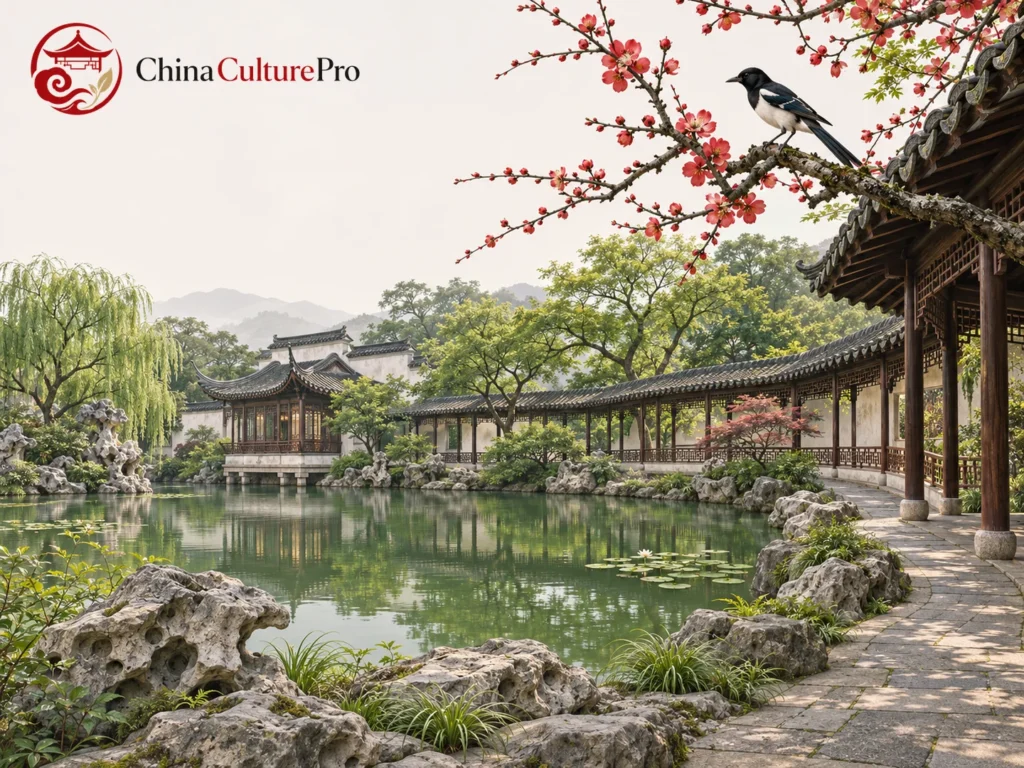
A covered walk, a pond and a planted rockery might look like separate features on a plan. On foot, they work together. A walk keeps a bank out of sight, a gap reveals the water, and an outcrop gives the new view a foreground.
Water Sets the Plan
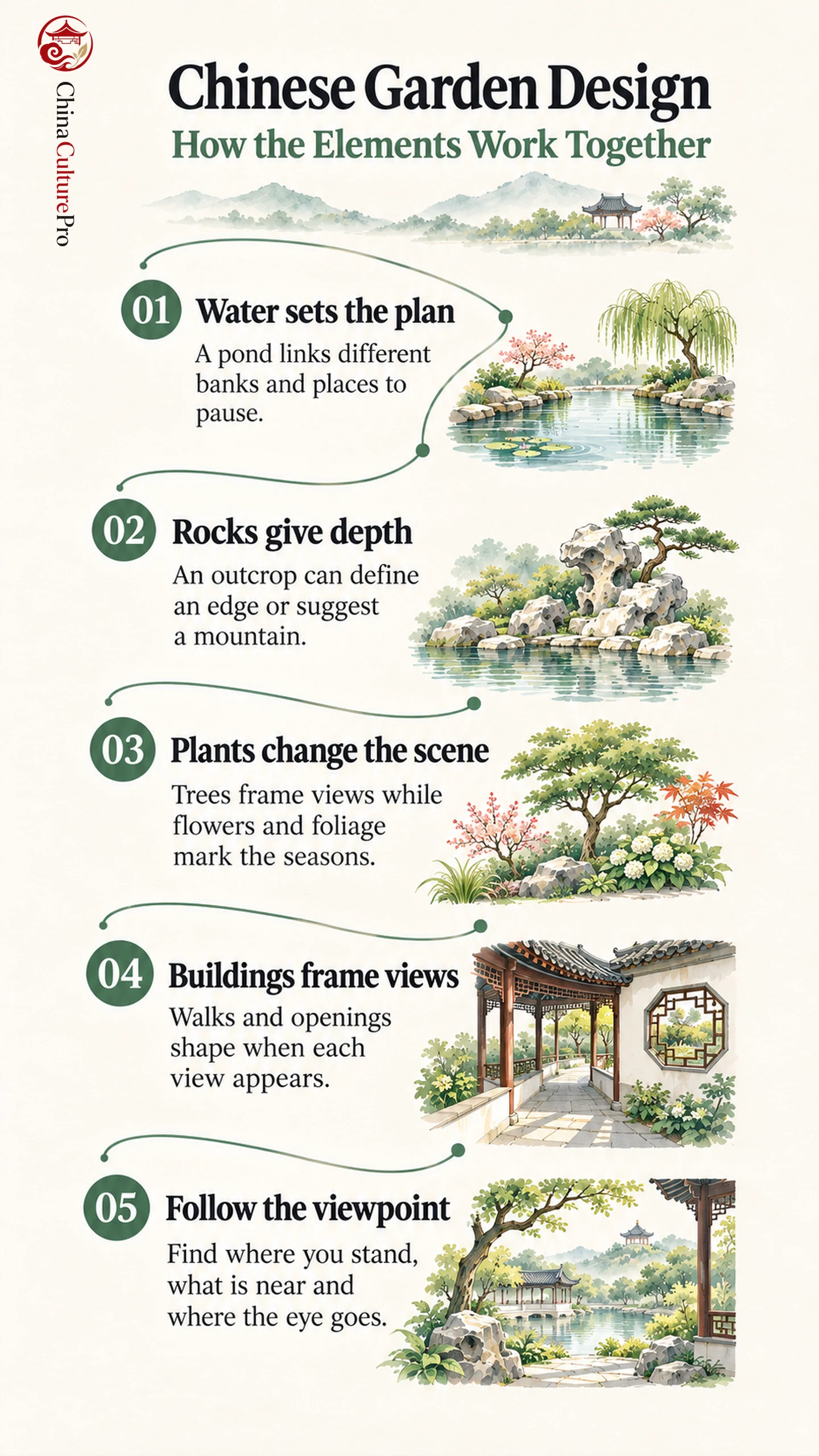
A pond can do the work of a clearing. From a pavilion at its edge, the eye can travel toward the opposite bank without being stopped by paths or walls. A route around the water gives that openness a series of different edges, each with its own foreground and background. In Chinese gardens with a central pond, the arrangement of those edges often explains where the most important rooms and stops are. [1][2][3]
At the Master of the Nets Garden, a relatively compact residence garden, the pond brings nearby buildings into relation with one another. From one side you can see buildings across the water. From another, an immediate detail such as a rock by the bank changes the scene. Water makes the spaces feel connected even when the walk between them bends or passes under a roof. [3][4]
The central part of the Humble Administrator’s Garden uses water over a larger area. Building positions, islands and banks divide the scene into views with different lengths and widths. Two of the classical gardens of Suzhou can therefore use the same element as a center while offering quite different experiences of distance. [1][2][3]
Rocks Shape the Ground and the View
Rocks can mark a shoreline, rise as a rockery or stand on their own as an object to look at. A group of stones can give one side of a garden enough height to conceal what lies behind it. A prominent single stone can draw attention from across a courtyard. Nearby planting or a wall can make holes and ridges in a rock more legible. [1][5][6]
Suzhou’s garden traditions value unusual stones, including perforated limestone associated with Lake Tai. Their silhouettes, holes and folds can evoke formations that would otherwise be far too large to fit inside a residence. From one angle, a stone can stand out as a peak. From the side, it may read as part of a ridge. [5][6]
The way a stone stands matters as much as its shape. A stone built into a bank belongs to the terrain of the garden. A stone set apart can be appreciated more like sculpture. Smaller scholars’ rocks carry that concentrated attention to the scale of a room or desk. [5]
Plants Give Structure and Mark the Seasons
Planting can set the distances within a view. A nearby branch can mark its upper edge, while bamboo or shrubs can soften the wall behind a rock. Leaves filter what you see through a screen of foliage. A more open patch of water then gives the eye a place to rest. These effects come from where plants are placed and how they grow. [1][4][6]
Plants also change how a fixed view feels over the year. The Huntington’s contemporary Suzhou-inspired garden explains how peach blossoms recall spring and chrysanthemums recall autumn. Evergreen foliage can hold its place in the composition after other trees have dropped their leaves. The same path can then expose a wall or roof that was partly hidden in summer. [6]
Chinese garden plants can carry associations that also appear in paintings, poems and architecture. At the Huntington, carvings of pine, bamboo and plum blossom adorn the Pavilion of the Three Friends. Each of these plants is associated with endurance through cold weather, and the carving keeps the trio together throughout the year. [6]
Architecture Makes Places to Look
An opening shapes the limits of a view. A lattice window can offer a partial glimpse across a wall. A doorway can frame a fuller scene and give you a way to enter it. The sequence through garden paths and windows changes what you can see as you turn or approach. Circular moon gates can provide both a frame and a threshold. [4][6]
Buildings can also give the visitor a place to stop. A roofed walk offers a succession of viewing positions. Chinese pavilions can single out one position from which to see the water, a planted bank or a rockery. An enclosed room may direct attention toward only one part of the garden. [3][4][6]
A view can extend beyond the garden itself through borrowed scenery (借景, jièjǐng). The Ming garden designer Ji Cheng (计成, Jì Chéng) discussed how a design could work with its site in The Craft of Gardens (园冶, Yuányě). In Suzhou, the North Temple Pagoda is documented in a borrowed view from the Humble Administrator’s Garden. A frame can point you toward a garden feature or toward something outside. The second possibility lets the view reach beyond the physical boundary. [4][7][8][9]
Read a Garden One View at a Time
Find the viewing position first. A scene seen from a veranda may have been composed with a roofline overhead and a railing at the lower edge. Next, look for what lies close by. A rock or branch can give the foreground texture and make the water feel farther away. Finally, trace where the eye comes to rest across the pond or through an opening. [2][3][4]
This works across different scales. In a small Suzhou garden, the far shore might be just across a pool. In a larger setting, the focal point might be a hill or a building beyond a broad stretch of water. Differences between imperial and scholar gardens make scale, distance and patronage part of the comparison. [1][2][3]
FAQs About Chinese Garden Design
What are the main elements of a traditional Chinese garden?
Water, rocks, plants and architecture are four common elements. A path connects viewpoints. Ponds, rockeries and plants form the scenes you encounter along the route. [1][4]
Why is water often at the center of a Suzhou garden?
A pond creates an open area in an enclosed garden. It also gives paths and rooms a shared edge and lets people see from one part of the garden to another. [2][3]
What is the difference between framing and borrowing a view?
Framing uses an opening or foreground element to select part of a scene. Borrowing can make something outside the garden, such as a pagoda or hill, part of the view inside it. [4][8][9]
出典
[1] UNESCO World Heritage Centre. Classical Gardens of Suzhou
[2] Suzhou Bureau of Gardens and Landscaping. The Humble Administrator’s Garden
[3] Suzhou Bureau of Gardens and Landscaping. Master of the Nets Garden
[4] Suzhou Bureau of Gardens and Landscaping. Architecture in Garden Design
[5] The Metropolitan Museum of Art. Chinese Gardens and Collectors’ Rocks
[6] The Huntington. Chinese Garden
[7] Stanford Encyclopedia of Philosophy. Aesthetics in Chinese Philosophy: Painting and Calligraphy
[8] Shanghai Landscaping and City Appearance Administration. Borrowed Scenery in the Humble Administrator’s Garden
[9] The Textbook of Architecture. Borrowed Scenery in The Craft of Gardens