
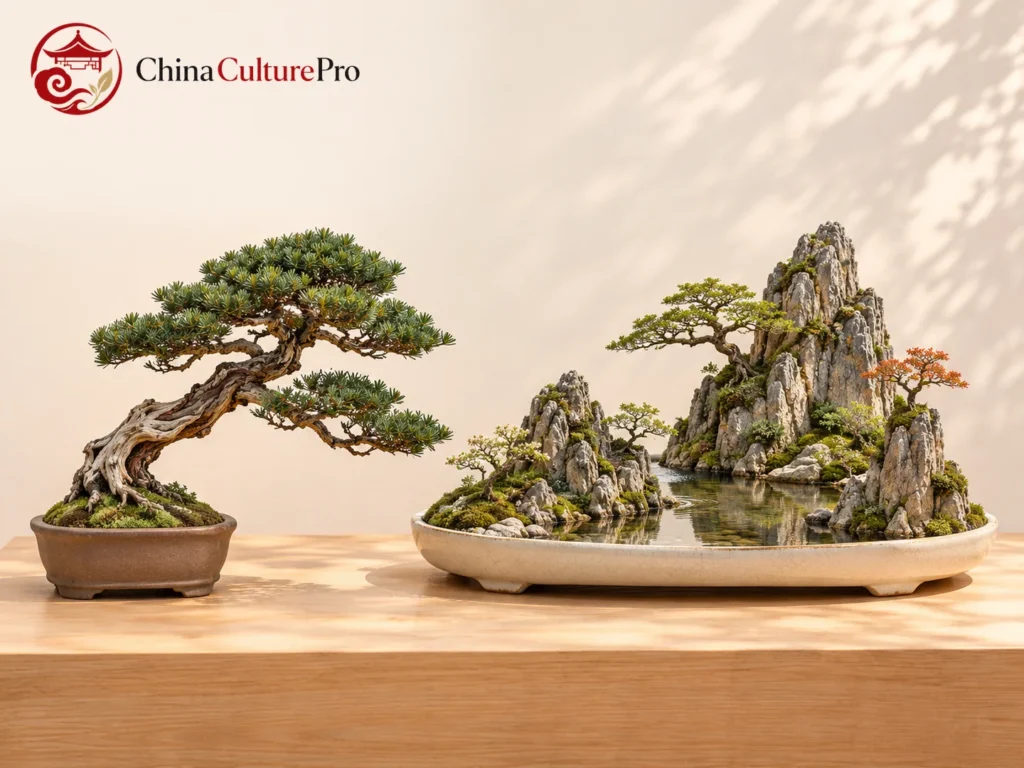

Quick Answer: What Is the Difference Between Penjing and Bonsai?
Chinese penjing (盆景, pénjǐng) means a scene in a pot. It can center on a living tree, a rock landscape, or a composition of land and water. Japanese bonsai (盆栽) typically centers on a living tree or group of trees. Both can suggest a landscape much larger than the container. [1][2][3][4]
- Tree-centered works can look similar in both traditions. Artists shape woody plants to suggest the growth of mature trees. [1][3]
- Some penjing compositions place rocks or water at the center. A crag or water channel can set the scale of the entire scene. [2][3]
- Bonsai can include a whole grove. A Japanese beech group at the Omiya Bonsai Art Museum evokes a mountain forest. [5]
Begin by noticing where your eye lands and what leads it through the composition.

Imagine two trays on neighboring display tables. A slanting trunk takes up most of one view. In the other, a gap between rocks seems wide enough for a river. These are two ways to make a small composition suggest a place much larger than itself.
What Penjing and Bonsai Have in Common
In both traditions, a living tree can become the subject of a composition in a shallow container. An artist might use a bend in a trunk to suggest wind exposure or arrange spreading branches to convey a long life in an open site. An older-looking shape can result from training and careful choices about proportion. [1][2][4]
A tree keeps growing after it has taken shape. Pruning and training help maintain the design, while watering and fertilizing support the living plant. Leaves may turn in autumn or fall away to expose branching that was hard to see in summer. Comparing the same deciduous specimen across seasons can make it easier to see the decisions behind its shape. [1][5]
The pots also do visual work. The line of a rim establishes a horizon below the trunk. Placing a tree toward one end of a tray leaves space on the side toward which it leans. A container can give a viewer a sense of the scale and movement the artist intends. [2][4][6]
Three Kinds of Penjing
The artist Zhao Qingquan distinguishes three forms of Chinese penjing. They offer a way to describe where the composition puts its emphasis. [3][6]
- Tree penjing (树木盆景, shùmù pénjǐng) puts the plant in the leading role. The trunk, roots or silhouette can carry the whole scene. This is the form with the strongest overlap with bonsai.
- Landscape penjing (山水盆景, shānshuǐ pénjǐng) uses stone to suggest features such as cliffs, islands or mountains. Small plants can help establish an imagined scale.
- Water-and-land penjing (水旱盆景, shuǐhàn pénjǐng) builds a scene in which land and water are both important. Soil, stones, plants and sometimes small figures can suggest a shore or a place to cross.
Rock-led penjing can recall ways of arranging stone and water in Chinese gardens. The comparison is about what these elements do at different scales. A separate tradition of displaying Chinese scholars’ rocks also values a stone’s ability to suggest a landscape, even when it sits alone on a stand. [2][3][7]
How to Look at a Bonsai
The Omiya Bonsai Art Museum in Saitama invites viewers to look closely at the roots, trunk, branches and foliage as well as the overall shape. Start where the trunk meets the soil. Then follow its line upward and notice how branches and the spaces between them define the silhouette. A closer view can reveal differences that disappear when you look only at the outline. [4]
In a group planting, the eye may move across several trunks instead. The museum’s Shirakami-no-sato is a planting of Japanese beeches named for the Shirakami Mountains. The upright trunks and the openings between them suggest the depth of a forest. In summer, foliage joins the trees into a canopy. In winter, the separate trunks and branches are easier to distinguish. [5]
Penjing and Bonsai Compared
| 見分けるポイント | In penjing | In bonsai |
|---|---|---|
| Main subject | A tree, a group of plants, or an entire scene | A tree or group of trees |
| Sense of scale | A small plant can make a rock read as a cliff | The proportions of roots, trunk and branches can suggest a mature tree |
| Role of stone and water | They can organize the whole scene | A rock can become a growing surface for one or more trees |
| A forest effect | Several trees can suggest depth in a landscape | A group planting can suggest a forest through spacing and canopy |
A single trained tree in a shallow pot might fit either tradition. Omiya also holds a work in which Tomio Yamada established a Japanese white pine in a circular stone, with other trees in the composition. [8] With a rock-led composition, ask whether the stone supplies the setting or becomes the main subject. For a group of trees, see whether your eye settles on a single trunk or moves through the gaps as if you were looking into a woodland. The label may name the tradition, artist or style that you cannot identify from the composition alone. [1][3][4][5]
A Shared History and Distinct Traditions
Chinese precedents for potted scenes are older than the established Japanese bonsai tradition, but an exact starting date is hard to pin down. The Huntington points to early Chinese tomb paintings that show arrangements in containers. Those images document an early practice, while the full development and transmission of later forms remain harder to reconstruct. [2][3]
Both traditions have changed through the work of artists and collectors. For example, Hong Kong collector Yee-sun Wu practiced the Lingnan approach to penjing. The Chinese pavilion named for him at the U.S. National Arboretum sits within a museum that also presents Japanese bonsai. Seeing the labeled collections side by side gives visitors more varied examples than a comparison based on just one tree and one rock tray. The same approach works when comparing Chinese and Japanese gardens. [1][9]
FAQs About Penjing and Bonsai
Is penjing the Chinese name for bonsai?
Penjing is the name of a broader Chinese art. Its tree-centered form overlaps strongly with bonsai, while other penjing forms give the main role to rocks or to a scene composed of land and water. [2][3]
Can bonsai include more than one tree?
Yes. Group plantings are part of bonsai. Omiya’s Shirakami-no-sato uses Japanese beeches to evoke a forest. [5]
Does penjing always contain rocks or water?
No. Tree penjing can focus entirely on a living tree and the shape its artist gives it. Stones and water play a bigger role in other forms of the art. [2][3]
出典
[1] U.S. National Arboretum. National Bonsai & Penjing Museum
[2] The Huntington. The Art of Penjing
[3] National Bonsai Foundation. Penjing Defined by Master Zhao Qingquan
[4] The Omiya Bonsai Art Museum. Appreciating Bonsai
[5] The Omiya Bonsai Art Museum. Shirakami-no-sato
[6] The Huntington. Penjing
[7] The Metropolitan Museum of Art. Scholar’s Rock
[8] The Omiya Bonsai Art Museum. Rock-Grown Japanese White Pine
[9] National Bonsai Foundation. National Bonsai & Penjing Museum Collections