


Quick Answer: What Is an Aoqun?
Aoqun (袄裙, ǎoqún) describes an outfit made from an ao (袄, ǎo), or jacket, and a separate qun (裙, qún), or skirt. A late Qing museum ensemble shows a jacket covering the upper part of a two-piece skirt.[2]
- Top: A jacket closes on the upper body. The collar and fastening vary with the cut and period.[1][5]
- Skirt: The skirt has its own waistband. Some historical skirts used overlapping panels and side pleats.[1]
- Fit: Check where the jacket hem falls and whether you can sit and walk without the waistband slipping.
Modern aoqun appears among the many layered outfits worn as hanfu (汉服, hànfú).
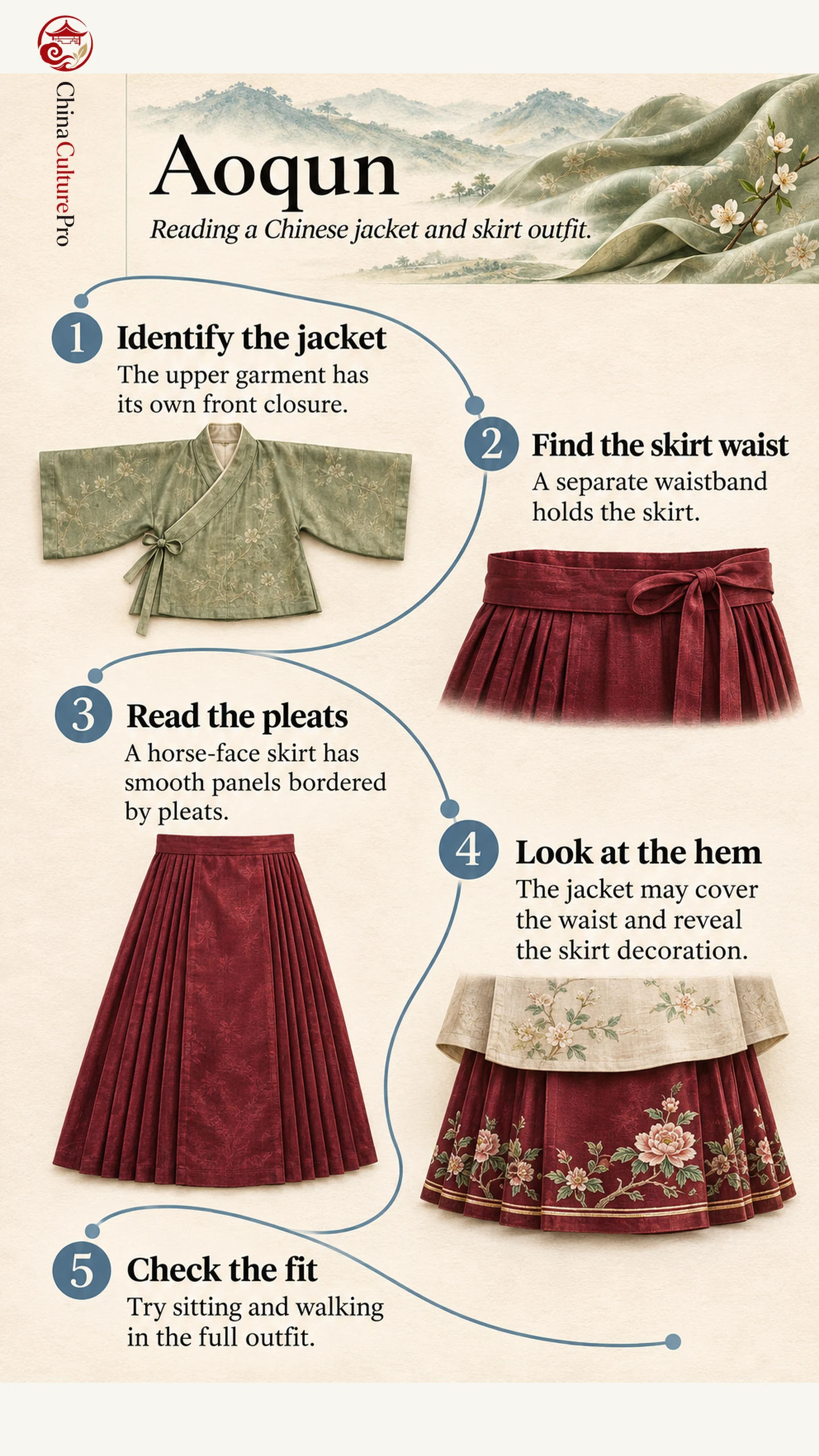
Look for two hems when identifying the outfit. The jacket may hide the waistband, but the skirt continues below it as a garment with its own construction.
How the Jacket and Skirt Fit Together
On a crossed front, one panel overlaps the other. Some Ming upper garments had straight collars on two parallel edges, and standing collars with buttons also appear in later Ming examples.[1][5]
The jacket hem affects how much of the skirt is visible. The late Qing ensemble at the Asian Civilisations Museum places the skirt decoration below that hem.[2]
A pleated mamianqun (马面裙, mǎmiànqún), often called a horse-face skirt, has smooth panels bordered by pleats. A late Ming example has two overlapping sections formed from sewn lengths of cloth. Wenzhou Museum notes that Ming usage commonly called such a garment a skirt.[1][3]
What Surviving Garments Show
The China National Silk Museum presents an unlined cross-collar upper garment and a gauze skirt excavated from a late Ming tomb in Jiangxi. A woven floral pattern covers the top. The pleated skirt uses patterned gauze, light enough for summer wear in the regional example.[1]
The Asian Civilisations Museum pairs a late Qing embroidered ao with a skirt whose decoration appears below the jacket. An early twentieth-century wedding ensemble at The Met pairs a straight-cut jacket with a skirt derived from the horse-face form. Its embroidered motifs suit its wedding context.[2][4]
What to Check in Modern Wear
Start with the waist and shoulders. If the skirt wraps, check that the overlap remains in place through a full stride. The jacket should close without pulling at the chest or bunching above the waistband. Raise your arms and sit down to check whether the sleeves and hem move comfortably.
For a history-led outfit, use a dated image or garment record to guide the collar, sleeve and skirt. The guide to hanfu cross-collars explains the closure used on some historical tops. Check the combined length after adding the other hanfu layers you plan to wear.
FAQs About Aoqun
Does an Aoqun Require a Horse-Face Skirt?
The horse-face skirt is one option. The outfit name describes the jacket and skirt combination.
Does the Jacket Always Have a Crossed Collar?
Historical upper garments include crossed, parallel-front and standing collar forms.[1][5]
Are Modern Aoqun Copies of Museum Garments?
Some are made from a dated model. Others adapt a historical cut for current fabrics and fastenings.
出典
[1] China National Silk Museum. Late Ming Patterned Silk Top and Gauze Skirt
[2] Asian Civilisations Museum. Fashion and Textiles Gallery Guide
[3] Wenzhou Museum. Clothing on Ming Ceramic Figures
[4] The Metropolitan Museum of Art. Woman’s Wedding Jacket and Skirt
[5] Beijing Wenbo. Study of Women’s Clothing in the Ming Dynasty