

Quick Answer: What Is Xiang Chinese?
Xiang Chinese(湘語,Xiāngyǔ), also called Hunanese, is a group of Chinese speech varieties associated chiefly with Hunan(湖南,Húnán). It is one part of the province’s multilingual landscape.[1]
- Varieties: Distinct local systems belong to the wider group.
- Classification: Conventional subgroups describe living speech.
- Sounds: Consonants, vowels and tones need a locality-specific description.
A label such as “Hunan dialect” is too broad to identify a recording precisely. Ask which town or community the speaker represents before choosing pronunciation material.
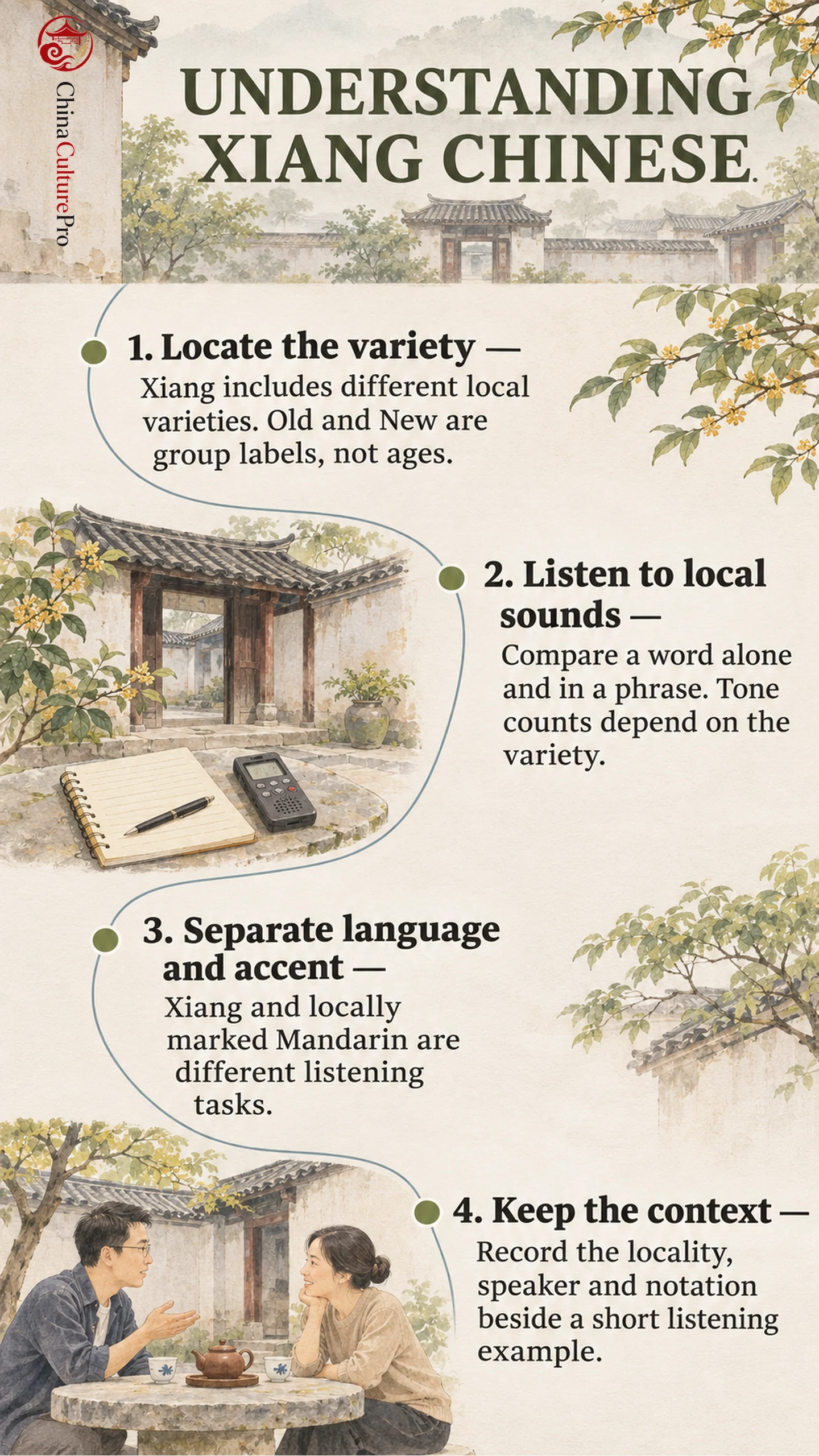
A recording labelled “Hunanese” can raise several questions at once. Is it Xiang, a local Mandarin variety or someone speaking Standard Mandarin with a regional accent? Separating those possibilities makes the sound differences easier to understand. It also helps you choose material that matches a particular family or place.
Where Xiang Is Spoken and What Old and New Mean
Hunan is the geographical starting point. The provincial overview places Xiang chiefly in the Xiang and Zi river basins. It also records Southwestern Mandarin, Gan, Hakka and other local speech, alongside minority languages.[1] “From Hunan” therefore identifies someone’s home province, not their language.
New Xiang(新湘語,xīn Xiāngyǔ)is conventionally represented by Changsha(長沙,Chángshā). Old Xiang(老湘語,lǎo Xiāngyǔ)is represented by varieties including Xiangxiang(湘鄉,Xiāngxiāng)and Shuangfeng(雙峰,Shuāngfēng). These are contemporary groupings, not successive historical periods.[2][3] The pinyin here gives Mandarin readings of names; it does not transcribe local speech.
One important distinction concerns voiced consonants: Xiangxiang retains a contrast involving sounds such as /b d g/, alongside voiceless unaspirated and aspirated stops.[2] This gives the labels a phonological basis rather than a judgment about cultural authenticity.
There is another distinction within Changsha itself: old-style and new-style speech. Wu’s description of new-style Changsha uses a principal speaker born in 1949. Style is not simply a speaker’s age.[3]
Nor does a two-part introduction settle every boundary. Sevilla’s study of hesitation sounds across 16 Xiang localities found a distribution that did not neatly match established classifications.[4] Use Old and New as orientation within the wider Chinese language landscape, while retaining the locality.
Sounds and Tones: Changsha and Xiangxiang Examples
Wu’s Changsha study records six citation tones; Zeng’s Xiangxiang description records seven.[2][3] Citation tones are forms pronounced in isolation. The difference rules out a single tone count for the whole group.
These Changsha examples come from Wu’s phonetic description.[3] They illustrate actual local forms rather than Mandarin spellings with a different accent.
| 意味 | Changsha transcription |
|---|---|
| 花 | /fa³⁴/ |
| Sand | /sa³⁴/ |
| 火 | /xo⁴³/ |
The raised digits indicate relative pitch: 1 is low and 5 is high. They are neither syllable counts nor Mandarin’s numbered tone categories. Read the phonetic symbols with a recording where available; familiar-looking letters alone are an incomplete pronunciation guide.
The historical entering tone(入聲,rùshēng)also needs care. Wu describes Changsha’s corresponding tone as rising, without the short duration typical of checked syllables.[3] A historical category name does not guarantee that its old consonant ending survives.
Connected speech adds a further layer. In Zeng’s two-syllable Xiangxiang words, the first syllable keeps its tone while the second reduces to one of three level pitches. The study expressly limits this generalization to two-syllable words.[2] Learning isolated entries is therefore only a first step toward recognizing words in conversation. Our guide to Chinese tones explains the broader distinction between tone categories and their realization.
Xiang Chinese, Mandarin and Plastic Mandarin
Knowing Mandarin does not automatically make Changsha Xiang intelligible. Xu’s research distinguishes the local Xiang variety from forms of Mandarin spoken in the same city.[5] This is the essential difference between learning a regional language and learning to recognize an accent in another language.
Plastic Mandarin(塑料普通話,sùliào pǔtōnghuà)is a local urban Mandarin variety examined in Xu’s 2025 study. It retains Standard Mandarin’s tone categories, but its pitch patterns differ; some resemble Changsha Xiang. The study compares the two varieties as produced by the same multilingual speakers.[5]
The label is not proof that its speakers have failed to learn Mandarin. Xu describes young people choosing this locally marked speech despite having learned Standard Mandarin.[5] Avoid treating regional identity as a measure of education or ability.
For a learner, these distinctions change the task. A subtitled clip may be useful for recognizing regional Mandarin without teaching the household Xiang your relatives speak. Conversely, a careful Xiang word list may sound unfamiliar even when its translation uses ordinary Chinese characters. Establish the spoken variety before using the subtitles as a pronunciation model.
Choose a Local Variety Before You Start Listening
Start with a place and a purpose: talking with a Changsha relative, following Xiangxiang speech or comparing a study’s recording with its transcription. Check that the recording is actually available before choosing it as your main resource. “Learn Hunanese” leaves that choice unresolved.
When assessing a recording or lesson, look for:
- Locality: The town, district or community represented.
- Speaker context: The variety the person normally uses, rather than an assumed classification based on age.
- Notation: Whether the accompanying text gives pronunciation, ordinary characters or a Mandarin translation.
- Speech setting: An isolated word, a short phrase, conversation or performance.
Documentation can help locate a starting point. An official report published in 2020 recorded completion of 100 provincial language-survey points by the end of 2019. It described a separate community-funded survey initiative too.[6] Those are dated documentation records, not a promise that every recording is publicly available today.
Compare one short expression in isolation and in a phrase, keeping its source beside your notes. If the sound changes, check the context before replacing the entry with a supposedly correct spelling. For family learning, a willing relative can clarify which form belongs to everyday household speech.
FAQs About Xiang Chinese
Is Xiang Chinese the same as Mandarin?
No. Xiang is a separate regional group. A person may also speak Mandarin with a Hunan accent.
Does everyone in Hunan speak Xiang?
No. The province includes several Chinese language groups and minority languages.
Does Xiang Chinese have six tones?
Some varieties do. The cited Changsha description has six citation tones; Xiangxiang has seven.
Is Old Xiang only spoken by older people?
No. Old Xiang names a group of living varieties, not an age bracket.
出典
[1] Hunan Provincial Government. Overview of Hunan Dialects
[2] Ting Zeng. The Xiangxiang Dialect of Chinese
[3] Nankai Wu. Changsha Xiang Chinese
[4] Robert Marcelo Sevilla. Vowel Quality in Xiang Non-Lexical Hesitation Markers: New Forms of Typological Evidence?
[5] Chenzi Xu. Plastic Mandarin Tones: Regional Identity in Prosody
[6] Hunan Provincial Government. Promoting Putonghua and Protecting Language Resources