


Quick Answer: What Is Que She Tea?
Que She(雀舌,quèshé)means “sparrow tongue,” a tea name associated with a small, pointed appearance. It does not identify just one growing region or processing category.[1][3][4]
- Regional green tea: Jintan has a named, flat green tea.
- Other green examples: Sichuan products also use Que She.
- Wuyi usage: Que She can name a cultivar made into rock oolong.
- Buying clue: Read the tea type, place and actual batch before choosing brewing parameters.[1][3][4]
A shared name does not make all these teas interchangeable.
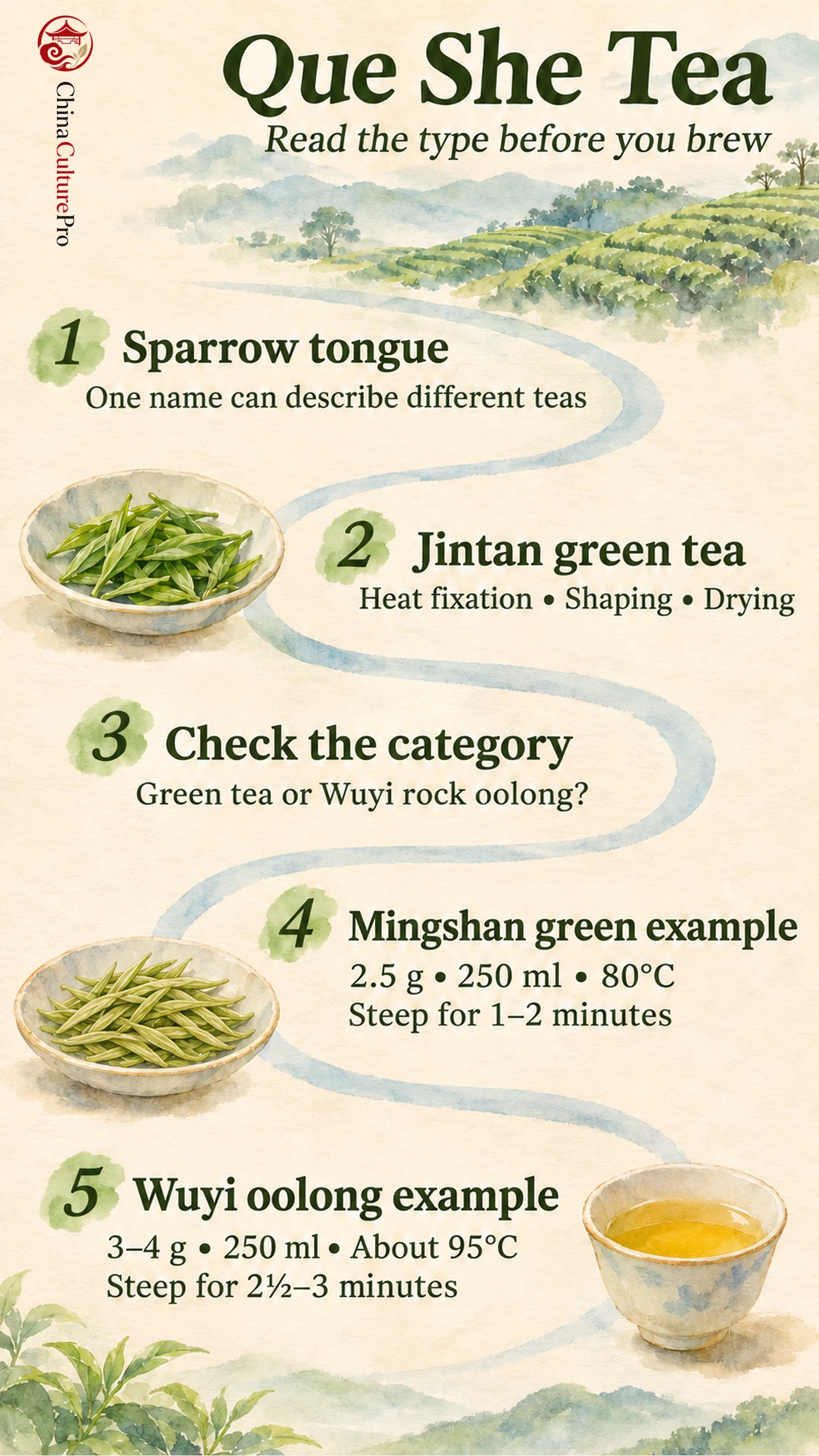
The most useful first question is whether the packet contains green tea or oolong.
One Name, More Than One Tea
| Label or example | 地域 | 名称が示すもの |
|---|---|---|
| Jintan Que She(金坛雀舌,jīntán quèshé) | Jintan, Jiangsu | A regional flat green tea |
| March 2026 Mengding Que She | Mingshan District, Sichuan | A green tea made from Mingshan No. 9 material |
| May 2025 Wuyi Que She | Shui Lian Dong, Wuyishan, Fujian | A medium-roast rock oolong with Que She stated as the cultivar |
Jintan’s yearbook describes tea growing on the eastern slopes of the Maoshan hills. The Sichuan and Wuyi rows describe specific batches.[1][3][4]
Read tea cultivar and tea type separately: the Mingshan example names a different plant, while the Wuyi example gives Que She as the cultivar.
How Green Que She Gets Its Shape
A green tea’s pointed appearance involves both the picked material and shaping. A 2005 technical patent gives one mechanical method for Jintan Que She: sort the fresh material, wash and drain it, spread it, use microwave heat fixation, cool and screen it, align and shape it, then dry and pack it.[2]
The patent contrasts this method with earlier hand-frying and addresses several raw-material grades. It is one technical example; heat fixation, shaping and drying remain distinct operations.[2]
What Que She Tastes Like
Jintan’s official description emphasizes flat, straight, green leaves, a fresh tender aroma and bright liquor.[1]
The March 2026 Mingshan green example is described with vegetal, umami, herbal and floral notes and a savory finish. The May 2025 Wuyi example instead has brown sugar, roasted cereal, caramel and mineral notes with a smooth texture. These are the respective suppliers’ descriptions of their batches.[3][4]
Choosing and Brewing the Right Que She
Check the exact type and producing place before comparing packets. Chinese tea origin labels help separate the product name from geography. If an early-picking claim matters, compare the actual harvest date with what Mingqian and Yuqian mean.
For the March 2026 Mingshan green tea, the published method is:[3]
- Measure 2.5 g of tea for 250 ml of water.
- Add water at 80°C and steep for one to two minutes.
- Pour off the infusion so the drinking tea is separated from the leaves.[3]
The May 2025 Wuyi oolong’s published pot method uses 3–4 g per 250 ml at about 95°C for two and a half to three minutes; lengthen subsequent steeps.[4]
Use the directions for the actual batch. Keeping brewing water and equipment consistent makes comparisons easier.
FAQs About Que She Tea
Are All Que She Teas from Jintan?
No. Jintan has its own named green tea, but Sichuan green products and Wuyi oolong also use Que She. The location must be read separately.[1][3][4]
Is Que She Always Made Only from Buds?
No single rule covers every use of the name. The Mingshan example is bud tea, while the Jintan patent discusses different raw-material grades; Wuyi uses Que She as a cultivar name.[2][3][4]
Should Every Que She Be Brewed at 80°C?
No. The cited green tea uses 80°C, while the Wuyi oolong’s pot method uses about 95°C.[3][4]
出典
[1] Jintan District Government. Jintan Yearbook: local products and tea
[2] Wang Huqin, Wang Zheming and Wang Jinxi. Flat green-tea processing method, patent CN1593172A
[3] Curious Tea. Que She Sparrow Tongue, March batch
[4] Wuyi Origin. Que She, Shui Lian Dong harvest