
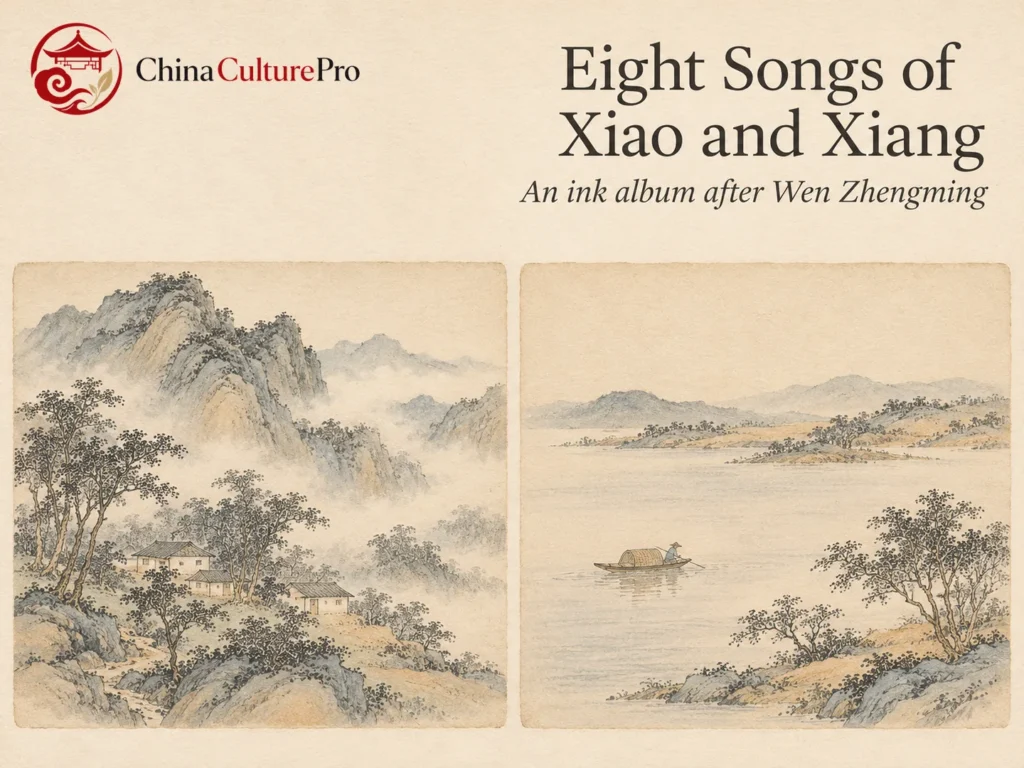

Quick Answer: Is Eight Songs of the Xiao and Xiang Rivers by Wen?
Eight Songs of the Xiao and Xiang Rivers (潇湘八咏, Xiāo Xiāng Bā Yǒng) is an ink album associated with Wen Zhengming (文徵明, Wén Zhēng Míng), but the Metropolitan Museum of Art currently attributes it to an unidentified artist working after him.
- Date: Sixteenth or seventeenth century.
- Format: Eight paintings with facing leaves of calligraphy.
- Material: Ink on paper.
- Look first: Compare a small landscape with the poem facing it, then move to another pair.
The signature naming Wen belongs to the evidence being evaluated; it does not establish accepted authorship.
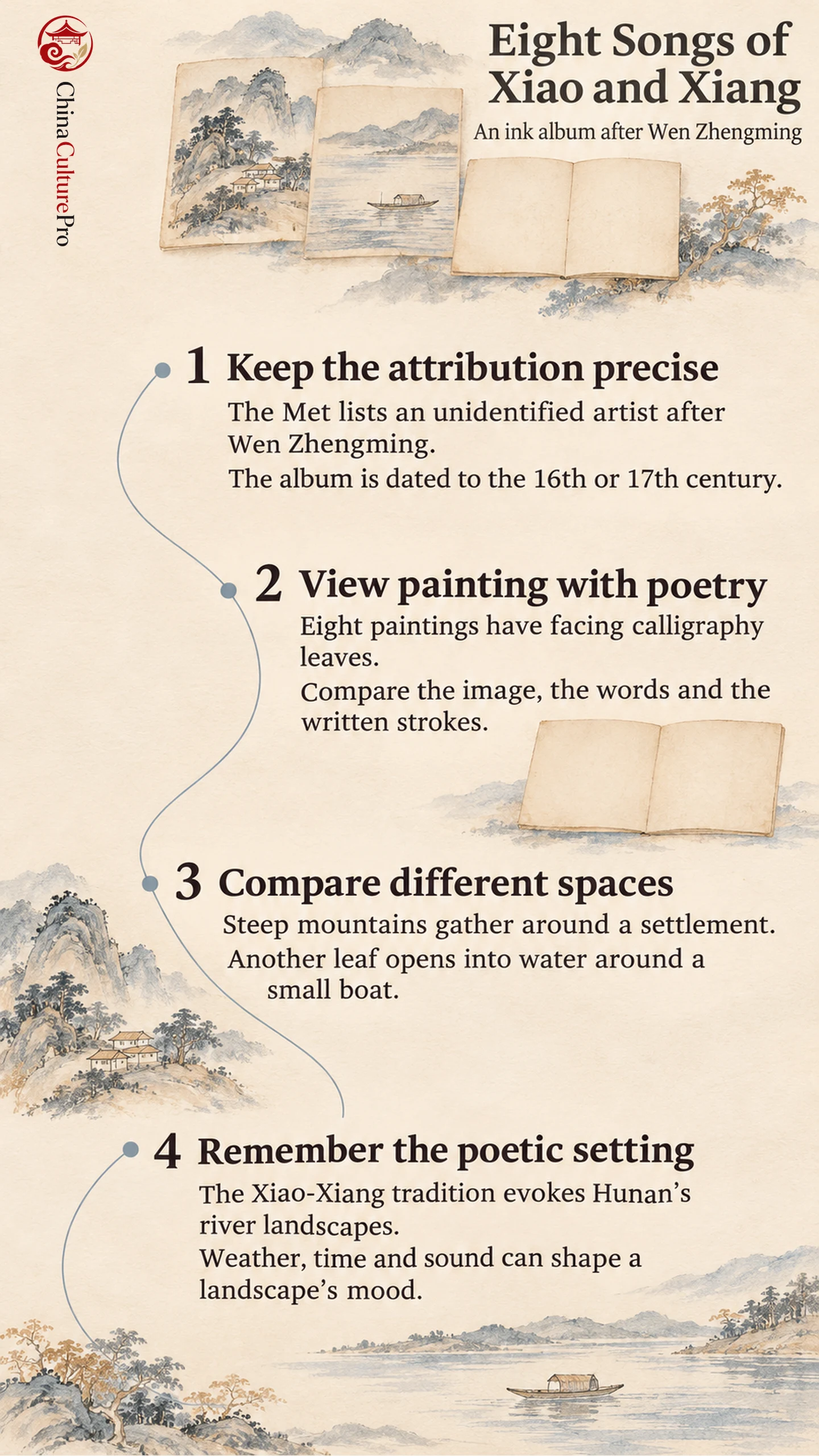
One leaf places buildings and trees beneath a group of steep mountains. The rocks occupy much of the upper field, while pale openings separate roofs and paths below.
Another leaf opens into broad water. A small boat near the center and a moored vessel below occupy only a fraction of that pale field. Compare the dense upper mountains with the open field around the boat.
Identify the Album and Its Current Attribution
The Met catalogs the album as 1972.278.9a–t, by an unidentified artist after Wen, in the sixteenth or seventeenth century. Its assessment treats both painting and calligraphy as less subtle than his accepted work and considers it a later imitation. [1]
That qualification changes how the signature should be read. A painted or written name can preserve an association with a famous artist while leaving the object’s actual maker uncertain.
The individual painting and facing calligraphy leaves measure 21.0 × 19.7 cm. The frontispiece sections have different dimensions, 21.0 × 42.9 cm. [1]
These are parts of an album, rather than one uninterrupted panoramic landscape. The scroll-format guide helps distinguish an album’s separate views from a handscroll’s continuous horizontal field.
Notice how much can change within a similarly sized painting surface. A mountain can dominate one leaf, while open water occupies the corresponding area in another. Compare the two leaves at the same scale before looking at their smaller details.
Read a Painting beside Its Facing Poem
Poetry can enter a Chinese painting through direct illustration or a less literal evocation of a verse. A facing text therefore offers another way into an image without requiring every word to correspond to a visible object. [3]
In the album’s calligraphy, the poem columns distribute dark strokes across pale paper. Some characters occupy broad, dense shapes; others extend into longer, thinner lines.
Compare one such column with a tree trunk in a painting. Both leave a visible dark path, but the written character organizes language while the trunk locates a plant within a landscape.
The calligraphy-styles guide develops the vocabulary for comparing written forms. Here, begin with stroke width, spacing and the relationship between a character and the next one below it.
The large title characters offer another scale of writing. Their heavy strokes and rougher edges differ markedly from the smaller poem characters. Compare a broad horizontal stroke with the surrounding unmarked paper.
The Chinese poetry guide provides literary context. When returning to the album, keep the words, their brushwork and the landscape as three connected objects of attention.
Compare a Mountain Settlement with Open Water
In the mountain leaf, the buildings step upward along the right side. Their angular rooflines contrast with the uneven mountain contours behind them.
Look lower, where a small bridge extends across an opening at the left. Its few straight marks provide a crossing within a much more irregular arrangement of banks and trees.
The tree foliage is made from groups of dark accents. Compare those clustered marks with the more continuous wash on a nearby mountain face: the same ink medium produces very different kinds of surface.
The open-water leaf distributes attention differently. A boat near the center remains legible because little else interrupts the surrounding pale paper.
At the lower edge, a mast rises above the moored boat. It supplies a vertical accent within a scene whose farther hills and shorelines run mainly sideways.
The landscape-painting guide develops these differences between mass and interval. Here, compare the amount of open space around the central boat with the much tighter spacing among buildings in the mountain scene.
A third leaf brings houses close to the water beneath a steep rock face on the right. Posts project from a landing near the lower left, while pale distant hills remain separated from the nearer shore.
The painting-techniques guide helps distinguish contour, wash and small accents. Test those differences against one roof, one tree cluster and one distant slope before turning the page.
Place the Album within the Xiao-Xiang Tradition
The Eight Views of Xiao-Xiang (潇湘八景, Xiāo Xiāng Bā Jǐng) belong to a long tradition associated with the river landscapes of Hunan. Song Di (宋迪, Sòng Dí) developed an influential eight-scene series in the eleventh century; those paintings no longer survive. [2]
Traditional subjects include returning sails, evening snow, night rain, an autumn moon and a distant temple bell. They give landscape a time, atmosphere or suggested sound as well as a visible arrangement. [2]
That background explains why a river view can invite more than geographic identification. A title or poem can direct attention toward a condition that the painting evokes through sparse marks and open space.
The inscriptions-and-seals guide develops the different roles of writing and attribution. In this album, return to the individual pair after reading its historical setting: the particular distribution of ink remains more useful for close viewing than assigning the whole work a single mood.
FAQs About Eight Songs of the Xiao and Xiang Rivers
Did Wen Zhengming paint this album?
The Met’s current attribution is to an unidentified artist after Wen. The museum considers the signature insufficient to establish his authorship.
Are there eight paintings or eight pages in total?
There are eight paintings with facing calligraphy leaves, as well as frontispiece material. Eight refers to the painting sequence, not the total number of component sheets.
Does Songs mean that the album contains musical notation?
Here the relevant pairing is landscape painting and written poetry. The facing calligraphy is read as verse, rather than presented as a musical score.
出典
[1] Metropolitan Museum of Art. Eight Songs of the Xiao and Xiang Rivers, collection record 1972.278.9a–t
[2] Kyoto National Museum; Minoru Nishigami. Returning Sails off a Distant Shore Attributed to Muqi: Examining the Eight Views Tradition
[3] Metropolitan Museum of Art. Vision and Verse: The Poetry of Chinese Painting, exhibition overview