

Quick Answer: What Is the Difference Between Mingqian and Yuqian Tea?
Mingqian(明前,míngqián)means tea picked before Qingming(清明,qīngmíng). In a spring-harvest comparison, Yuqian(雨前,yǔqián)usually means picking after Qingming and before Guyu(谷雨,gǔyǔ), or Grain Rain.[1]
- Waktu yang tepat: The labels divide spring by solar terms, rather than by a change in the tea-making method.
- Rasa: Earlier material often gives a delicate, fresh cup; later spring material can taste fuller.[1]
- Quality: Neither date label alone establishes the better tea.[3]
Compare the actual tea, origin, cultivar, picking and year before comparing two harvest labels.
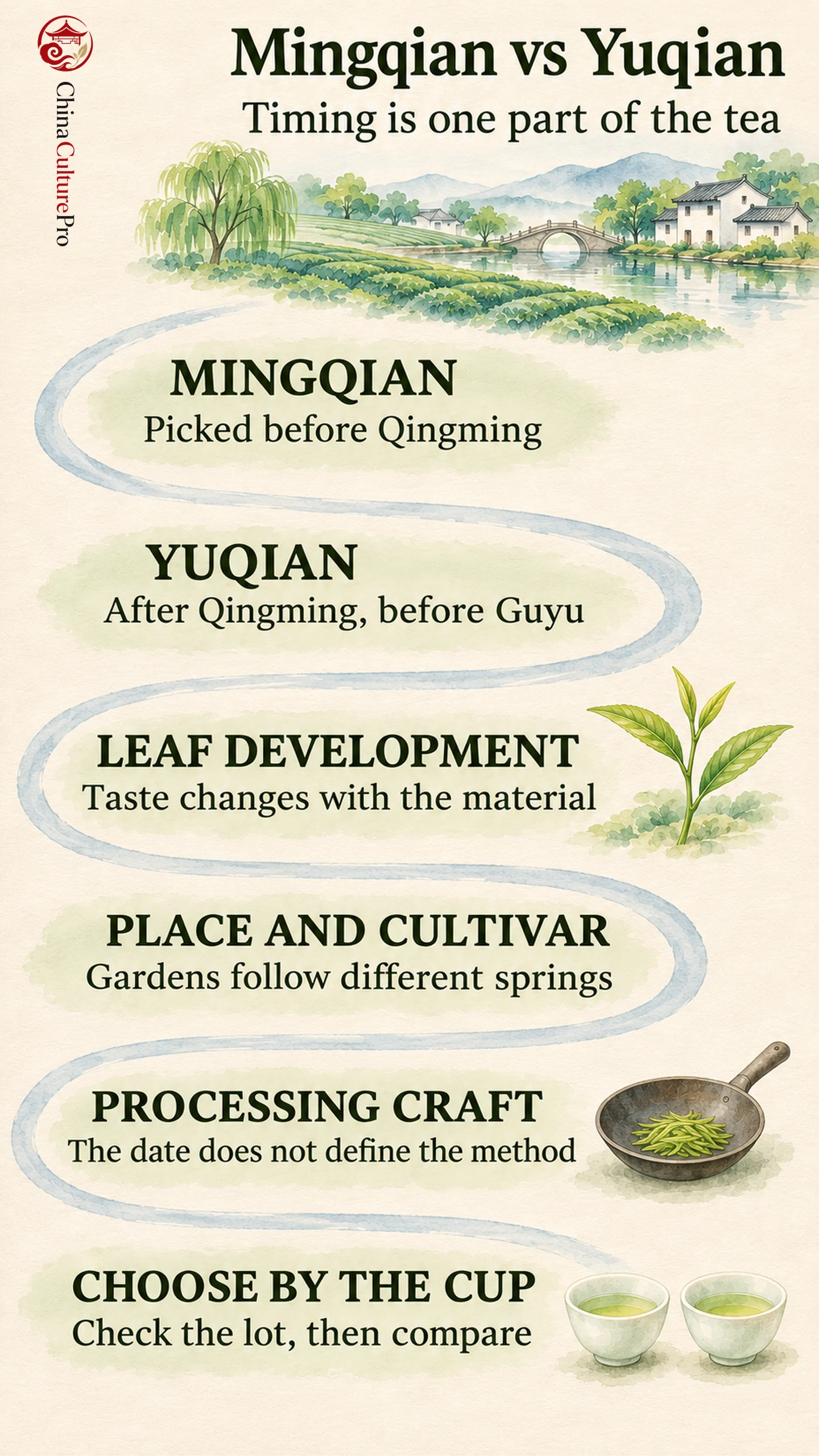
A harvest label makes more sense when read alongside the leaf, place and craft.
Harvest Windows and the Solar-Term Calendar
| Label | Usual comparative window |
|---|---|
| Mingqian | Before the early-April Qingming solar term |
| Yuqian | Between Qingming and Guyu, the latter around April 20 |
This is the conventional comparison.[1] Literally, Yuqian says “before Grain Rain,” and some descriptions use that broader wording without specifying its starting point. Ask for the picking date when the label is unclear.[4]
For a dated example, the 2026 solar terms fall on April 5 for Qingming and April 20 for Guyu in Hong Kong time, UTC+8. They are solar-calendar markers, not dates that must remain identical every year.[2]
Leaf Development, Flavor and Value
In the familiar spring green-tea comparison, cooler early conditions slow shoot growth. As the season warms, shoots expand and their chemical balance changes. Amino acids contribute freshness, while polyphenols contribute bitterness and astringency. Their balance helps explain the tendency toward a lighter, sweeter early cup and a fuller later one.[1]
These tendencies are useful starting points, not fixed tasting guarantees. Very early picking can produce thin aroma and flavor if the material is not ready. A later cup may suit someone seeking more body, while a delicate early lot may appeal to someone prioritizing freshness.[3]
Scarcity helps explain the prestige of Mingqian tea, but a premium is not proof of superior taste. Yuqian can offer appealing value for regular drinking. Judge that against the actual quantity, origin and cup rather than assuming the earlier label deserves any asking price.[3][4]
Why Region and Cultivar Change the Comparison
The distinction is especially associated with spring green-tea traditions south of the Yangtze. It should not become one national timetable for judging all tea regions.[4] A 2023 report from Changqing, Shandong, emphasizes the later northern spring and local interest in Guyu tea, while also recording some picking on April 7.[5]
Different northern growing conditions also matter when reading a Laoshan green tea label. A pre-Qingming date from a warmer region does not establish superiority over a later northern harvest.
Within Longjing(龙井,lóngjǐng), the early-sprouting Longjing 43(龙井43号,lóngjǐng sìshísān hào)cultivar and local seed-grown populations develop differently. Comparing their picking dates can therefore mix cultivar differences with seasonal ones.[4]
Harvest Timing Is Not a Processing Method
Both harvest windows can supply Longjing processed through pan work, shaping and finishing. The date label does not specify hand or machine processing.[4]
Cultivar and tea type identify plant material and finished category; harvest timing identifies the season. Read all three together.
How to Choose Between Mingqian and Yuqian Tea
- Confirm the tea name, actual origin and harvest year. Ask for a picking date if the seasonal wording is broad.
- Compare the picking standard and cultivar where supplied. Bud-only tea and a bud with opened leaves are different materials.
- Check processing and storage information, then taste a small amount if possible. Compare freshness, body, bitterness and the finish against your own preference.[3][4]
- For a side-by-side trial, use matching vessels, weighed leaf and the same brewing water, temperature and timing. Record which cup you prefer before looking again at its harvest label.
For the comparison, keep the same brewing water and preparation, then adjust each batch separately to your taste.
FAQs About Mingqian and Yuqian Tea
Does Yuqian Mean Tea Picked Before Actual Rain?
No. It refers to the Grain Rain solar term. A rainy day in the garden does not independently change the tea from one label to the other.[1]
Is Mingqian Always the First Picking?
No. The word states a deadline, not that this was the first picking from that garden. Check the actual harvest description rather than treating the two claims as synonyms.
Is Yuqian Tea a Lower Quality Grade?
The timing label alone is not a quality grade. Suitability of the leaf, processing and the finished cup still need to be assessed.[3]
Can the Same Brewing Recipe Compare Both Teas?
Yes, as a controlled tasting of comparable lots. Keeping preparation the same makes differences easier to assess, although each batch may ultimately taste best with different settings.
Sumber
[1] Su Zhucheng / People’s Daily. “明前茶”“雨前茶”,為啥以節氣來劃分?
[2] Hong Kong Observatory. 2026 April Calendar
[3] Guangming Daily / Tea Research Institute, Chinese Academy of Agricultural Sciences. 选“明前茶”还是“雨前茶”?国家一级评茶师这样说
[4] China National Tea Museum Tea Club / West Lake Longjing Tea Association. 西湖龙井生长日记⑤ 西湖龙井八条干货知识分享
[5] Shao Minghong and correspondents / Jinan Daily. 长清:“三茶统筹”乡村振兴