


Quick Answer
A Miao lusheng (芦笙, lúshēng) festival brings together musicians and dancers around a bamboo-pipe mouth organ. In southeastern Guizhou, two well-documented gatherings are Zhouxi’s festival in Kaili and the Gulong gathering in Huangping. Each has its own calendar and local setting.[1][3][5]
- Instrument: Air makes small reeds vibrate inside a group of pipes.[1][2]
- Zhouxi: The 2026 gathering ran from the 15th through the 20th day of the first lunar month.[3]
- Gulong: Its named gathering takes place on the 27th day of the ninth lunar month.[5]
Use the place name with the festival name when reading a programme or identifying a performance.[3][5]
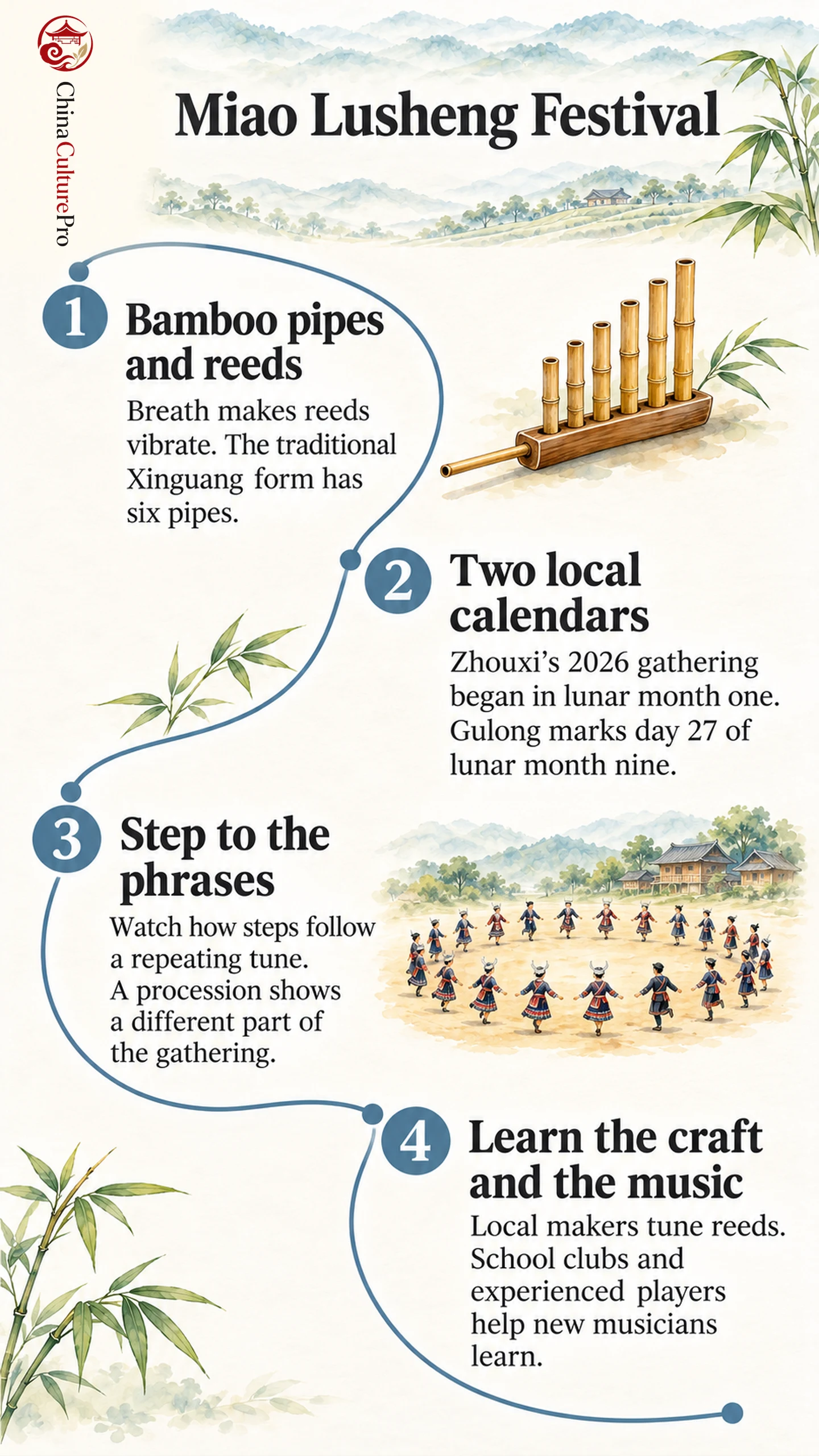
The music and the movement are easiest to understand together. In a shared dance ground, a phrase played on bamboo pipes gives dancers something they can step to. A village gathering can bring experienced performers, learners and spectators into the same space. The setting explains as much about the festival as the instrument on its own.
What the Lusheng Sounds Like and How It Is Made
The lusheng is a free-reed mouth organ. The player’s breath enters a wind chamber and reaches the reeds associated with the pipes. The pipes offer different pitches, and a player may combine tones. The national inventory describes a traditional six-pipe instrument made in Xinguang village in Zhouxi, where makers use bamboo, wood and hand-worked metal reeds. The registry describes a five-tone scale in this local tradition.[1][2]
That description is a useful starting point for listening. A single pipe can sound a pitch, and pitches can also be held together. The result has a different texture from a single-line flute melody. The related Lahu gourd mouth organ dance uses a different local mouth organ design. In the Lancang description, five bamboo pipes are fitted into a gourd.[1][6]
Zhouxi and Gulong Follow Different Calendars
The Gannangxiang Lusheng Festival (甘囊香芦笙会, Gānnángxiāng Lúshēng Huì) takes place in Zhouxi, a town in Kaili. Guizhou Daily documented its 2026 programme from March 3 to 8, spanning the 15th through the 20th days of the first lunar month. The Gannangxiang lusheng ground is the central venue. The provincial heritage register recognizes the Zhouxi gathering, according to Guizhou Radio and Television.[3][4]
Gulong, in Huangping County, is another festival setting. Xinhua reported its gathering on November 5, 2026, the 27th day of the ninth lunar month. The observance is also called the “Nine Twenty-Seven” gathering after that lunar date. The two places can feature the same instrument in very different seasons.[5]
When comparing reports, read the town, county and year first. A Gregorian date tells you when a particular public event happened. The lunar date helps explain its place in local practice.[3][5]
What to Watch in the Dance Ground
A Zhouxi account describes people taking part in caisheng (踩笙, cǎishēng), stepping or dancing to the pipes. The festival ground is a place where the music can be shared across a large group. In the Gulong photographs, performers take part in group dancing and a procession. A photograph of a procession shows how participants move through town. Dance-ground footage shows musicians and dancers sharing the same space.[3][4][5]
Follow a short musical phrase and watch the dancers as it repeats. A video that shows both the players and the dancers lets you hear when the phrase returns and see how the steps line up with it. Festive clothes and silver ornaments are another visible feature of the recorded events. Their appearance reflects a particular group and occasion.[3][5]
How the Gathering Connects Makers and Learners
The Xinguang instrument-making entry describes craft knowledge passed through families, with reed pitch judged by experienced makers. A player learns a different set of skills from a maker. Players have to coordinate breath and fingering, then match timing with other musicians or dancers.[1][2]
The 2026 Zhouxi report describes a school club near the festival ground. Its teacher said that the school invited local bearers to give lessons and that club members had taken part in public performances. A local participant recalled attending with family from childhood and coming back to dance after classes. That example connects school instruction with the opportunity to hear and play music in a community setting.[3]
For another festival with its own local setting and performance traditions, see the Miao Dragon Boat Festival. Its river setting gives a different context for the gathering.
FAQs About the Miao Lusheng Festival
Does the Festival Have One Date?
Dates depend on the local gathering. Zhouxi’s documented 2026 programme began on the 15th day of the first lunar month. Gulong’s gathering is named for the 27th day of the ninth lunar month.[3][5]
Is Every Lusheng the Same?
Makers in Xinguang produce a traditional six-pipe form. The Center for Chinese Music and Culture also describes modern adaptations with more pipes. The name describes an instrument family with local forms and uses.[1][2]
Sumber
[1] Center for Chinese Music and Culture. Instrument gallery entry for the lusheng
[2] China Intangible Cultural Heritage Network (Jaringan Warisan Budaya Takbenda Tiongkok). Miao lusheng making in Kaili
[3] Guizhou Daily. The 2026 Gannangxiang gathering and Zhouxi school club
[4] Guizhou Radio and Television. The Gannangxiang Lusheng Festival in Zhouxi
[5] Xinhua. The ninth-month lusheng gathering in Gulong
[6] China Intangible Cultural Heritage Network. Lahu lusheng dance and the five-pipe gourd mouth organ