
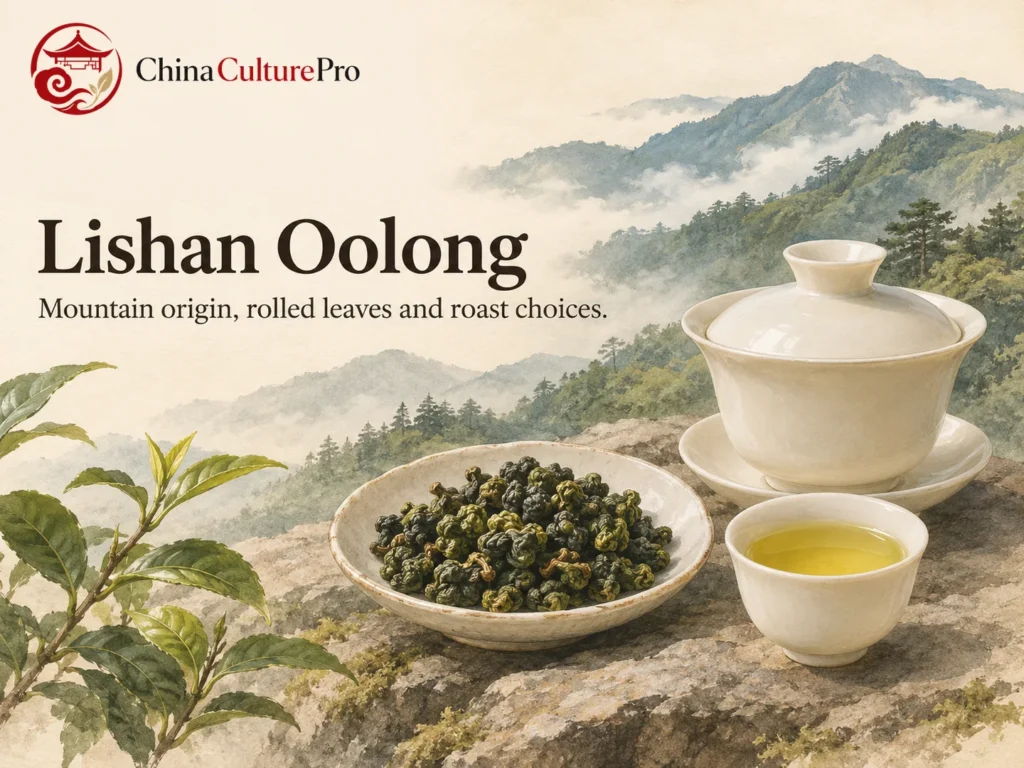

Quick Answer: What Is Lishan Oolong?
Lishan(梨山,Líshān)oolong is a high-mountain tea from Taiwan. Taiwan’s Tea and Beverage Research Station places the tea area in Taichung’s Heping District and describes a lightly oxidized, rounded style.[1]
- Asal: A regional name that should be supported by a particular lot’s growing information.
- Manufacture: Cultivar, oxidation, rolling and roasting are separate details.
- Cup: The actual harvest and preparation matter alongside the named place.
Lishan is not one cultivar or one farm’s product. The name also does not require every tea to have the same roast, flavor note or brewing schedule. Read the lot before treating the regional name as a complete specification.

A pale honey-green infusion and compact rolled leaves often introduce drinkers to Lishan oolong. The cup may seem delicate, yet its texture and finish can be quite distinct. Understanding it means looking beyond mountain imagery to the leaf material, manufacturing choices and records behind the tea you are drinking.
Lishan’s Region and Modern Tea Development
The research station places Lishan and Baxianshan within Heping District and describes differences between their teas.[1] Ask for the specific growing location when a broad regional name appears on a packet.
Fushoushan(福壽山,Fúshòushān)Farm is an important part of the local tea story. Its own history records tea development in 1980 on land below Tianchi, with oolong, Tieguanyin and Wuyi planting material.[2] That is a documented stage in one institution’s development, rather than a date that settles every earlier instance of tea growing around Lishan.
The farm and the wider named tea area should remain separate. A packet described as Lishan tea is not automatically a product made by Fushoushan Farm. Equally, a nearby garden needs its own identity and records rather than borrowing another producer’s history.
For the larger category, see Taiwan high-mountain tea. A regional comparison becomes useful once the locations behind the names are clear.
Qingxin Leaves and the Rolled Oolong Process
Qingxin Oolong(青心烏龍,Qīngxīn Wūlóng)is the principal cultivar named in the research station’s Lishan-area account.[1] Cultivar identifies the plant material; it does not tell you every decision the maker subsequently took.
A 2026 field interview published by a PeoPo citizen journalist provides one local grower’s processing sequence. The grower describes outdoor and indoor withering, followed by langjing(浪菁,làngjīng), fixation(殺青,shāqīng), rolling and repeated shaping until the tea is dried.[3] This account supplies a concrete example, not a timetable for all farms.
Group the operations by their place in the sequence:
- Withering and leaf handling: The earlier stages precede the heat treatment in the grower’s account.
- Fixation: A distinct heated stage before the subsequent rolling work.
- Rolling and repeated shaping: In this grower’s sequence, repeated compression and loosening develop the rounded form before manufacture is complete.[3]
This is why green-looking rolled oolong should not be identified solely by its color. The leaf has a processing history. A picture of the finished pellets cannot supply the oxidation or roast history of the lot, so those details are worth asking about separately.
Fresh Fragrance and Roasted Versions
The research station describes Lishan’s characteristic cup as honey-green with yellow tones, clear fragrance and a fresh, mellow taste.[1] Use that as a regional reference rather than a promise that all harvests will smell or feel identical.
Roasting introduces another distinction. In a 2026 notice, Fushoushan Farm explains that its refined oolong receives additional sorting and roasting after the initial tea has been made, developing a light roasted aroma.[4] This is a documented example of a later treatment, so “Lishan” cannot by itself mean “always unroasted.”
When comparing two teas, establish their roast histories first. Otherwise, a difference attributed to mountain location may partly reflect what happened after initial manufacture. A lightly finished cup and a later roasted version can each be evaluated on their own terms.
The research station’s sensory guide separates dry-leaf appearance, liquor color, aroma, taste and infused leaves.[5] That offers a useful way to record a cup: smell, taste and texture need not tell the same story. A floral or pear-like impression alone does not establish where the tea grew or what was added; check the ingredient and origin information separately.
What a Lishan Origin Mark Can Establish
Heping District maintains documents for its Lishan origin certification mark(產地證明標章,chǎndì zhèngmíng biāozhāng). The office explains that the scheme identifies qualifying tea produced in the district. Its assessment form covers several areas together.[6]
| Assessment field | What the form checks | Reader’s takeaway |
|---|---|---|
| Tea quality | Passing the quality assessment | Certification involves an assessment, not just a name |
| Residue testing | A compliant laboratory report | Compliance is not a zero-residue claim |
| Garden management | Normal management of the declared garden | The growing operation forms part of the review |
| Production records | Detailed records of production work | Traceability requires recorded information |
| Processing hygiene | Equipment and production surroundings | The processing site also matters |
These are conditions of that scheme, not a description of every tea sold under a broad market name. The issuing office’s criteria should be distinguished from a shop’s tasting adjectives.
The research station also explains how consumers can check origin-mark serial numbers and associated anti-counterfeit information through Taiwan’s quality-tea information system.[7] Where such a mark is claimed, check the actual issuer and serial rather than relying on a mountain photograph. No certification or claimed seal should be inferred from aroma alone.
Brewing and Comparing Harvest Lots
Start with the instructions for the actual product and vessel. Record the leaf amount, water and infusion conditions so that changes in the next cup are deliberate. The rolled leaf needs room in the brewing vessel; pouring off the liquor lets you control how long it remains with the leaves.
For comparisons, keep the preparation consistent. The research station’s formal sensory method uses controlled preparation to compare samples.[5] That is a judging context, not a mandatory everyday recipe. A casual session can still benefit from recording its conditions without copying an evaluation schedule.
Our gaiwan versus teapot guide can help you choose a vessel. When comparing another named mountain tea, such as Dayuling oolong, record the producer, harvest and roast as well. Describe the actual cups before ranking the place names.
FAQs About Lishan Oolong
Is Lishan a tea cultivar?
No. Lishan names a place or regional origin. Check the cultivar as a separate product detail.
Is every Lishan tea from Fushoushan Farm?
No. The named farm and the wider tea area are different. Check the actual producer.
Is Lishan oolong always unroasted?
No. Later roasted versions exist. The lot’s roast history matters alongside its origin.
Can aroma alone prove Lishan origin?
No. Aroma is a sensory observation. Check the growing information and any claimed origin-mark records.
Sumber
[1] Tea and Beverage Research Station. Characteristics of Central and Southern Taiwan Tea Areas
[2] Fushoushan Farm. Farm History
[3] Fengying, PeoPo Citizen Journalism. Tea Fragrance in the Mountain Mist: A Lishan Grower Interview
[4] Fushoushan Farm. 2026 Tea Notice: Additional Processing of Refined Oolong
[5] Tea and Beverage Research Station. Introduction to Tea Sensory Evaluation
[6] Heping District Office. Lishan Origin-Mark Certification Documents and Assessment Form
[7] Tea and Beverage Research Station. Tea Origin Certification Marks