


Quick Answer: What Is the Lifan Yuan?
The Lifan Yuan (理藩院, Lǐfānyuàn) was a Qing court institution for governing relations with Inner Asian rulers, communities and religious authorities. It grew from an office concerned with Mongol affairs. By later reigns, its records touched on Mongol banners, Tibet, parts of the northwest and dealings connected with the Russian frontier.[1][2]
- Court business: Handle ranks, succession, petitions and formal visits.
- Territorial affairs: Keep records relating to banners and other jurisdictions.
- Jurisdiction: Work alongside ministries and regional authorities whose responsibilities also mattered.
The English name varies by historian. The range of surviving files gives a more reliable guide than one translation.
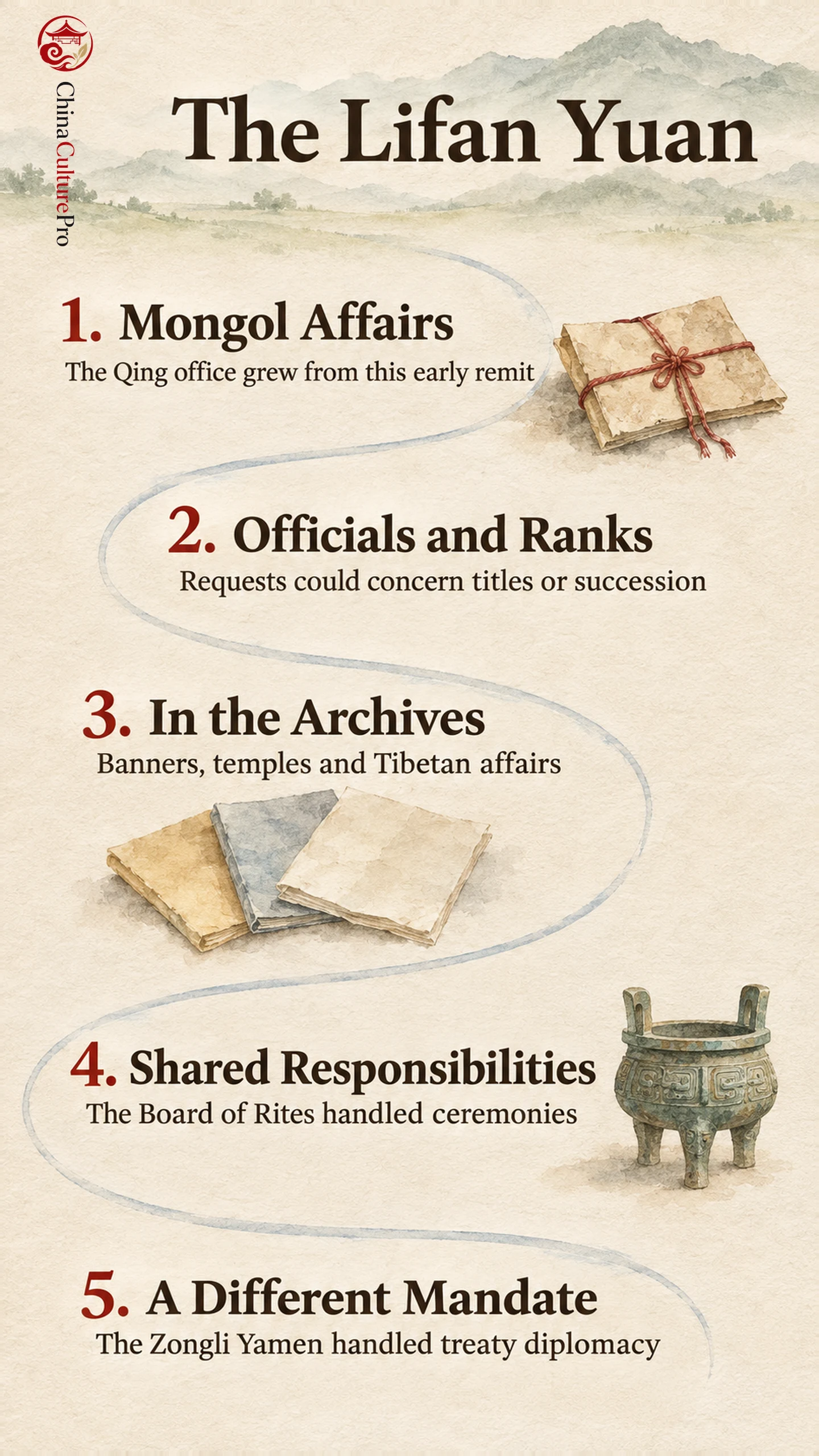
A banner succession, a religious appointment and a visiting delegation could all reach the court through the same office. Reading the files by type helps you see how the Qing governed relationships that crossed several kinds of jurisdiction.
From Mongol Affairs to a Wider Remit
The institution had roots in the early Manchu court’s dealings with Mongol leaders. As the Qing dynasty expanded, its work changed. One branch of correspondence might concern recognized ranks or visits, while other paperwork concerned territorial administration and disputes.[1][2]
The Manchu names and their translations also changed over time. When you compare two archival titles, first check their date and language. Several translations can refer to related stages of the same institution. A name in a translation may hide an important difference in how the Qing document describes a particular office.[1]
What Its Records Show
An archival opening announced in 2025 names categories including Mongol banners, Tibetan affairs, lama administration, temples and tusi. Much of the opened collection comes from the late Qing, though the papers span a longer period. These series show the work of administration: decisions on people, offices, local relationships and institutions.[3]
Earlier rules and files also cover such matters as assembly, tribute and ranks. Other Qing agencies kept their own records on related business. A court audience, for example, could produce paperwork on both the visiting party and the ceremony, handled by different bodies.[2][4]
Where Its Responsibilities Overlapped
The Board of Rites retained important ceremonial responsibilities involving Mongol and Tibetan elites. Meanwhile the Lifan Yuan had its own staff and channels to the emperor. Case by case, the particular request determined which government bodies took part.[2]
The remit could include business with Russia. That work helps explain why historians sometimes use diplomatic language to describe it. For a comparison, the Zongli Yamen was founded in 1861 in a treaty system with resident foreign diplomats. The two offices arose from different relationships.
FAQs About the Lifan Yuan
What Does Lifan Yuan Mean in English?
Translations include Court of Colonial Affairs and Court for the Administration of Outer Regions. They reflect different ways of interpreting the historical office. The term Lifan Yuan keeps the institution identifiable.
Did the Lifan Yuan Handle Tibetan Affairs?
Tibetan and religious matters appear in its records. The court also used other boards and regional authorities, so the answer depends on the matter and period.
Sumber
[1] Saksaha. Monggo Yamun and Tulergi Golo be Dasara Jurgan
[2] Palace Museum. Research on the Lifan Yuan and Qing Court Administration
[3] China Central Television. First Historical Archives opens the Lifan Ministry collection
[4] Renmin University Institute of Qing History. Publication and Study of Lifan Yuan Regulations