


Quick Answer: How Do Huzhou’s Mulberry–Fish Ponds Work?
Huzhou’s mulberry-dike and fish-pond system (桑基鱼塘, sāngjī yútáng) links mulberry trees, silkworms and fish in lowland Zhejiang. The pond banks carry mulberry trees whose leaves feed silkworms. Some material from silkworm rearing enters fish production. Mud from ponds goes back to the banks. FAO recognized the system as agricultural heritage in 2017. [1][2]
- Dikes: Raised banks provide space for trees and separate water from planting ground. [1]
- Silkworms: Mulberry leaves feed the worms, which supply cocoons for silk. [1][2]
- Ponds: Fish production uses the adjacent water, and sediment can be returned to the banks. [1]
The landscape brings several kinds of work close together, and their materials can move between them.
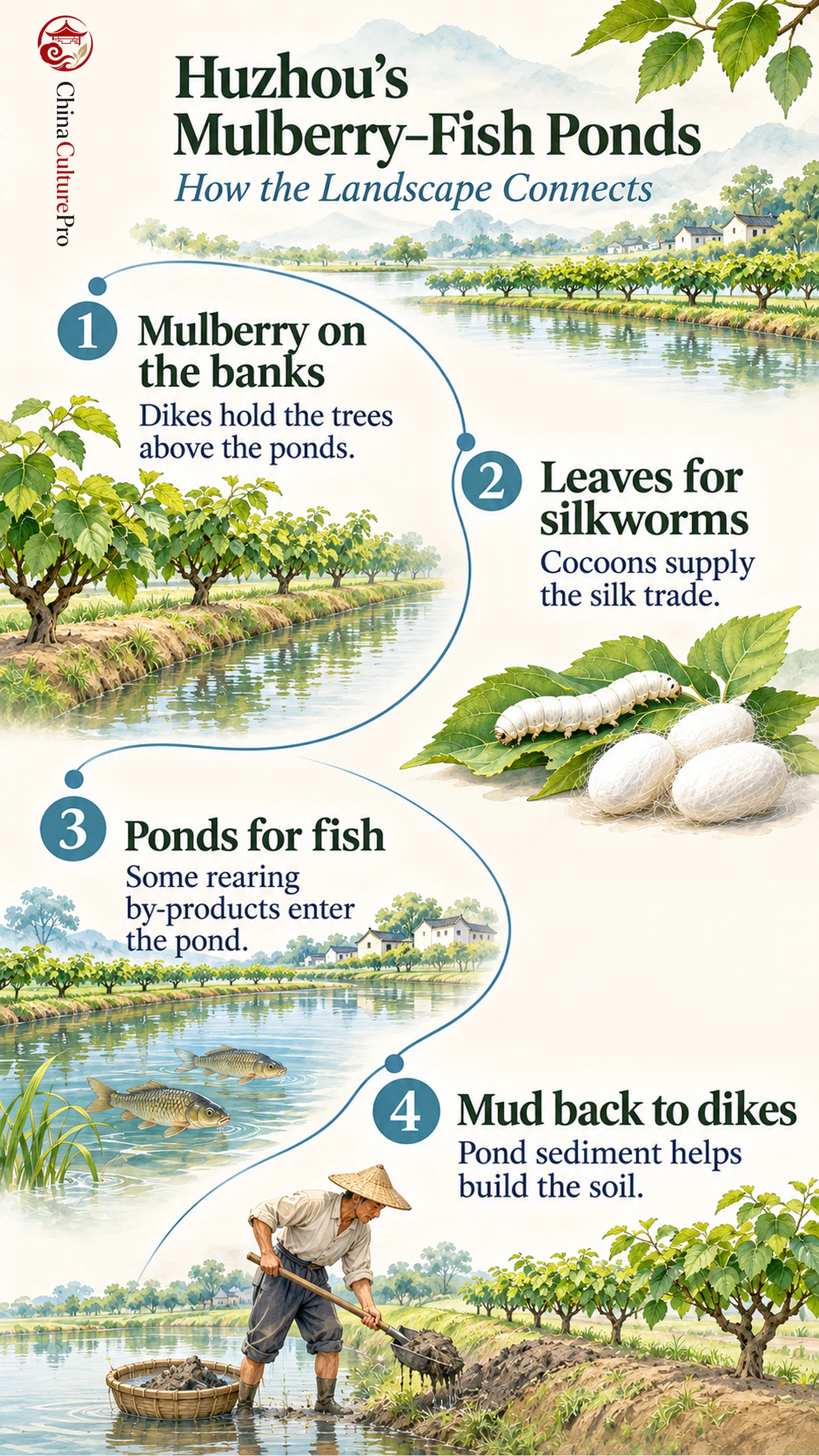
Start by looking at the edge of a pond. The bank is where a farmer can walk and grow trees. The water below it is where another part of the household’s production takes place.
What Each Part of the Huzhou System Does
| Bagian | Local role | Where the material goes |
|---|---|---|
| Mulberry trees | Grow along raised pond banks. [1] | Leaves are taken to feed silkworms. [1] |
| Silkworm rearing | Turns a leaf harvest into cocoons and produces organic by-products. [1][2] | Cocoons go into silk production. Material including silkworm droppings can be used in fish raising. [1] |
| Fish ponds | Aquaculture in excavated water areas. [1] | Farmers harvest fish and can move nutrient-rich sediment out of the ponds. [1] |
| Water and banks | Dikes, canals, irrigation and drainage structure the lowland. [1] | Mud from water bodies can be placed back on banks to support the trees. [1] |
Why Farmers Need Both a Dike and a Pond
The agricultural heritage is a landscape of water and raised land. The water network allows people to manage the low-lying plots. Digging ponds and building raised banks create spaces for different organisms and kinds of work within a compact area. Its design makes sense in the longer story of Chinese agricultural history. [1][2]
FAO describes moving mud in winter. At this stage, mud and organic matter can improve dike soil. Bringing material back to the growing area also makes the relationship visible at a different time of year from leaf harvest or fish harvest. The recurring exchanges can reuse local materials, but the system also relies on work, managed water and a broader farm economy. [1][2]
The ponds also have internal variety. FAO describes raising several kinds of fish that occupy different layers of water. The contrast is visible at two scales: the bank and pond divide the landscape, while the different zones within a pond affect what the fish use. [1]
How Huzhou Differs From a Rice–Fish Paddy
In Qingtian’s rice–fish system, rice and fish share a flooded field. In Huzhou, trees grow on the bank and fish live in the pond. Their proximity supports transfers of leaves, organic material and soil rather than a shared rice-growing space. [1][3]
Silkworm rearing is one part of the web of production. The steps after the cocoon belong to the wider history of Chinese silk, with distinct skills and markets. The heritage site shows how the cocoon’s farm setting fitted into a living landscape. [1][2]
FAQs About Huzhou’s Mulberry–Fish Ponds
Do the fish and mulberry trees grow in the same water?
The fish occupy ponds. The trees grow on raised dikes alongside them. It is a linked system with distinct habitats. [1]
What is returned to the mulberry banks?
FAO describes moving nutrient-rich mud from ponds and other waterways to the banks, where it helps improve soil for mulberry growing. [1]
When was the Huzhou system recognized as agricultural heritage?
FAO listed the Huzhou system as a Globally Important Agricultural Heritage System in 2017. [1]
Sumber
[1] Food and Agriculture Organization. Zhejiang Huzhou Mulberry-Dyke and Fish-Pond System
[2] Food and Agriculture Organization. Fifth International Agricultural Heritage Forum Report
[3] Food and Agriculture Organization. Rice Fish Culture China