


Quick Answer: What Do the Four Annual Markers Use?
Tai Sui (太歲, tàisuì), Sui Po (歲破, suìpò) and San Sha (三煞, sānshà) use the year’s Earthly Branch. Five Yellow (五黃, wǔhuáng) is the number 5 in the annual Flying Star chart.[1][2][3][5]
- Tai Sui and Sui Po: These use two opposite compass mountains.[2][3]
- San Sha: This uses a direction group associated with the year branch. It covers a wider sector under common readings.[1][2][3][4]
- Five Yellow: Find the palace containing 5 in the annual chart. It can be the center as well as a compass sector.[2][5]
This comparison uses the solar-year convention beginning at the Start of Spring. The four terms are labels within traditional practice.[2][3][5]
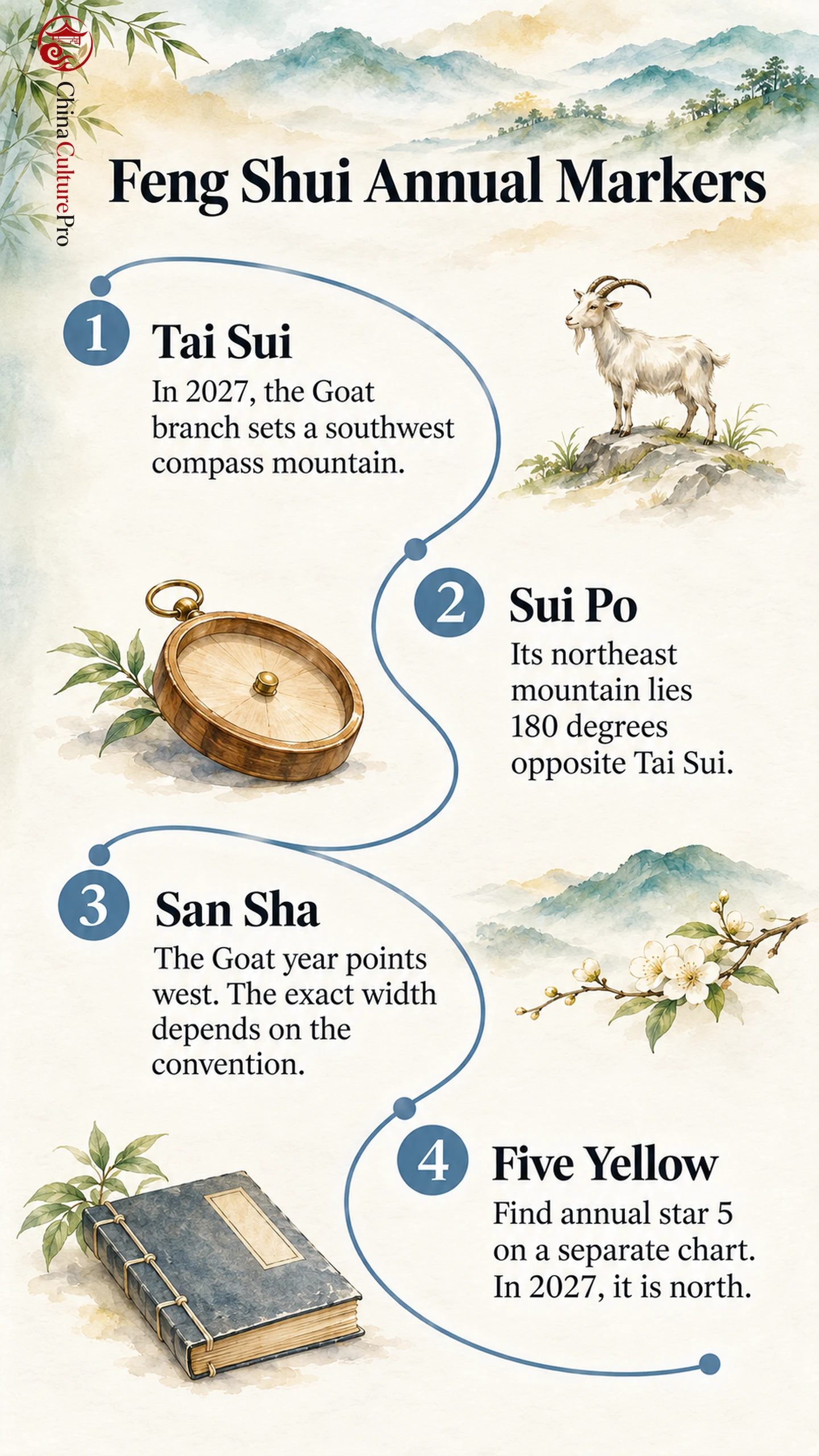
A feng shui annual chart can mark both the west and the north in the same year, but the two labels may come from different calculations. The starting point is to ask whether the maker used a year branch or the annual sequence of Flying Stars.[1][2][5]
Four Markers Compared
Use the middle column to identify which calculation each row uses. The year-branch pattern repeats on a twelve-year cycle, and the annual Flying Star positions repeat on a nine-year cycle. Both are shown as annual readings here.[1][2][5]
| Marker | What sets the position | Direction in the 2027 Goat solar year |
|---|---|---|
| Tai Sui | The year branch’s own compass mountain | Wèi 未, 202.5° to 217.5° |
| Sui Po | The compass mountain 180° opposite Tai Sui | Chǒu 丑, 22.5° to 37.5° |
| San Sha | The direction assigned to the year branch’s three-branch group | West; 247.5° to 292.5° in the narrower reading |
| Five Yellow | The palace containing star 5 in the annual grid | North palace |
Read the Three Year-Branch Markers
The Goat year branch is Wèi (未, Wèi). Its 15° sector is centered at 210°. The opposite center is 30°, the Chǒu (丑, Chǒu) sector. Traditional stories and observances around Tai Sui dan Fan Tai Sui are another use of the year branch. A compass label refers to a place on the plan.[2][3]
For San Sha, traditional tables group Goat with Pig and Rabbit and assign the three sha to the west side. Published diagrams can use the 45° west core or a 75° span from 232.5° to 307.5° that includes the outer branch sectors. On a plan, 240° lies within the wider span and outside the narrower one. Note which convention produced the label.[1][2][3][4]
Read Five Yellow on Its Own Chart
In the 2027 annual grid, 5 sits in north, 2 in west and 9 at the center. A west room can therefore fall within a San Sha reading and carry annual star 2 in the same year. The two labels come from separate calculations, and neither turns 2 into Five Yellow. See the Flying Star Feng Shui guide for the annual grid and building-specific chart layers.[2][3][5]
For this example, use the Awal Musim Semi in February 2027 as the changeover. A monthly Five Yellow position is a separate entry and can differ from the annual one.[2][5]
FAQs About Feng Shui Annual Markers
Is the Year Breaker the same as Five Yellow?
No. The Year Breaker is Sui Po, located opposite the year branch’s Tai Sui direction. Five Yellow is read from the position of 5 in a Flying Star chart.[2][3][5]
Can two markers appear in the same direction?
Yes. In 2029, for example, published annual tables place San Sha and annual Five Yellow in the east. The direction coincides while the rules remain distinct.[2]
Sumber
[1] Wikisource, Complete Library of the Four Treasuries. Qinding Xieji Bianfang Shu, volume 34
[2] Feng Shui Toolkit. Tai Sui, Three Killings and Five Yellow Directions by Year
[3] Daniel Hanna. 2027 Feng Shui Annual Afflictions
[4] Lucky Properties. 2027 Sector Table, Narrow and Wide San Sha
[5] Yap Tian Xuan. Flying Star 2027: Annual Nine-Palace Chart