


Quick Answer: What Are Chinese Tongue Twisters?
Chinese tongue twisters (绕口令, ràokǒulìng) are short lines or verses that become tricky to say when similar sounds repeat close together. Mandarin versions can target a pair of initial consonants, make a repeated rhyme harder to keep clear, or do both.[1][2][5]
- Sound contrast: The well-known number verse flips between the initials of “four” and “ten.”[1]
- Rhythm: Repeated words and rhymes help you remember a line and hear where it tends to tangle.[1][5]
- Performance: Stage performers also use longer drills to work on clear delivery.[4]
Read a short version slowly before trying a faster one. Keep the initials, syllable endings and tones audible as you build speed.
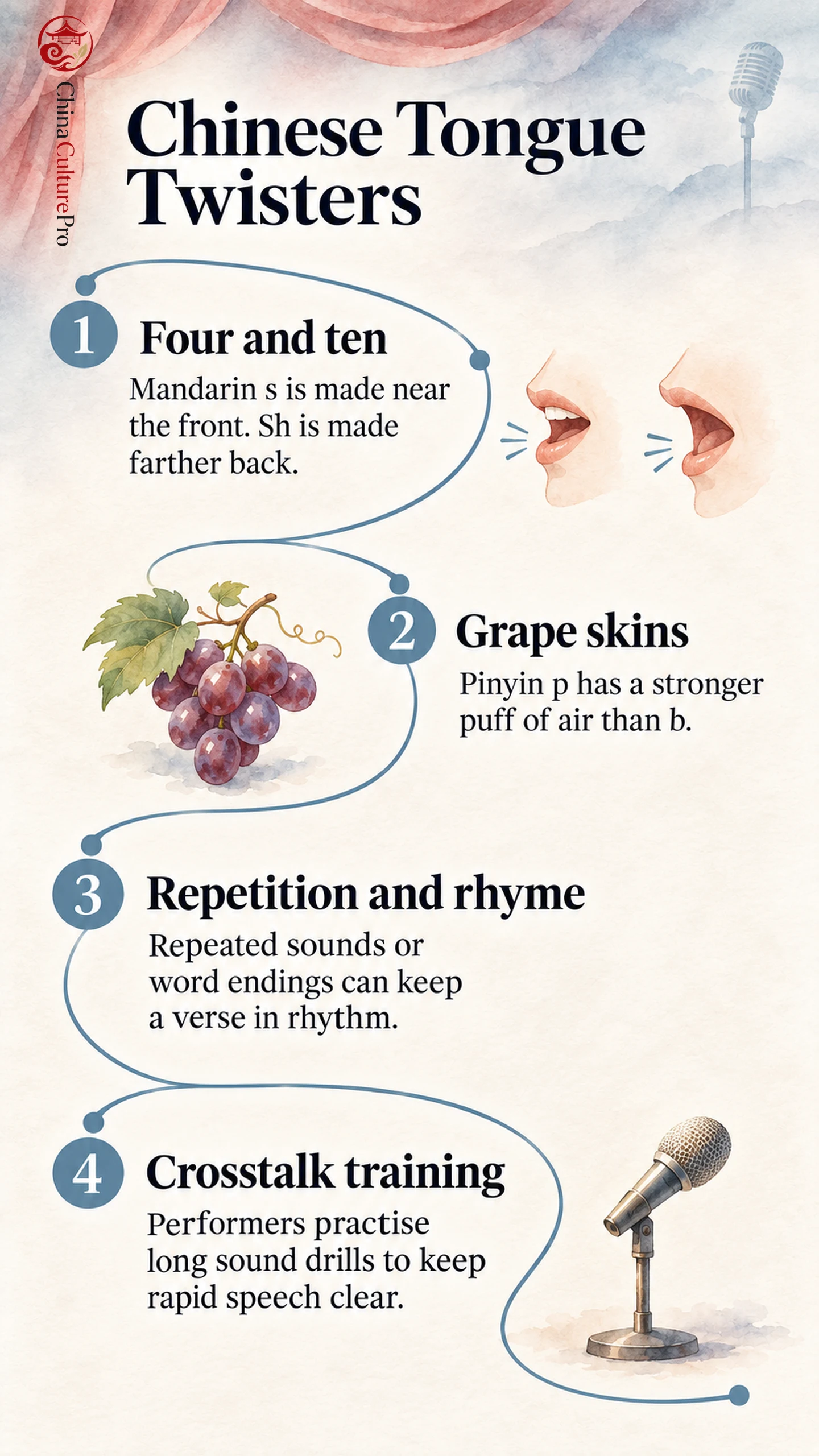
Try saying “four is four, ten is ten” in Mandarin. The words are simple, but the first sound keeps shifting as you move between them. That small change is enough to turn a counting sentence into a speaking game.
Four and Ten: The Difference Between S and Sh
Original: 四是四,十是十。四十是四十,十四是十四。
Pinyin: Sì shì sì, shí shì shí. Sìshí shì sìshí, shísì shì shísì.
Meaning: Four is four and ten is ten. Forty is forty and fourteen is fourteen. This is a short arrangement of the traditional line. It pairs 四 (sì, “four”) with 十 (shí, “ten”), while 是 (shì, “is”) uses the same sh initial with a fourth tone.[1]
For s, the tongue makes the friction near the front of the mouth. For sh, move the tongue tip farther back. Try 四十 (sìshí) and 十四 (shísì) as separate pairs before putting them into the sentence. The position of each sound changes which number the listener hears.[1][3]
Grape Skins: The Difference Between B and P
Original: 吃葡萄不吐葡萄皮儿,不吃葡萄倒吐葡萄皮儿。
Pinyin: Chī pútao bù tǔ pútao pír, bù chī pútao dào tǔ pútao pír.
Meaning: When you eat grapes, you don’t spit out the skins. When you don’t eat grapes, you spit out the skins instead. The comic reversal keeps the words nearly the same while the two halves change their order.[2]
Listen for the first sound in 不 (bù) and in 葡 (pú) or 皮 (pí). Mandarin p starts with a stronger puff of air than Mandarin b. The line above also uses 儿 at the end of 皮儿 (pír), a form with an r-coloured ending. You can hear or read shorter variants without that ending.[2][3][4]
The number and grapes lines get much of their effect from repetition. Other verses use a more obvious end rhyme. For example, a verse about climbing a mountain on the third day of the third month repeats endings such as 山 (shān, “mountain”) and 衫 (shān, “shirt”), keeping the beat while the surrounding words change.[1]
When reading aloud with a partner, take turns saying one half of a line. Ask your partner to say which number or word they heard before you switch roles. The listener’s answer tells you whether the contrast survived the faster pace.
How Tongue Twisters Help Crosstalk Performers
In Chinese crosstalk (相声, xiàngsheng), a fast delivery still needs clear consonants and audible timing. A report on the Central Academy of Drama’s crosstalk programme describes students practising an extended set of tongue twisters arranged around initials and finals. The drill helps a performer sustain precision across longer runs of speech.[4]
An exercise creates difficulty on purpose. In a performance, the audience needs to follow the words while hearing the rhythm and changes in delivery. The format around that delivery is part of what distinguishes Chinese crosstalk and xiaopin.[4]
FAQs About Chinese Tongue Twisters
What is a good first Mandarin tongue twister?
Start with 四是四,十是十 (sì shì sì, shí shì shí). It is short enough to repeat slowly while you listen for the change from s to sh.[1]
Do Chinese tongue twisters always rhyme?
No. Some verses lean on rhyme, but a line can be difficult simply because it repeats nearly identical syllables or alternates two similar initial sounds.[1][2]
Sumber
[1] Tsinghua University Press. Mandarin Pronunciation Training Textbook
[2] Shaanxi Normal University. Selected Mandarin Tongue Twisters
[3] University of Georgia repository. Mandarin Phonetic Inventory and Pinyin Consonants
[4] Central Academy of Drama. Learning Crosstalk at the Central Academy of Drama
[5] Chinese Language Institute. Chinese Tongue Twisters