


Quick Answer: What Shapes Chinese Culture in the Netherlands?
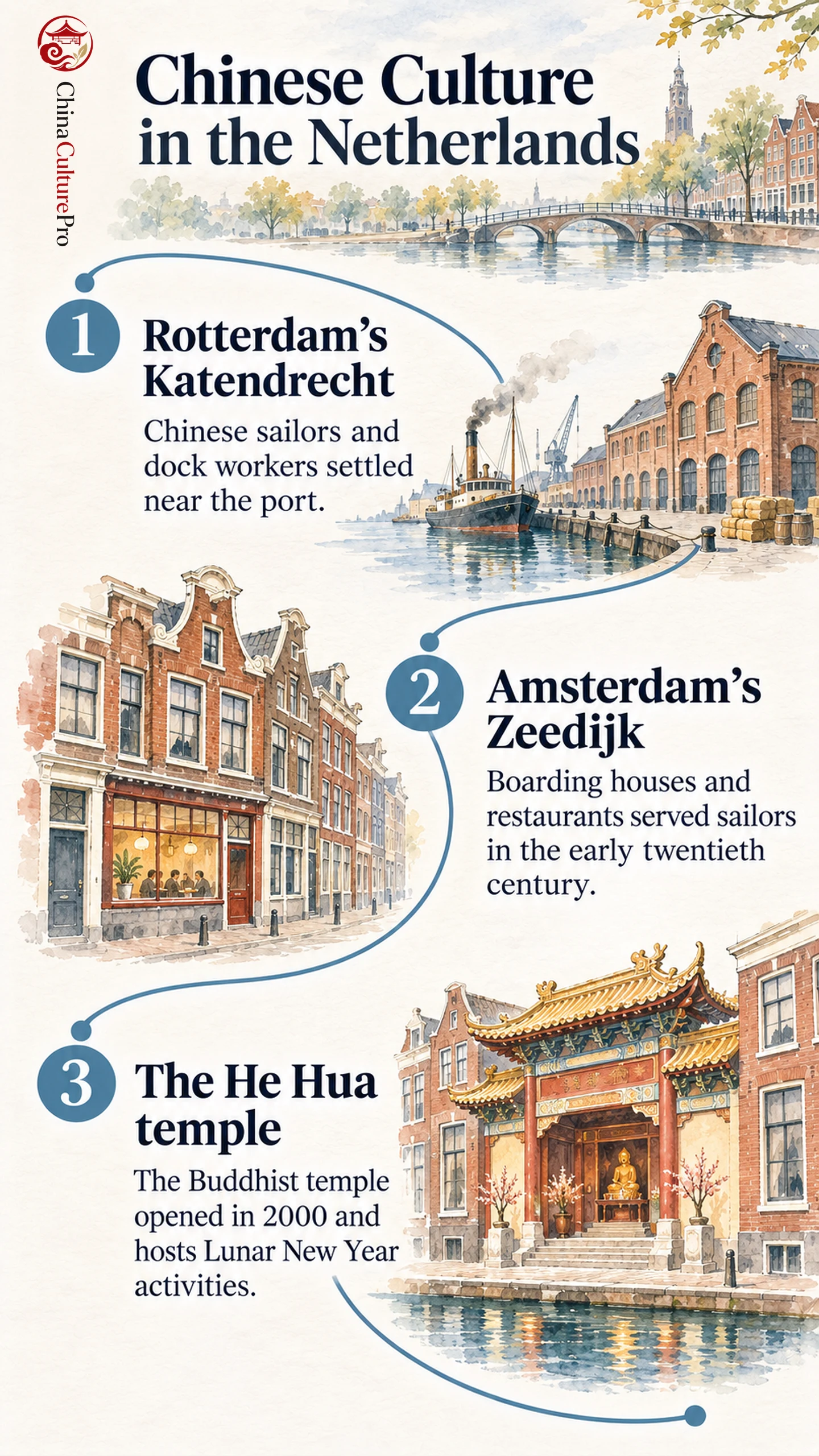
Early Chinese communities in the Netherlands grew around port work. In Rotterdam, sailors and dock workers settled in Katendrecht. In Amsterdam, lodging houses and restaurants developed around the Zeedijk. Later migration and community institutions changed what those districts were known for. [1][2]
- Rotterdam. Katendrecht had a substantial Chinese neighborhood by the 1920s. [1]
- Amsterdam. Chinese restaurants opened near the Zeedijk in the 1910s. [2]
- Later community life. Migration from Indonesia, Chinese-Indonesian restaurants and the He Hua Buddhist temple added other forms of cultural life. [2][3]
The two cities share a maritime starting point and preserve different parts of the history.
A photograph of a restaurant kitchen in Katendrecht and a Buddhist temple on Amsterdam’s Zeedijk mark different generations of settlement. Port employment helps explain how the early neighborhoods formed.
Katendrecht and Rotterdam’s Port Workers
Chinese seafarers and dock workers settled in Katendrecht in the early twentieth century. The district was surrounded by port activity and had developed a sizable Chinatown by the 1920s. A 1936 photograph of a Chinese restaurant kitchen shows how businesses gave the area a life beyond the docks. [1]
The connection between ships and settlement also shaped Hamburg’s Chinese community. The two ports developed their own lodging houses and businesses in response to the lives of seafarers.
Amsterdam’s Zeedijk: Lodging, Food and Worship
Shipping companies brought in Chinese sailors and stokers. Some ended up in boarding houses near the Zeedijk after their contracts expired. Restaurants opened nearby on Binnen Bantammerstraat in the 1910s. These services gave workers somewhere to stay and eat between jobs. [2]
After the Second World War, migration from Indonesia and the popularity of Chinese-Indonesian restaurants expanded the neighborhood’s restaurant culture. The He Hua Buddhist temple opened on the Zeedijk in 2000 and became a center for Lunar New Year celebrations. The street connects successive periods of Chinatown culture. [2][3]
FAQs About Chinese Culture in the Netherlands
Where did Rotterdam’s historic Chinatown develop?
It developed in Katendrecht, a neighborhood in the port area where Chinese seafarers and dock workers settled in the early twentieth century. [1]
What is the He Hua temple?
It is a Chinese Buddhist temple on Amsterdam’s Zeedijk. It opened in 2000 and is associated with local Lunar New Year celebrations. [2][3]
Sumber
[1] Stadsarchief Rotterdam. Koloniaal Rotterdam: Stad in beweging
[2] Stadsarchief Amsterdam. 1927 Zeedijk
[3] Stadsarchief Amsterdam. Het nieuwe Maanjaar