


Quick Answer: What Is Baba Nyonya Dress in Malaysia?
Baba Nyonya dress includes several Peranakan clothing traditions. A Nyonya ensemble may pair a long baju panjang or a shorter embroidered kebaya with a sarong. Brooches can fasten the front, and beaded slippers can complete the outfit. Melaka and Penang both have documented examples. Kebaya is also a shared Southeast Asian heritage practice. [1][2][3][4]
- Start with the top: The baju panjang is a long blouse. The short Nyonya kebaya can have embroidery along the opening and hem. [1][2]
- Read the layers: A sarong wraps around the lower body. Brooches and beadwork are separate details. [1][2][3]
- Use the context: Date, place and occasion help identify an outfit more accurately than one motif alone. [1][3][5]
When comparing two photographs, identify each piece and look for the place and date.
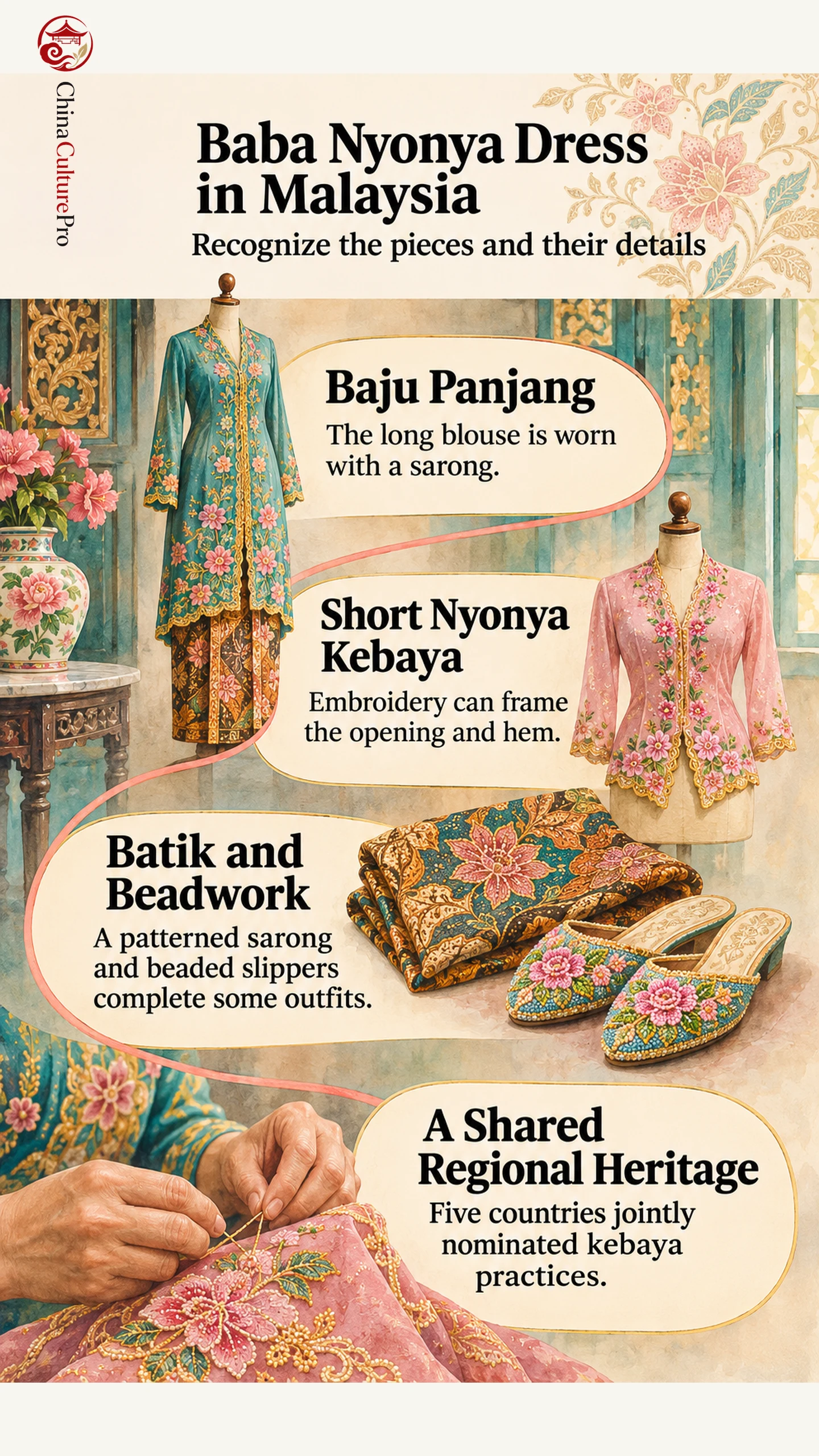
In a photograph of a Nyonya outfit, the blouse is only one part of what you see. A long front-opening garment, a patterned wrap and a pair of beaded slippers each give a different clue. Knowing their names helps you read what the wearer chose, and what the outfit can tell you about Peranakan dress in Malaysia. [1][2][3]
The Long Blouse: Baju Panjang
Malaysia’s Department of National Heritage describes the baju panjang, also called baju belah labuh in some accounts, as a long front-opening blouse. It records its use among Nyonya Peranakan and Chetti communities in Melaka, Penang and Singapore. The long cut is a first clue to its identity. The wearer can pair the long blouse with a sarong wrapped around the lower body. [1]
A dated museum photograph can tell you more than the garment name. A Singapore collection portrait, for example, records a long blouse fastened with three kerosang brooches and worn over a cotton sarong. It gives a regional comparison for Malaysian examples. The details describe the outfit in that portrait rather than a rule for every long blouse. [3]
The Short Nyonya Kebaya and Its Embroidery
Malaysia’s arts and culture inventory describes the short Nyonya kebaya worn with patterned batik. The neckline, front opening and hem are useful places to look for embroidery. The blouse can be distinguished from the long form by the length of its body and its proportions when worn over the sarong. Embroidery can follow the front opening and hem, giving those edges a decorative role. [1][2][4]
A flower or animal motif is a clue to decoration. To identify the wearer’s hometown, look for a place name or collection record alongside the motif. A dated label, a documented maker or a photograph with a known location offers stronger evidence. The guide to Peranakan culture gives the wider context for how dress, language and family traditions developed across the region. [2][3][5]
How Batik, Brooches and Beaded Slippers Fit Together
A sarong is the cloth wrapped around the lower body. Batik can describe how the textile’s pattern was made, while sarong describes how that cloth is worn. A brooch, or kerosang, fastens the opening. These names refer to different parts of the same outfit, even when a museum groups them as one ensemble. [1][3][4]
Beaded slippers are often called kasut manek. Singapore’s National Heritage Board records the craft in Penang and Melaka as well as Singapore. Look for beadwork on the upper of the shoe and embroidery on the blouse. A family might choose different items for a wedding than for another gathering. See Chinese diaspora wedding traditions for examples of garments in a specific ceremonial context. [2][5]
What the UNESCO Kebaya Listing Covers
UNESCO inscribed kebaya knowledge, skills, traditions and practices in 2024. Brunei Darussalam, Indonesia, Malaysia, Singapore and Thailand jointly nominated the element. The listing recognizes a shared regional practice that includes making and wearing front-opening garments of different lengths. The wider listing includes Malaysian Nyonya forms among several local ways of making and wearing kebaya. [1][4]
If you are reading a display label, identify the named garment first. Then look at the place, date, materials and occasion. Those details tell you which clothing tradition is represented and how the outfit was put together. The Chinese diaspora culture guide connects such clothing choices to other forms of local adaptation. [1][3][4][5]
FAQs About Baba Nyonya Dress in Malaysia
What is the difference between a baju panjang and a short Nyonya kebaya?
The baju panjang is a long front-opening blouse. The short Nyonya kebaya has a shorter body and may have decorative embroidery around its opening and hem. Both can be worn with a sarong. [1][2][4]
What are Nyonya beaded slippers called?
They are commonly called kasut manek. Heritage records describe the craft in Melaka, Penang and Singapore. [2][5]
Did UNESCO list only the Malaysian Nyonya kebaya?
The 2024 listing covers shared knowledge and practices connected with kebaya. Five Southeast Asian countries submitted the nomination together. [4]
Sumber
[1] Malaysia Department of National Heritage. Malaysian Kebaya
[2] Malaysia Department for Culture and Arts. Baba Nyonya Cultural Attire
[3] National Museum of Singapore. Portrait of a Peranakan Woman
[4] UNESCO Intergovernmental Committee. Decision 19.COM 7.B.26: Kebaya
[5] Singapore National Heritage Board. Nyonya Beadwork and Embroidery