


Quick Answer: Where Is Chinese Culture Visible in India?
Kolkata offers a detailed view of Chinese culture in India. Migrants and their descendants built community institutions, businesses, and places of worship in Tiretta Bazaar and Tangra. Local history includes Cantonese, Hakka, and other Chinese backgrounds, as well as exchanges with the wider city.[1][2][3]
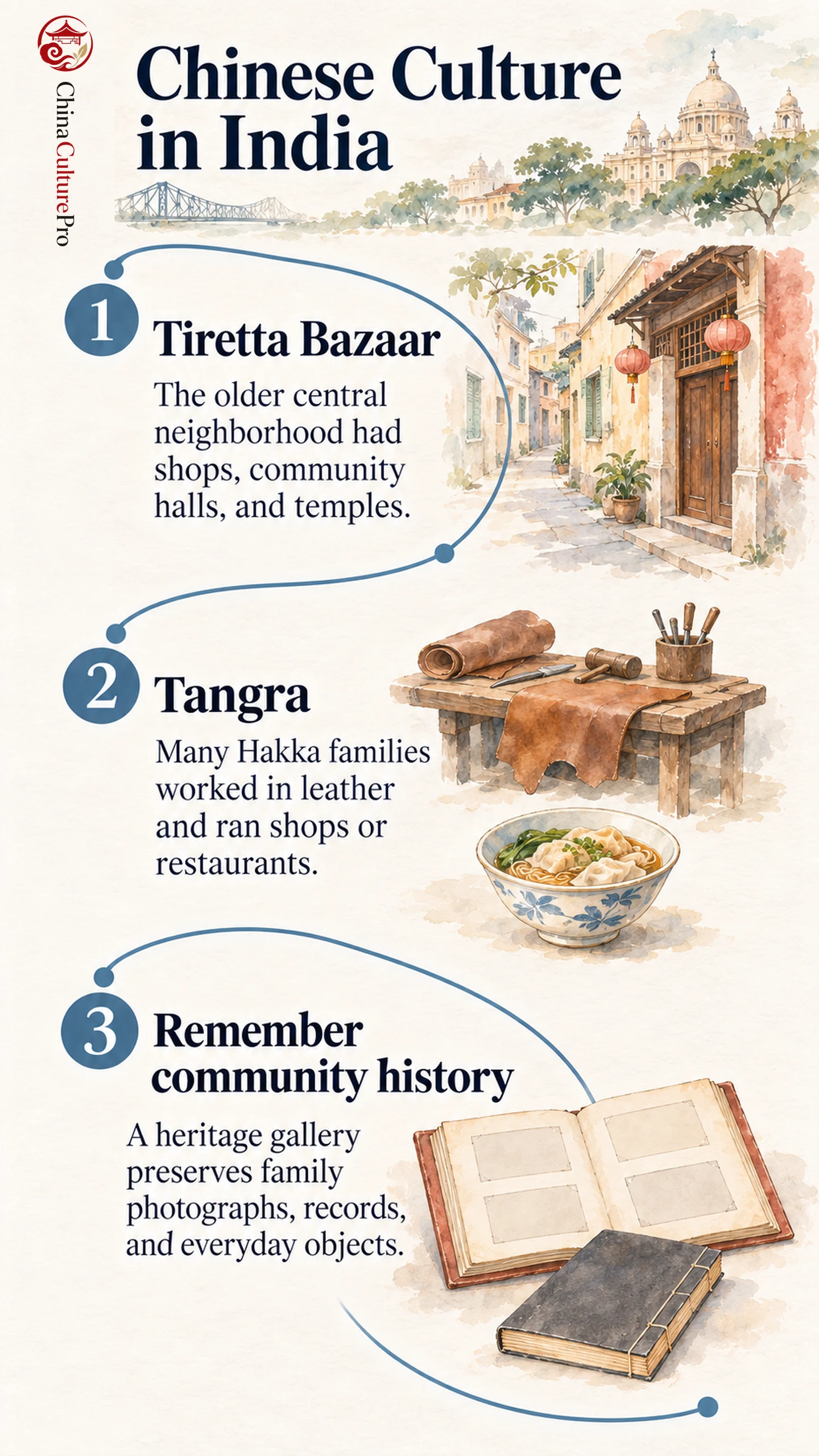
- Tiretta Bazaar. The older neighborhood is associated with merchants, workshops, and community halls.[1][3]
- Tangra. Many Hakka families worked in the leather trade and later operated restaurants.[1][2]
- Public memory. A heritage gallery preserves photographs, registers, and objects donated by community members.[3][4]
These neighborhoods tell distinct parts of the Chinese Indian story.[1][2]
A club register in Tiretta Bazaar records one kind of community life. A restaurant in Tangra shows another. The two neighborhoods help explain how people organized around work, family, and places to gather.[1][3]
Tiretta Bazaar and Its Community Institutions
Tiretta Bazaar, also called Cheenapara, developed as a center of Chinese settlement in nineteenth-century Kolkata. The neighborhood’s work included shoemaking, carpentry, and trade. Its religious buildings and clubs provided places for people to meet beyond their workplaces.[1][3]
A huiguan (會館, huìguǎn) is a community association or the hall it uses. Huining Huiguan, founded by migrants from Sihui, housed an association and temple. Its history offers a local example of Chinese diaspora associations built around shared origins.[3]
Tangra, Leatherwork and Food
Tangra grew as a separate center of Chinese settlement on the east side of the city. Research and local reporting associate Hakka families there with tanneries, shoemaking, shops, and restaurants. Tangra’s restaurant history grew alongside these other forms of work.[1][2]
The Impact of 1962 and Later Heritage Work
During the 1962 Sino-Indian war, Indian authorities detained people of Chinese descent, including long-established residents, and sent some to an internment camp at Deoli in Rajasthan. The Open University records the lasting effects of internment on affected families.[2]
The Cheenapara Heritage Gallery opened in Tiretta Bazaar in 2026. Photographs, association registers, and donated objects document occupations and festivals from within the community. These collections help tell the local history of Chinatown culture.[3][4]
FAQs About Chinese Culture in India
Are Tiretta Bazaar and Tangra the same neighborhood?
Tiretta Bazaar is the older central district. Tangra lies farther east and developed a community closely associated with Hakka families and the leather trade.[1][2]
Does Indo-Chinese food represent every Chinese Indian household?
Restaurant food is one public expression of Chinese Indian culture. Family backgrounds and cooking traditions vary. Tiretta Bazaar’s breakfast stalls and Tangra’s restaurants illustrate different local settings.[1][2]
Sumber
[1] The Indian Express. The history of Kolkata’s Tiretta Bazaar
[2] The Open University. The 1962 war and internment of Chinese people in India
[3] Sravasti Datta, Mint. Kolkata’s Chinese community and the Cheenapara Heritage Gallery
[4] Chinese Consulate General in Kolkata. Opening of the Cheenapara Heritage Gallery