


Quick Answer: What Is Angel Island Chinese Poetry?
Angel Island Chinese poetry refers to verses that detainees wrote or carved on wooden walls at the U.S. Immigration Station in San Francisco Bay. The station operated on the island from 1910 to 1940. The poems record experiences of confinement, uncertainty, separation, and anger.[1][2]
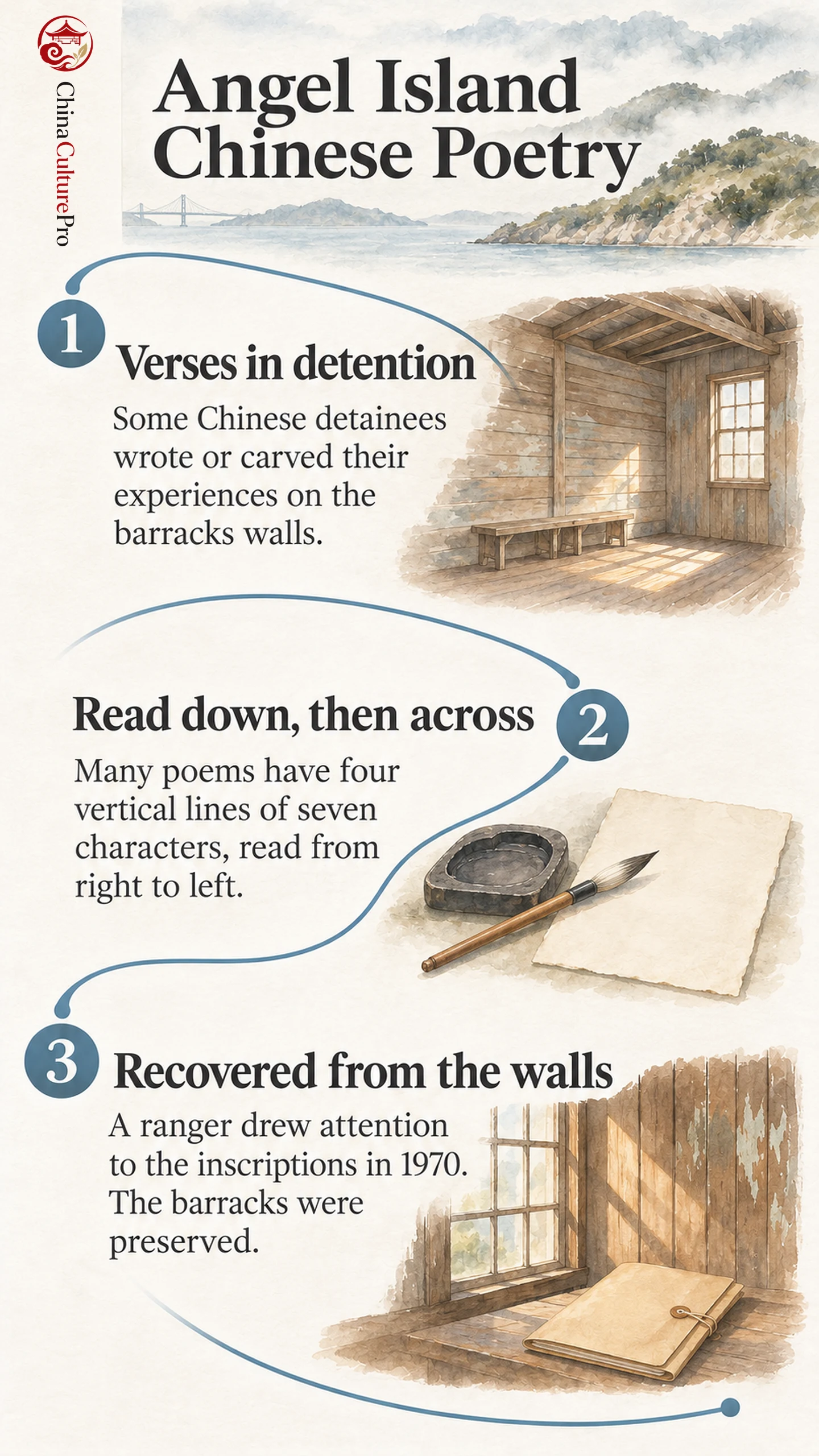
- Where. The best-known Chinese inscriptions survive in the detention barracks.[1][2]
- Form. Many use four lines of seven Chinese characters, following a classical verse pattern.[3]
- Survival. Paint concealed some inscriptions. A California State Parks ranger brought the carvings to wider attention in 1970.[1][4]
Surviving texts and modern translations record individual voices within a larger detention history.[1][3]
An inscription’s location can matter as much as its words. A wall can hold several poems, and the Poetry Finder identifies them by room and section.[3]
Why Detainees Wrote on the Walls
Officials used the station to process immigrants, including Chinese arrivals facing scrutiny under Chinese exclusion-era policies. California State Parks notes that cases could take time when the people needed to testify lived across the country.[1][2]
Poetry gave some detainees a way to describe waiting and confinement in their own terms. A poem could also speak to someone far away. One translation in the foundation’s gallery describes a traveler remembering a person’s kindness and looking to letters for news.[5]
How to Read an Angel Island Poem
Many inscriptions place characters in vertical columns, read top to bottom and then from right to left. Modern transcriptions often present the same characters horizontally. In one example cataloged as Island 78, the first character of each line spells out a demand for the island to be abolished. Reading across the four beginnings reveals something that a translation of each line alone might miss.[3][4]
Other poems leave clues to places and routes. Island 132 names Dow Moon (斗門, Dǒumén) in the Pearl River Delta and refers to journeys to and from Tahiti. The poem’s speaker also worries about debt and returning home. Voices 38 and 40 refer to Mexico and the cost of traveling there, another route in the wider history of Chinese migration to Mexico. [4] It offers one perspective on the journeys behind Chinese culture in Tahiti.[4]
How the Poems Survived
Officials painted over some inscriptions. In 1970, park ranger Alexander Weiss recognized the carvings while the building was at risk of demolition. Community advocates helped preserve the barracks, where the inscriptions now help visitors understand the station.[1][4]
The Angel Island Immigration Station Foundation’s Poetry Finder maps inscriptions by room and wall. It also provides readings in several regional varieties, an entry point into the languages carried through Cantonese diaspora networks.[3]
FAQs About Angel Island Chinese Poetry
Can you still see the original poems?
Yes. Surviving carvings can be seen in the detention barracks museum on Angel Island. The online Poetry Finder offers images or transcriptions and points to the locations of inscriptions.[1][3]
Were all the poems spoken in Cantonese?
The surviving poems are written in Chinese. Modern audio recordings include Cantonese, Toisanese, and other regional readings. A particular recording does not always establish how an anonymous author would have pronounced the verse.[3]
Sumber
[1] U.S. National Park Service. U.S. Immigration Station, Angel Island
[2] California State Parks. Immigration Station
[3] Angel Island Immigration Station Foundation. Poetry Finder
[4] Angel Island Immigration Station Foundation. Poetry Insider
[5] Angel Island Immigration Station Foundation. Voices of Resilience: Chinese poetry