

Quick Answer: What Is the Zongli Yamen?
The Zongli Yamen (总理衙门, Zǒnglǐ Yámen) was the Qing court’s central office for handling foreign affairs from 1861 to 1901. It dealt with foreign representatives in Beijing, processed information on treaties and commerce, and coordinated responses with officials elsewhere in the empire.[1][2]
- Founding: The court opened the office after the 1860 peace settlements.
- Work: Its records cover negotiations, trade, missionaries and Chinese labour abroad.
- Successor: A formally constituted foreign ministry replaced it in 1901.
Yamen was an ordinary term for a government office. The full name identifies this particular Qing institution.
A foreign consul in Shanghai asks to visit Hankou. A trade official needs instructions about a newly designated port. The Zongli Yamen’s files show what it took to move a question from a local official to the attention of the Qing court.
Why the Qing Opened the Office in 1861
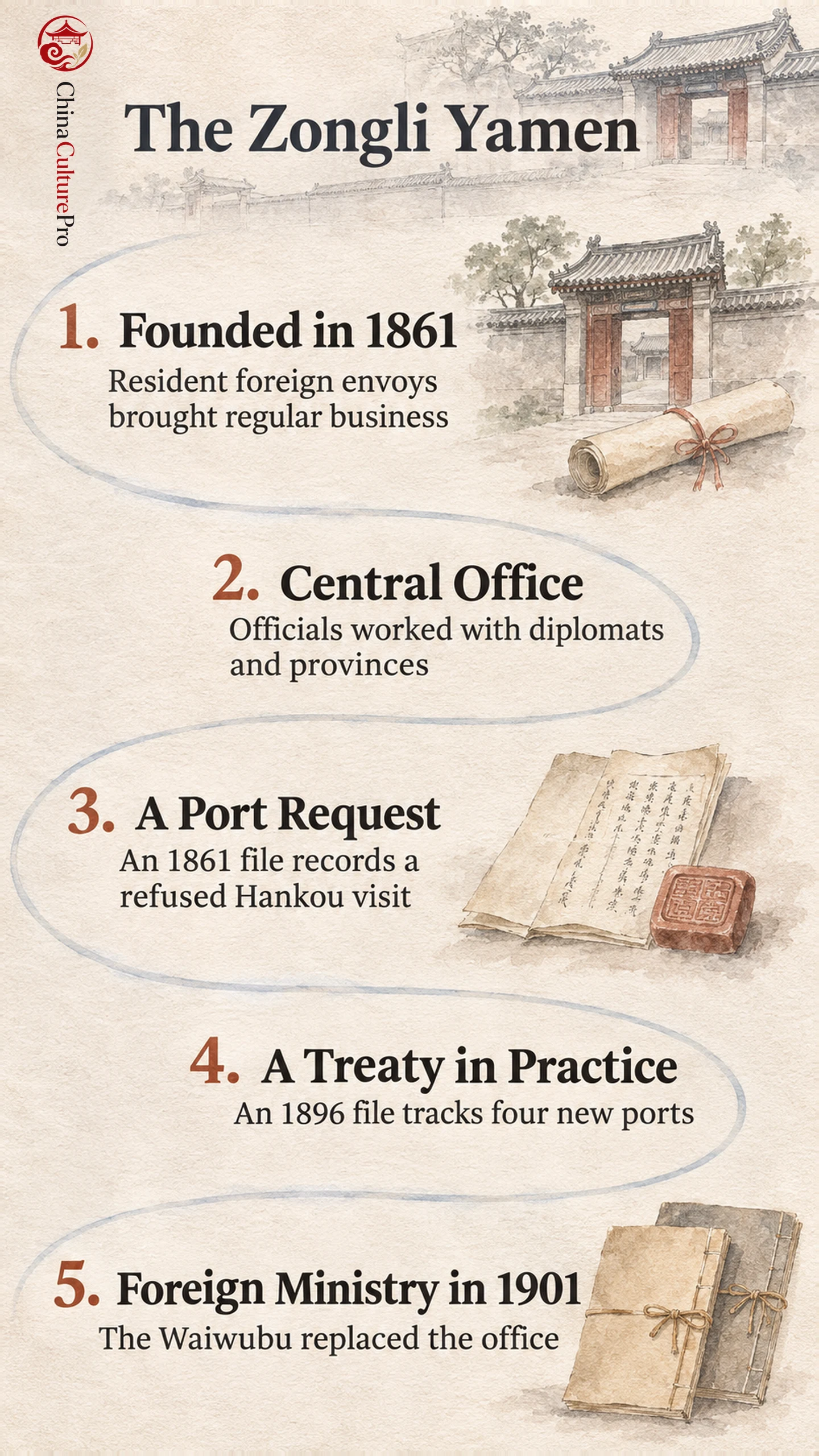
The 1860 settlements after the Second Opium War allowed foreign envoys to reside in Beijing. The court needed an office that could handle regular communication with those representatives. An imperial order created the new body in January 1861, with Prince Gong among its leading figures.[1][2][3]
High officials could serve concurrently in other posts. The office grew inside an imperial system of memorials, provincial officials and court decisions. Its existence made foreign business easier to direct to one place, while other authorities continued to carry out much of the work.
What the Archive Shows the Office Doing
In 1861, the Shanghai-based Italian consul sought to travel to Hankou to investigate trading conditions. The archive records the refusal. The request shows how status under a treaty, a proposed journey and permissions at a port could become questions for the central office.[1]
Another file records an 1896 communication about arrangements for opening Shashi, Chongqing, Suzhou and Hangzhou to commerce. A treaty provision and its administrative follow-through were separate steps. The correspondence connects central decisions to everyday questions of treaty ports and cultural exchange.[1]
From the Zongli Yamen to the Waiwubu
In 1901, the Boxer Protocol required the Qing court to turn the office into a formally constituted foreign ministry. The Waiwubu (外务部, Wàiwùbù) took precedence over the six older ministries. The change concerned the new ministry’s standing and organization as well as its name.[2]
Keep that reorganization distinct from late Qing constitutional reform. They belong to the same broad period of institutional change, and the foreign ministry’s creation had a specific diplomatic origin. Archival catalogues separate the office’s files from those of its successor, which helps when tracing a case across 1901.[1]
FAQs About the Zongli Yamen
What Was a Yamen?
A yamen was a government office or the premises from which it operated. Zongli Yamen abbreviates the longer name of a particular office in Beijing.
Who Replaced the Zongli Yamen?
The Qing court reorganized it as the Waiwubu in 1901. English sources often call the successor the Ministry of Foreign Affairs.
Sources
[1] Institute of Modern History, Academia Sinica. Zongli Yamen Collection and Selected Documents
[2] American Journal of International Law. How China Administrates Her Foreign Affairs
[3] Encyclopaedia Britannica. China: Government, Wai-wu Pu (1911 edition)