


Quick Answer: What Is the Lijin Tax?
Lijin (厘金, líjīn), often written likin in older English sources, was a Qing commercial tax first collected in Jiangsu in 1853 during the Taiping conflict. It spread across provinces. Traders could encounter levies at internal checkpoints, while some local systems also taxed goods at production or sale.[1][2]
- Purpose: The first collections helped pay for armies during the Taiping Rebellion.
- Trade: Merchants moving goods could face charges more than once along a route.
- Revenue: The resulting income mattered to provincial and central governments.
The word can suggest a small percentage. Charges varied by place, commodity and the way the local system worked.
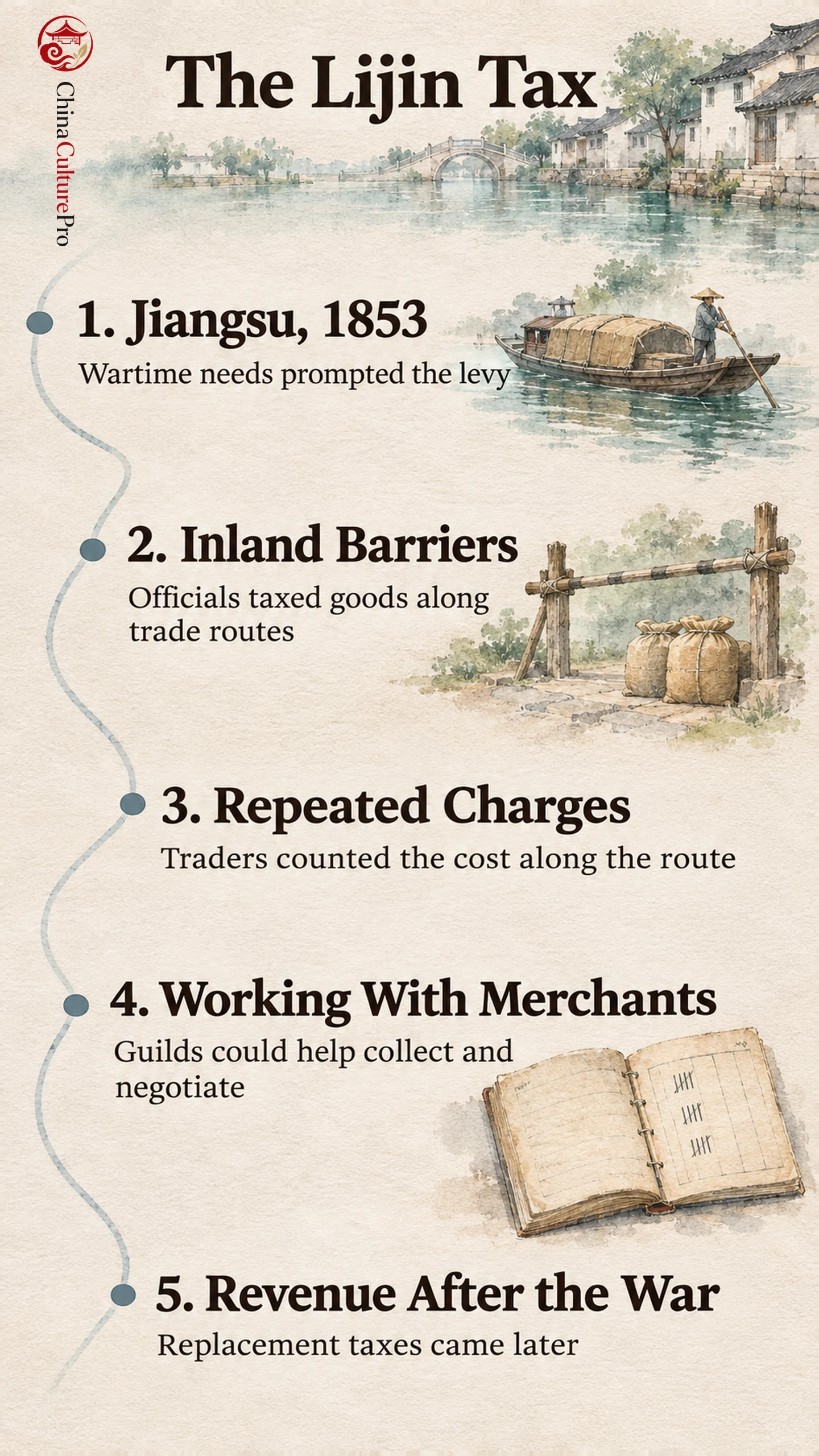
When a load of goods passed through several Qing tax barriers, the cost depended on the whole journey. A toll that seemed small at one stop could affect a merchant’s choice of route or the price a customer paid at the destination.
Why Jiangsu Began Collecting Lijin
By 1853, military costs from the Taiping conflict were putting pressure on Qing finances. Officials in Jiangsu began levying a commercial tax near Yangzhou. The levy could draw funds from goods already moving through an active trading area. Other provinces subsequently adopted it.[1][2]
The circumstances that brought it into existence also help explain its durability. Once government offices relied on the income, removing it created a funding problem even after the emergency that had prompted the first collections had passed.
What Merchants Faced Along a Route
A trader might be charged at a barrier as goods passed inland. A local scheme could also impose a charge at origin or on arrival. Repeated levies raised the delivered cost, and traders had to consider where barriers stood as well as how much each charged.[1]
Merchant groups could play a role in local assessment and collection. It is useful to read lijin alongside the networks described in Chinese merchant culture. Guilds gave officials an intermediary and merchants a way to negotiate collectively. Arrangements differed by locality.[1]
Why the Revenue Was Hard to Replace
Historians have reached different figures for the amount collected. Zhou Yumin’s study uses additional archival material to revise earlier national estimates upward for parts of the late Qing. The disagreement illustrates the limits of treating scattered provincial returns as a complete national total.[3]
The fiscal problem belongs alongside late Qing constitutional reform as one of the period’s pressures. The tax itself outlasted the dynasty. When the Republic abolished lijin, central and provincial governments turned to substitute taxes, including a business tax in Zhejiang, to replace lost revenue.[2]
FAQs About the Lijin Tax
Was Lijin a Tax on Imports?
It was principally an internal commercial levy. Goods travelling inland could meet lijin barriers. Duties collected at a maritime customs house were a separate charge.
Did Every Merchant Pay the Same Rate?
The charge depended on the goods and local arrangements. A trader had to consider the cumulative cost across barriers, especially on a long route.
Sources
[1] Meng Zhang. Merchant Guilds and Collective Taxation
[2] Pan Guoqi and Wang Xiaohao. The Business Tax in Republican Zhejiang
[3] Zhou Yumin. A Recalculation of the Total Annual Likin’s Revenue during the Late Qing