


Quick Answer: What Is Xin as Trustworthiness?
Xin (信, xìn) can mean trust, trustworthiness or being true to one’s word. In the Analects (论语, Lúnyǔ), it applies to a person’s reliability and to the confidence people place in a government. The text also asks whether a commitment deserves to be carried out.[1][2][3][4]
- A person’s conduct: Others need to be able to rely on what someone says.
- A political relationship: The confidence of the people helps a government stand.
- A commitment: Whether an undertaking is right matters to how it should be honored.[1][2][3]
The uses share a concern with what can be relied upon, though the quality of a person and the response of other people are different parts of the relationship.
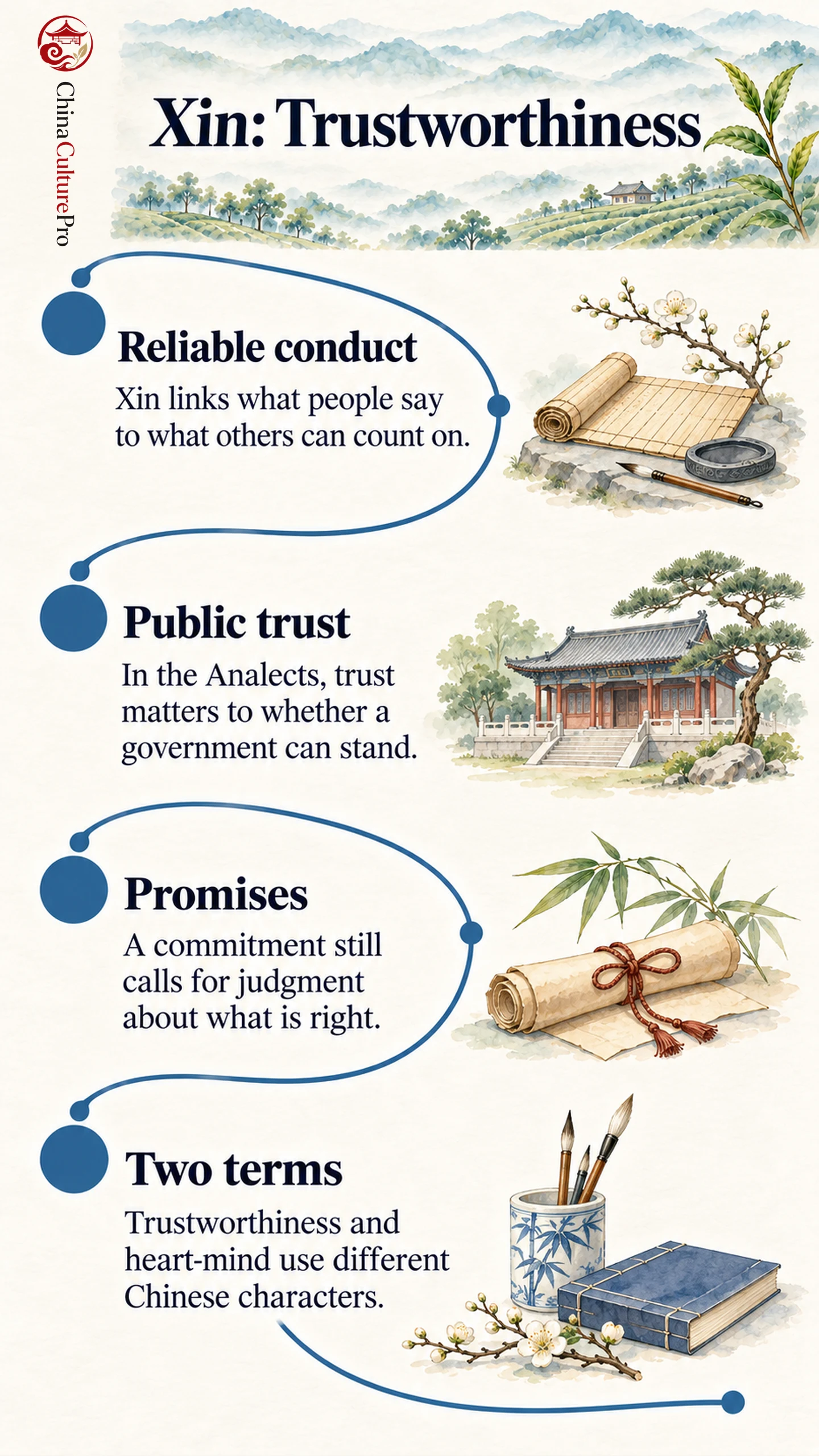
A promise matters partly because someone can make plans around it. That gives the person who makes it a responsibility. The Analects also asks what happens when a promise is out of step with what is right. The similar romanization of xin as heart-mind represents a different character.
Why the Analects Compares Reliability to a Carriage Fitting
In 2.22, Confucius uses the example of a vehicle that lacks the fitting needed to draw it. Its capacity to move depends on a small part that connects one element with another. The image makes reliability a condition of functioning with other people. A claim about the words alone would miss the dependence the image brings into view.[2][4]
A person can speak accurately once and still give others little basis for relying on a future commitment. The virtue concerns conduct across occasions. This explains some of the variation among translations such as good faith, truthfulness and trustworthiness. Each brings a part of that relationship into focus.[2][4]
The People’s Trust and the Stability of Government
In 12.7, Zigong asks about government. The reply identifies adequate food, arms and the people’s trust. As the questioning proceeds, arms and then food are things the speaker imagines giving up before trust. The passage gives public confidence a fundamental role in the ability of government to stand.[3][4]
The political use shifts attention from a person’s disposition to a relationship. The people have to place confidence in the government. What rulers and officials do can make that confidence easier or harder to sustain. The scene belongs with questions in Chinese political philosophy about what makes authority durable.[3][4]
When a Promise Calls for Judgment
In 1.13, a saying attributed to Master You connects a promise with rightness (义, yì). When the commitment is close to what is right, the words can be carried out. The saying asks people to consider the content of a promise as part of evaluating their reliability.[1][4]
Suppose someone promises a friend an advantage that would violate a responsibility to others. The case raises questions both about having made the promise and about carrying it out. A reader can see why this virtue sits among the Five Constants alongside virtues that direct judgment. Being someone others can rely on includes giving them reason to rely on one’s judgment about what to undertake.[1][4]
FAQs About Xin Trustworthiness
Is xin just honesty?
Honesty is part of its range. The passages also consider whether others can depend on someone’s actions and whether people put their confidence in a government.[2][3][4]
Does xin require keeping every promise?
The saying in 1.13 makes the rightness of a commitment relevant to whether it can properly be carried out. It gives the act of undertaking a promise moral weight as well.[1][4]
Is xin the same as heart-mind?
Trustworthiness is written 信 and pronounced xìn. The heart-mind is written 心 and pronounced xīn. They are different terms.[4]
Sources
[1] The Analects. 1.13: Promises and Rightness
[2] The Analects. 2.22: Good Faith and the Carriage
[3] The Analects. Glossary: Xin, Including the Discussion of Government in 12.7
[4] PhilPapers. Xin: Being Trustworthy