

Quick Answer: What Is Xiaohongshu Culture?
Xiaohongshu (小红书, Xiǎohóngshū), also called RedNote, is a lifestyle platform where a personal account can become an answer to someone else’s search. Users post notes about places, products and routines. Readers can compare those experiences, ask questions and check whether the conditions match their own.[1][2]
- Search: Look for a specific problem or place and read notes from several people.[1]
- Conversation: Comments can add practical details or challenge the image a post presents.[1][2]
- Commercial context: Personal accounts and promotional work can use the same familiar format.[1][3][4]
Treat a note as someone’s account of a particular experience. Its usefulness depends on details you can check.[1][2]
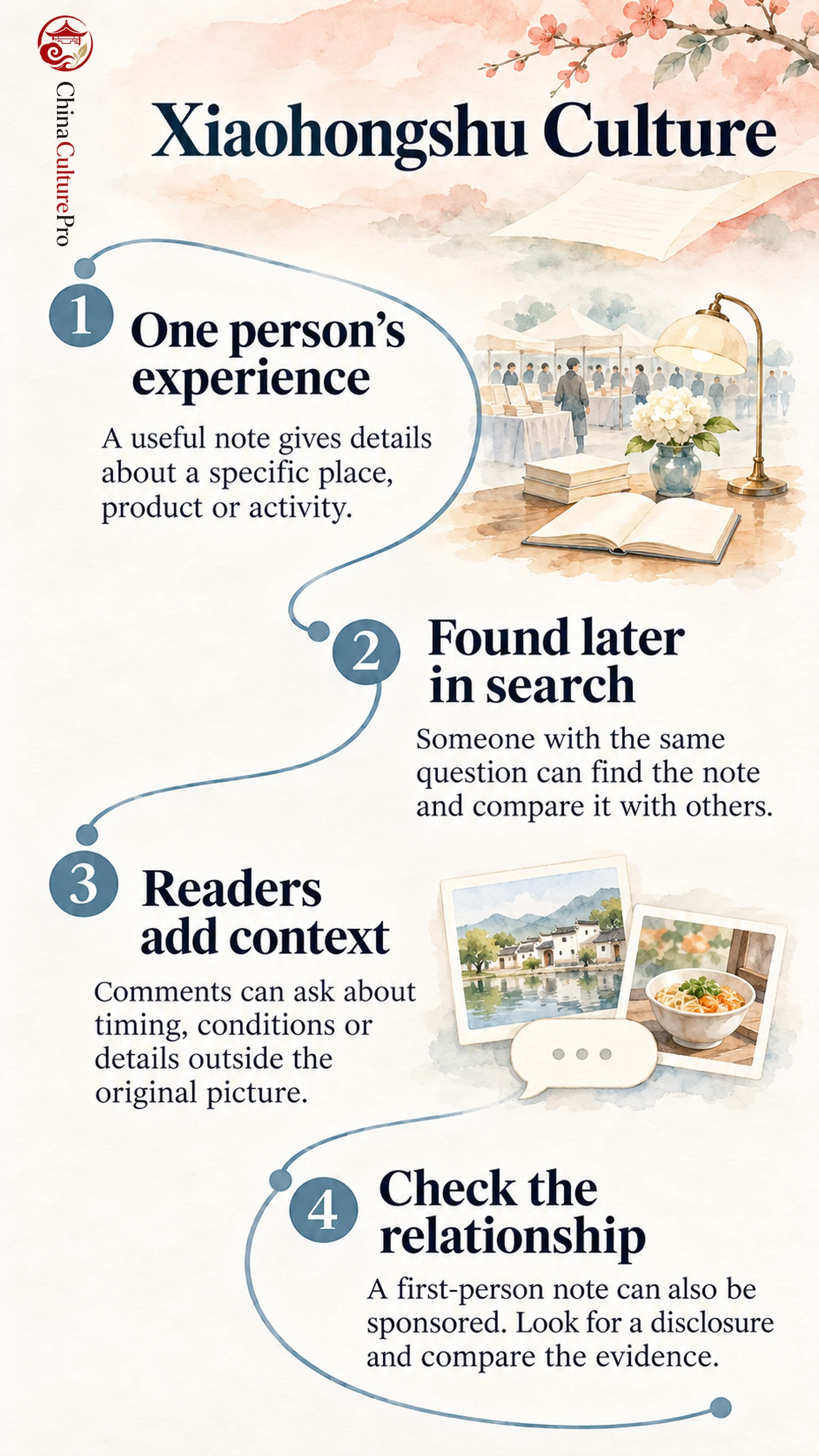
A book-fair post might show a small publisher’s table, list the titles the writer found and mention when a queue formed. For a later visitor, those details can matter as much as the polished picture. The note gives a concrete way into an unfamiliar event.[1]
Why a Personal Note Becomes a Search Result
A note can respond to a small, specific question. Photos show what the writer noticed, while a caption or list explains why they found it useful. Search can surface that material when a new reader has the same question. A feed can also surface a recommendation before the reader has looked for it.[1]
Planting grass (种草, zhòng cǎo) is a familiar term for getting someone interested in trying a product, place or activity. In a post about Chinese book fairs, the appeal could be a small press or a reading event rather than something to buy. Check the details that explain why the experience appealed to the person posting.[1]
What the Comments Add to a Recommendation
Several readers may know the same place. One can ask what time a photo was taken, while another explains that the view depends on the weather or an angle. A study of popular travel-photo locations on the platform documented how users and influencers negotiated what looked authentic. Another visitor’s photo can show what the original framing left outside the picture.[2]
That exchange is part of modern Chinese culture, where small acts of advice often become visible beyond a circle of friends. In WeChat social life, a similar detail might instead circulate in a private family or acquaintance group.[1][2]
How to Read Experience and Sponsorship Together
| Repère | Point à vérifier |
|---|---|
| Specific context | Look for the date, location or circumstances that made the experience possible.[1][2] |
| Other accounts | Compare notes with different photos or viewpoints, especially if appearance is central to the claim.[2] |
| Disclosed relationship | Look for a sponsorship, gift, invitation or other connection that the author identifies.[3][4] |
A commercial relationship can coexist with real experience. A well-edited personal account can also leave out details that would change your decision. Consider the disclosure alongside the evidence the note gives, and check disputed or dated details against a current source.[1][2][3][4]
FAQs About Xiaohongshu Culture
Is RedNote another name for Xiaohongshu?
Yes. RedNote is an international brand name for the Chinese platform Xiaohongshu.[1]
What does planting grass mean in a post?
It means making a product, place or activity sound appealing enough that someone wants to try it.[1]
Does a personal style mean a note is independent?
No. A polished first-person account can also be part of a commercial relationship. Check disclosures and compare the account with other posts and comments.[1][3][4]
Sources
[1] Shangwei Wu, Big Data & Society. Social media as search engines? The rise of RedNote in mobile search
[2] Yihan Li and Francis L. F. Lee, Tourist Studies. Social media and the negotiation of travel photo authenticity
[3] ACM. The Informal Labor in Creator Economy on Xiaohongshu
[4] 21st Century Business Herald. Community rules and commercial disclosures on Xiaohongshu