


Quick Answer: How Do Chinese Internet Memes Spread?
Chinese internet memes spread when people recognize a reusable image, sound or line and give it a new job. Someone may send a reaction sticker, or biaoqingbao (表情包, biǎoqíngbāo), as a reply in a chat. A clip or a line of dialogue can also become a template when others recut it or attach it to different situations. [1][2][3][4]
- Image: A familiar face can carry a different joke under a new caption. [1][2]
- Sound: A spoken line becomes comic material when editors repeat or recut it. [3][5]
- Conversation: A sticker answers someone in a chat. A public remix can invite more versions. [1][4][5]
What stays recognizable helps the joke travel. What gets changed helps it fit a new audience.
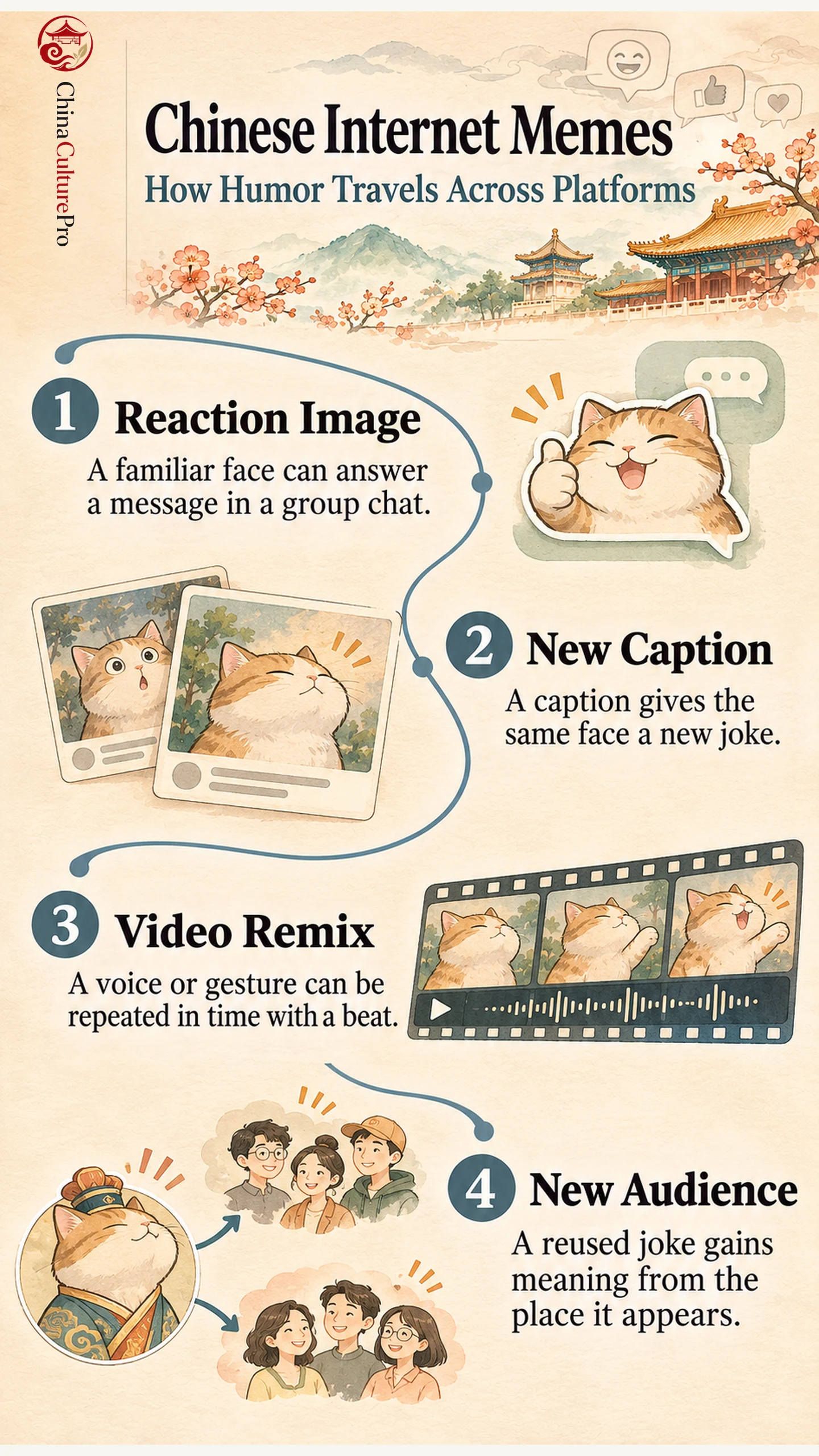
A grin under a message in a private group might be aimed at one friend. On a public feed, a new caption can turn that same face into a joke about a TV show that neither sender nor recipient mentioned. Chinese internet memes are easier to read if you ask what viewers are expected to recognize and why this version belongs where it appeared. [1][2]
How a Reaction Image Acquires New Meanings
In WeChat group chats, an image or sticker can stand on its own as someone’s turn in the conversation. The message above it helps tell you whether the sender is signaling delight, embarrassment or teasing. A public image built from the same template may need a caption to put that expression in context for strangers. The label biaoqingbao covers a range of expressive images and packs, including stickers people use without changing them. [1][2][6]
One documented example uses the grinning face of the American wrestler D’Angelo Dinero. Researchers studied 60 images that paired the face with other graphics or text. Some versions drew on Chinese entertainment and digital culture, while others pointed to social class or public institutions. The face traveled from its original setting, and its combination with local references gave each edit a more specific target. Knowing who Dinero is explains the source of the face. Reading the caption and the other visual clues helps explain that particular joke. [2]
How Chinese Video Memes Reuse Sound and Timing
A video version can reuse a voice, a gesture or a few frames. In the editing style known as guichu (鬼畜, guǐchù) on Bilibili, an editor may break speech into syllables and synchronize repeated gestures with a beat. A famous clip can become raw material because viewers recognize the person or voice even when the new sounds and actions have little connection to the original. Researchers trace early influences from Japanese video sharing and describe how the form acquired its own editing practices on Bilibili. [5]
A clip can circulate for the sound of its dialogue alone. Research on Chinese dubbing describes how stylized Mandarin from dubbed shows and films has acquired new uses on social media. A line that viewers once associated with a character’s voice can be replayed for its exaggerated delivery or set against a different situation. When the gag depends on repetition or a sudden cut, a transcript captures the words but loses part of the joke. [3][5]
What Changes When a Meme Moves Between Platforms
The same image can be forwarded unchanged, saved for a later conversation or edited before it is posted again. In a chat the previous message can do the work a caption would do on a public feed. Likewise, a few seconds shared from a remix can become the part that viewers recognize, even if they never saw the full upload. China’s social platforms offer multiple settings for that reuse, and they need not share an audience or a common starting point for every joke. [1][3][4][5]
Sometimes the words become more recognizable than any particular image. A history of Chinese digital folklore follows expressions such as “lying flat” (躺平, tǎngpíng) into wider conversations about social expectations. If you see a captioned image using language like this, it helps to read the surrounding post and ask what the caption makes the picture respond to. The companion guide to Chinese internet slang explains everyday word meanings and changes in usage. [4]
FAQs About Chinese Internet Memes
Is every Chinese reaction sticker a meme?
A sticker can be a simple visual reply. It acts as a meme template when people recognize it and reuse it, sometimes changing the caption or image for another situation. [1][2]
Why is a translated caption sometimes still hard to understand?
The humor may depend on recognizing the face, voice or scene, or on the timing of a cut. The translated words give only one of those cues. [2][3][5]
Sources
[1] First Monday. Biaoqing: The circulation of emoticons, emoji, stickers, and custom images on Chinese digital media platforms
[2] Internet Pragmatics. Exploring local meaning-making resources
[3] The Journal of Specialised Translation. Dubbing and reception
[4] Global Media and China. From ASCII Lanterns to Synthetic Livestreams
[5] University of Edinburgh Research Explorer. Legitimizing video-sharing practices on local and global platforms
[6] Chinese Language and Discourse. Understanding memes on Chinese social media