


Quick Answer: What Is Wulu Green Tea?
Wulu(婺绿,Wùlǜ)is the abbreviated name for Wuyuan green tea(婺源绿茶,Wùyuán lǜchá), associated with Wuyuan County in Jiangxi.[1]
- Identity: it is a regional green-tea family, rather than one compulsory leaf shape.[3]
- Craft: traditional manufacture includes heat fixation, rolling and staged drying.[2]
- Flavor: local descriptions emphasize green leaves, fragrance and a fresh taste.[2]
- Names: some overseas Wu Lu(霧綠,wùlǜ)products have a different stated origin.[4]
This guide focuses on Wuyuan’s Wulu. Check the Chinese name and stated origin when buying an English-labelled Wu Lu.
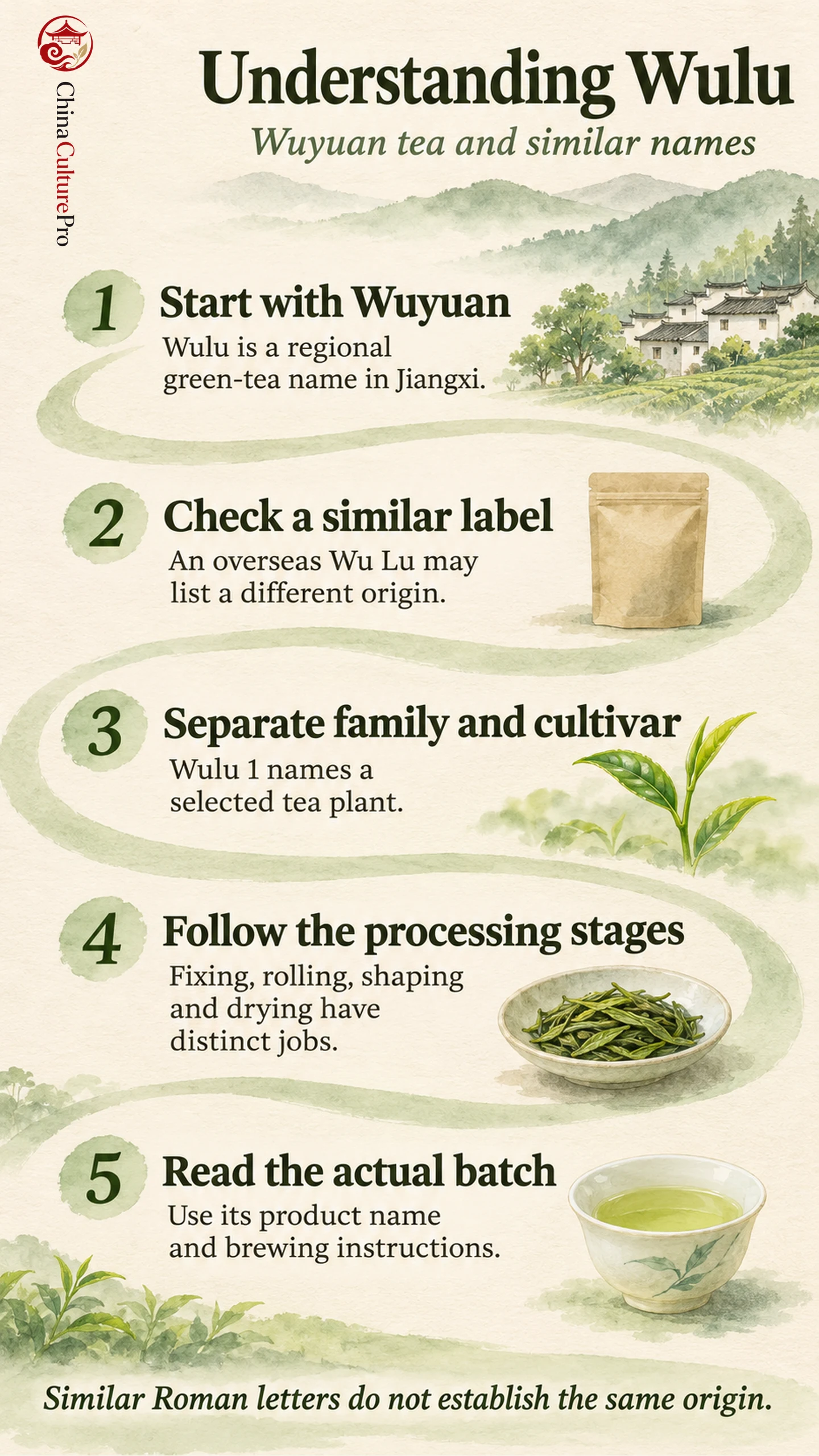
The first useful distinction is between a regional Chinese name and a similar-looking English trade name. It changes which processing and brewing information applies.
Wulu, Wu Lu and the Name on the Packet
In Wulu, the first character comes from Wuyuan, the county name; the second means green. The abbreviated regional name is therefore a place-linked term, not a literal translation of “mountain mist.”[1]
A separate overseas product spells Wu Lu(霧綠,wùlǜ), also called Emerald Cloud, and lists Huang Shan in Anhui as its origin. Another Mountain Mist Wu Lu listing specifies Zhejiang. These are the sellers’ descriptions of their products; neither establishes Wuyuan origin from the Roman letters alone.[4][6]
Ask for the Chinese name and growing county when the label is unclear. Our tea origin-label guide explains why a product’s name and a company’s address need separate reading.
A Regional Family, Not One Cultivar
The current provincial Wuyuan green-tea standard includes named specialty products such as Wuyuan Mingmei(婺源茗眉,Wùyuán Míngméi)and refined teas such as Chunmee(珍眉,zhēnméi)within the broader family.[3]
Wulu 1(婺绿1号,Wùlǜ yī hào)is a different kind of name: a cultivar selected from the Wuyuan tea population. Its breeders describe suitability for green, black and white tea manufacture. It is not the name of every finished Wulu tea.[5]
For the plant-versus-product distinction, see tea cultivars and tea types. Our separate Wuyuan Mingmei guide focuses on that named member of the family.
How Traditional Wuyuan Green Tea Is Made
The heritage account describes spreading the picked leaves, heat fixation, rolling, loosening and several drying and shaping stages. Pan work and baking both appear within the tradition. Fixing, shaping and final drying have different jobs; “pan-fired” should not be read as a complete description of every operation.[2]
The named Wuyuan green-tea craft entered the national heritage list in 2014. That handcraft record does not establish that every modern packet is entirely handmade, or that today’s methods have continued unchanged since ancient times.[2]
Appearance, Flavor and Choosing a Batch
Traditional descriptions emphasize tightly formed green leaves, clear liquor, fragrance and a fresh, brisk taste. The named product and grade affect what you see in a particular batch.[2]
Compare the specific product name, harvest, producer and preparation advice. Use tasting notes for that tea rather than transferring notes from a similarly named Green Mist product.
How to Read and Brew the Tea You Have
Identify the product before selecting a recipe. A method for an Anhui Emerald Cloud batch should not be presented as the official method for the entire Wuyuan tea family.
- Check the Chinese name and stated growing region. Confirm whether the product is Wuyuan green tea or a differently named Wu Lu.
- Find the preparation instructions for that batch, including leaf amount, fresh water volume, temperature and infusion time.
- Measure those conditions, infuse, and separate the liquor from the leaves when the stated time ends.
- Taste before changing another preparation. Adjust one variable at a time and keep a note of the result.
If the seller gives only a temperature, ask for the missing dose, water volume and time. Your brewing water also belongs in a useful comparison.
FAQs About Wulu Green Tea
Is Wulu the Same as Green Mist?
Do not assume so. Wulu here means Wuyuan green tea; at least one overseas Emerald Cloud or Wu Lu product lists an Anhui origin.[1][4]
Is Wulu the Same as Wuyuan Mingmei?
Mingmei is one named product within the broader Wuyuan green-tea family.[3]
Is Wulu 1 the Name of Every Wulu Tea?
No. Wulu 1 is a selected cultivar, while Wulu is the regional green-tea name.[5]
Can One Brewing Recipe Fit Every Wu Lu Label?
The spelling alone is insufficient. Identify the origin and actual tea, then use its batch instructions as your starting point.
Sources
[1] Mission of China to the European Union. 婺源绿茶:中欧地理标志协定产品推介(十九)
[2] China Intangible Cultural Heritage Network (Réseau chinois du patrimoine culturel immatériel). 绿茶制作技艺(婺源绿茶制作技艺)
[3] Jiangxi Administration for Market Regulation. DB36/T 752-2024: 地理标志产品 婺源绿茶
[4] Two Hills Tea. Organic Emerald Cloud / Wu Lu
[5] Peng Hua and colleagues. A New Tea Cultivar ‘Wulü 1’ with Early-sprouting and Strong Tenderness-keeping Ability
[6] The Teapot. Mountain Mist Wu Lu