

Quick Answer
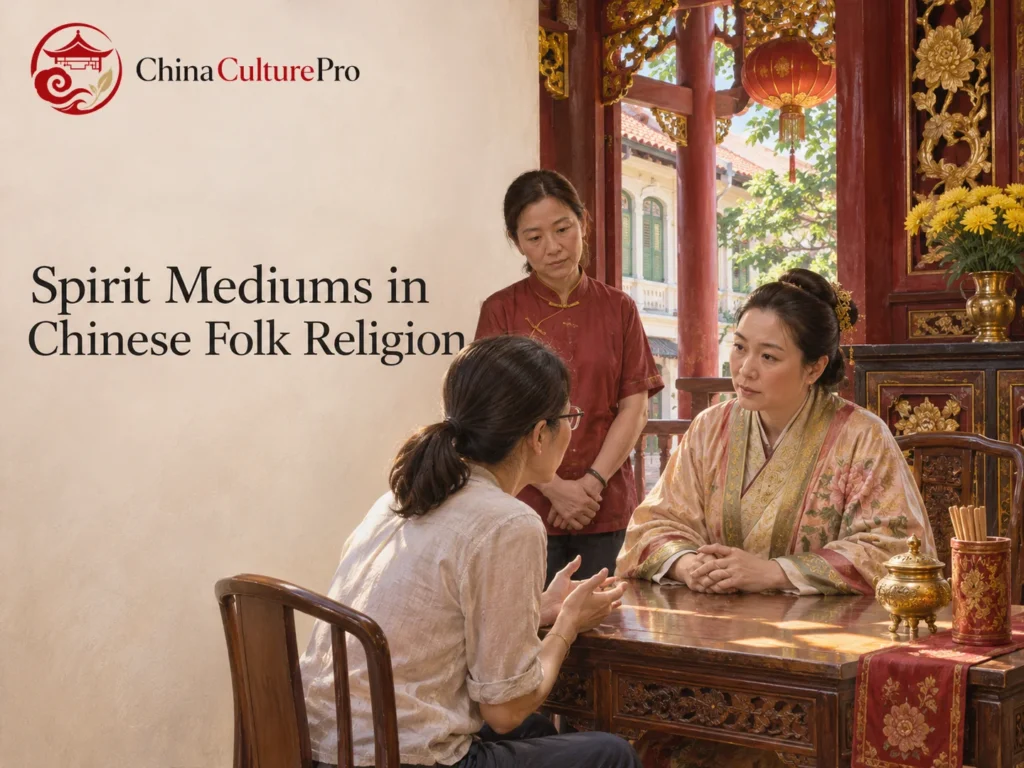
A spirit medium, called a tangki in Hokkien or tongji (童乩, tóngjī) in Mandarin, is a person through whom devotees believe a deity can appear, speak or act. A medium may answer questions at a temple or take part in a public procession. The role varies by temple, deity and region. Research in Putian (莆田, Pútián) and Singapore documents several ways communities make sense of the practice.[1][2][3]
- Consultation: Devotees may address a deity through the medium and receive a spoken or gestured response.[1][2][3]
- Recognition: Dress, movement, music and objects can help worshippers identify the deity the medium represents.[3][4]
- Local practice: Some Singapore temples feature mediums at the Nine Emperor Gods Festival (九皇爷诞, Jiǔhuángyé Dàn). Others observe the festival without them.[4][5]
Ethnographic accounts distinguish between what participants report believing and what a researcher can observe, such as changes of costume or the way a crowd gathers around a medium.[2][3][4]

The setting also changes the role. A consultation makes room for a person’s question. At a festival, a medium may be part of a temple’s public welcome for a god. At a festival, for example, assistants, musicians and worshippers help create a setting recognizable to the wider community.[1][3][4]
How Mediums and Devotees Communicate
In his fieldwork on Putian in Fujian, Chongqing Wu compares mediumship with block divination (卜杯, bǔbēi). The two means of addressing a deity produce different kinds of answers. A pair of blocks can register a response to a simple question through the way they land. In a consultation, people can ask a question that takes more than a yes or no answer and respond to what they hear.[1][2]
Fabian Graham’s research emphasizes the social exchange. Devotees can explain a concern to the person before them and, in their account of the encounter, put it directly to a specific god. A medium is one of several ways people seek divine guidance in <a href="/fr/”https://www.chinaculturepro.com/chinese-folk-religion/”/">Chinese folk religion</a>.[1][2]
How Worshippers Recognize the Deity
In a Singapore study, Margaret Chan describes changes in music and dress as a medium takes on the deity’s role. Assistants help with the costume and attributes. Chan offers the example of a Monkey God medium adopting a recognizable pose and of a medium for a deity of the underworld carrying an abacus. A familiar object can tell the audience something about the deity and its duties even before anyone asks a question.[3]
The medium’s role is distinct from an office gained through ordination in many Daoist settings. An ordained priest may use scriptures, registers and petitions as part of a liturgy. A medium’s role in the examples here rests on the community’s recognition of the deity appearing through that person. The two roles can belong to overlapping religious settings.[3][6]
How Singapore Temples Use Mediums at a Festival
At the Nine Emperor Gods Festival organized by Choa Chu Kang Dou Mu Gong (蔡厝港斗母宫, Càicuògǎng Dǒumǔ Gōng in Mandarin), an ethnographer describes the reception of the gods on a beach. Seats and palanquins were arranged facing an altar, and devotees gathered around them. The nine mediums took their places in a public ceremony that worshippers understood as the arrival of the gods.[4]
That beach ceremony belongs to a particular temple’s observance. Singapore’s heritage inventory notes that some temples have mediums represent the Nine Emperor Gods and others do not. To understand a ceremony, look at who organizes it, what the participants say is happening and which parts of the observance involve a medium.[4][5]
FAQs About Chinese Spirit Mediums
Does tangki mean the medium has to be a child?
No. The written term 童乩 contains a character for child, but adult mediums are well documented. In Margaret Chan’s account, the word also relates to a religious idea about who may be called to serve a deity.[2][3]
Is a spirit medium the same as a Daoist priest?
These terms identify different functions. Mediumship centers on a deity believed to act through a person. Daoist priesthood involves roles and training connected with specific liturgical traditions.[2][3][6]
Do all temples use spirit mediums?
Practices vary by temple. Singapore’s Nine Emperor Gods heritage entry records both temples with mediums and temples without them.[5]
Sources
[1] Chongqing Wu. The Transmission of Information in Chinese Folk Religion: Fieldwork in Putian
[2] Fabian Graham. Researching Chinese Religion in Southeast Asia and Taiwan
[3] Margaret Chan. The Chinese Spirit-Medium, National Library Board Singapore
[4] Religions. Ethnography of the Nine Emperor Gods Festival in Singapore
[5] Singapore National Heritage Board. The Nine Emperor Gods Festival
[6] Fabrizio Pregadio. Religious Daoism, Stanford Encyclopedia of Philosophy