


Quick Answer: What Can a Monkey Mean in Chinese Art?
A monkey can evoke a noble title, mark a place in the zodiac or appear as a lively animal in its own right. A gibbon can also carry a pun about examination success. The companion animals and the object’s format help distinguish these uses.[1][2][3][4]
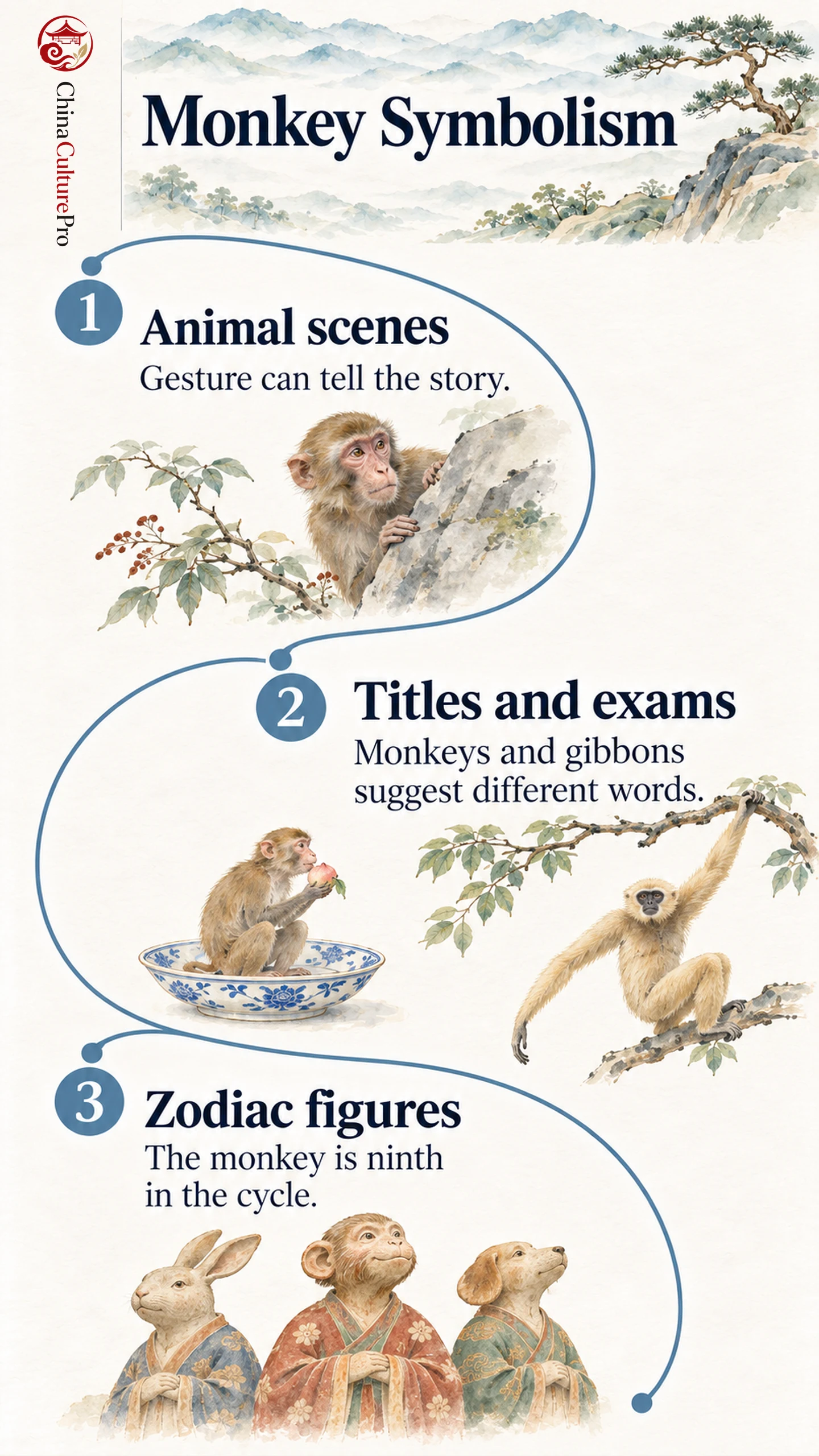
- In a scene. Look at the animal’s posture and what it is doing.[1]
- In a rebus. Count the animals and see which creatures accompany them.[2][3]
- In a set. Check for the other calendrical animals.[4]
A single primate in a scene may need an inscription or a closer look at its companions.
A monkey clutching a kitten and a monkey painted beside bees offer very different clues to a viewer. One painting concentrates on a moment between animals. A porcelain dish uses the creatures’ names to convey a wish.[1][3]
Monkeys and Gibbons as Living Animals
In Monkey and Cats, catalogued under the Northern Song painter Yi Yuanji, a tethered rhesus macaque holds a kitten with a red ribbon collar. The captured kitten tries to pull away while its companion looks back. Delicate fur strokes and light washes make their different bodies readable against the blank ground.[1]
A gibbon’s elongated arms and lack of a tail can help distinguish it from a macaque in a tree. To test a symbolic reading, first check which animal the catalogue identifies. The distinction affects which Chinese sound the image can evoke.[1][2]
The Wordplay of Rank and Examination Success
Monkey (猴, hóu) sounds like marquis (侯, hóu). On a late seventeenth- or early eighteenth-century blue-and-white dish, a monkey shares the scene with bees, a magpie and a deer. Together these creatures form a wish for a noble title and wealth. The monkey on horseback uses the same monkey sound but adds the idea of immediate advancement.[3]
Gibbon (猿, yuán) can instead sound like first place (元, yuán). A late twelfth-century fan shows three gibbons raiding an egret’s nest. Art historian Qianshen Bai reads their number as a reference to three firsts (三元, sānyuán), first place at each of the provincial, metropolitan and court examinations. The egret contributes a different sound to the same scene. The painting can be read as both animal drama and congratulations for examination success.[2][5]
When a Monkey Belongs to the Zodiac
The monkey comes ninth in the conventional sequence of twelve animals. An eighth-century earthenware set shows the animals with human bodies in robes. Their shared costume and grouping make the monkey part of the calendar cycle. Figures of this type served as tomb furnishings.[4]
The Monkey King (孫悟空, Sūn Wùkōng) belongs to a different story, in which he steals the peaches of immortality.[7]
A Qing set in pale green jade uses accessories and individual postures to distinguish its members. The horse, for example, holds a banana-leaf fan. Compare how banana leaves appear in Chinese painting as part of a scene. In the jade set, the fan is an accessory and the twelve figures together identify the zodiac.[6]
FAQs About Monkey Symbolism in Chinese Art
Does a monkey with a peach always depict the Monkey King?
A monkey reaching for a peach can recall the theft of the peaches of immortality. Look for other characters, an inscription or a title before identifying a particular figure as the Monkey King.[7]
Do gibbons and monkeys stand for the same words?
The gibbon sound can suggest coming first in an examination, while the monkey sound can evoke a marquis. The rest of the composition determines whether either sound belongs in the interpretation.[2][3]
Sources
[1] National Palace Museum. Monkey and Cats
[2] Qianshen Bai. Image as Word: A Study of Rebus Play in Song Painting
[3] The Metropolitan Museum of Art. Plate with Monkey, Bees, Magpie, and Deer
[4] The Metropolitan Museum of Art. Set of Twelve Zodiac Animals
[5] The Metropolitan Museum of Art. Gibbons Raiding an Egret’s Nest
[6] The Metropolitan Museum of Art. Twelve Animals of the Chinese Zodiac
[7] The Metropolitan Museum of Art. Sword Guard Depicting a Group of Monkeys in a Peach Tree