

Quick Answer: Who Was Hui Shi?
Hui Shi (惠施, Huì Shī), also known as Huizi (惠子, Huìzǐ), was a Warring States adviser and debater. Readers often meet him in the Zhuangzi (庄子, Zhuāngzǐ), which preserves both a set of propositions attributed to him and stories in which he argues with Zhuang Zhou.[1][2][3]
- Historical figure: The sources associate him with political advice and skill in argument.
- Ten theses: Several attributed propositions ask what changes when things are compared from different standpoints.
- The fish dialogue: Huizi challenges Zhuang Zhou’s claim to know the joy of fish.[1][2][3]
The surviving texts are evidence of his reputation and some of his arguments. The stories also give him a literary role of their own.

Two readers can know the same person through different texts. One recognizes Huizi as the skeptic on a bridge. Another recognizes Hui Shi as the thinker associated with puzzling statements about likeness and difference. Reading those accounts together means noticing what kind of evidence each one supplies.
Hui Shi in the Historical and Literary Sources
Early sources remember Hui Shi as an adviser associated with the state of Wei and as a skilled disputant. Modern accounts commonly discuss him under the School of Names (名家, míngjiā), a later category for several figures with interests in argument and distinctions. The label lets readers compare different thinkers, although it does little to establish the details of a common curriculum or organization.[1]
The Zhuangzi gives Hui Shi a recurring role as an interlocutor. In that role he can press a point, object to a claim or supply the contrast a story needs. The way a dialogue represents his position may be worth interpreting independently of the question of whether the exchange took place in that form.[1][3]
The Ten Theses: How Similarity Depends on Comparison
The chapter Under Heaven (天下, Tiānxià), at the end of the received Zhuangzi, attributes ten propositions to Hui Shi. They range from claims about limits of size to statements about similarity and difference. Some look paradoxical when read as ordinary descriptions. We have the brief formulations, while much of the reasoning connecting them has to be reconstructed.[1][2]
One proposition distinguishes greater and lesser forms of likeness and difference. A way into the puzzle is to change the respect in which two things are being compared. A small bowl and a large bowl are different in capacity and similar as vessels. The comparison changes when the category or scale changes, even though the objects have stayed the same. The bowls are a modern illustration of the interpretive issue, rather than an example preserved under Hui Shi’s name.[1][2]
Readers differ over whether the theses lead toward a single account of reality or chiefly expose the flexibility of distinctions. The same uncertainty matters when comparing Hui Shi with Gongsun Long. Their surviving evidence addresses related questions in different formats.[1][2]
What the Fish Dialogue Actually Disputes
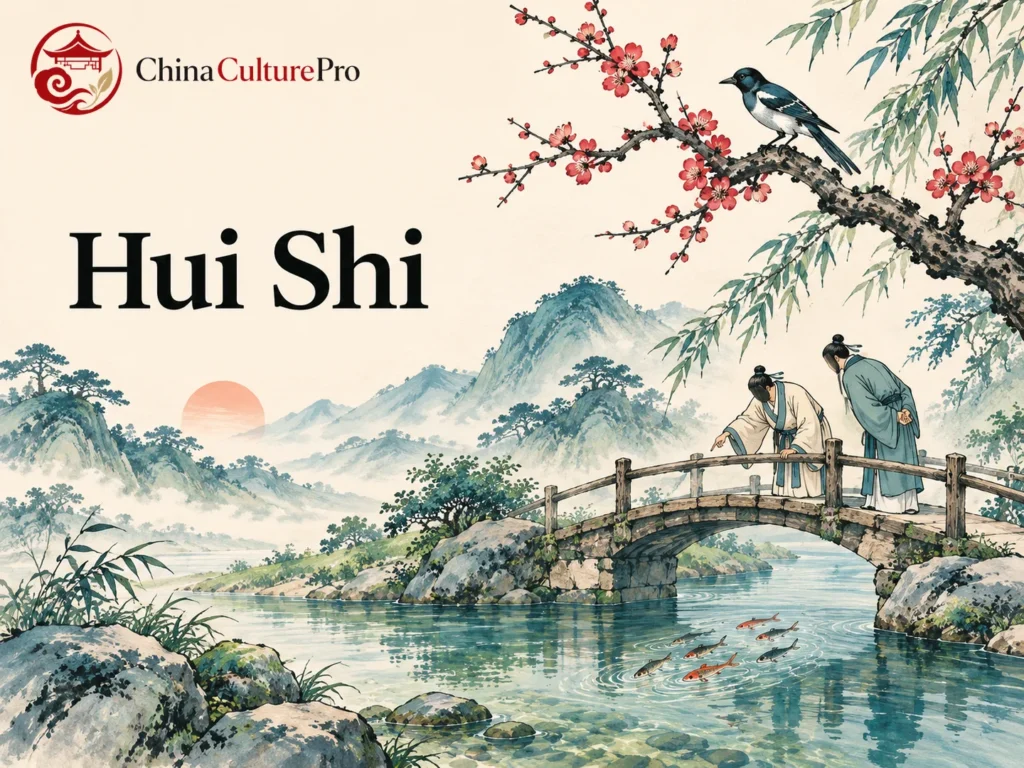
In the Floods of Autumn chapter, the two speakers stand by the Hao River. Zhuang Zhou says that the fish move about freely and calls this their joy. Huizi asks how a person who is not a fish could know that. Zhuang Zhou then turns the objection back on him, asking how Huizi could know what another person knows.[3]
At the end, Zhuang Zhou returns to how the original question was asked and says he knows from where he is standing. The shift gives readers two possible lines of inquiry. What kind of access to another being does a claim about joy require? What might an observer reasonably learn from shared surroundings and visible behavior? The dialogue stages the dispute without settling every question it opens.[1][3]
FAQs About Hui Shi
Are Hui Shi and Huizi the same person?
Yes, in these sources. Hui Shi is the thinker’s name, and Huizi is an honorific form often translated as Master Hui.[1][3]
Did Hui Shi leave a complete book?
The detailed arguments associated with him come chiefly from reports and quotations, especially in the Zhuangzi and Xunzi. A complete work by Hui Shi does not survive for comparison.[1][2]
How does Hui Shi differ from Gongsun Long?
The ten theses attributed to Hui Shi range across scale, time and comparison. Gongsun Long is especially known for an extended dialogue about how expressions pick out what people ask for. Their association with the same later label leaves room for those differences.[1][2]
Sources
[1] Stanford Encyclopedia of Philosophy. School of Names
[2] Chinese Text Project. Hui Shi
[3] Chinese Text Project. Zhuangzi: Floods of Autumn