


Quick Answer: How Do You Find Sitting and Facing?
Sitting and facing (坐向, zuòxiàng) are opposite ends of a directional axis. In methods that look for the open or active side of a building, that side is the facing. Other methods can use a unit’s external opening or its entry.[1][2][3][4]
- Choose the scope: Decide whether you are charting the entire building or an individual unit.[1][2][4]
- Measure the chosen line: Repeat a consistent compass measurement and note the north reference.[2][4][5]
- Find the sitting: Add 180° to the facing and wrap past 360° when needed.[3][4]
Door location, the direction you look when walking out, and the door leaf’s swing are different observations. This guide uses the outward bearing when a method calls for a door reading.[1][2][4]
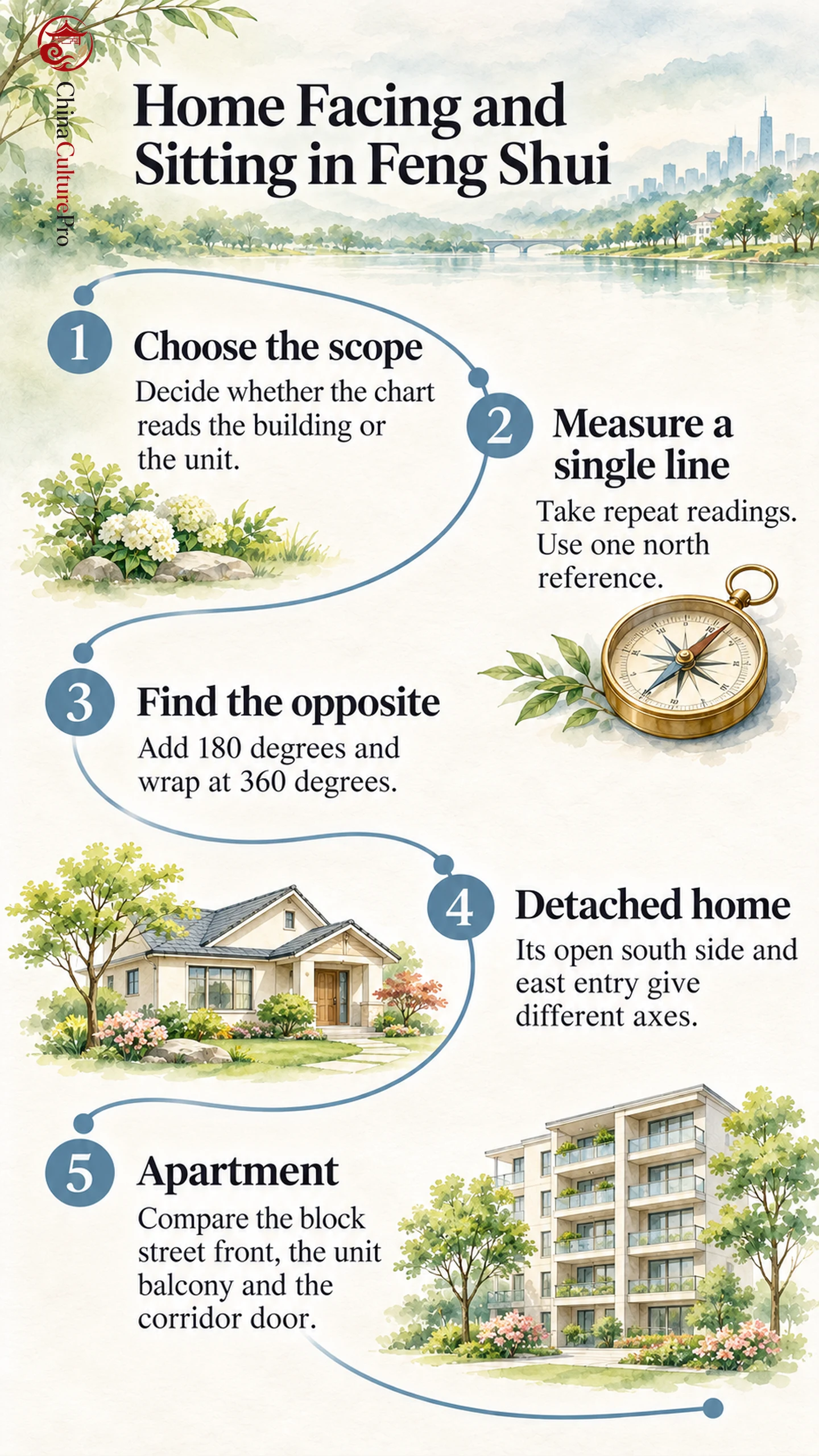
The front door can be on the side of a house, and an apartment door can open onto a corridor. To find the home’s axis, first choose the line that your feng shui method uses. A compass then measures that line.[1][2][3][4]
How to Measure and Record the Axis
Mark the front candidate and the scope
On your plan, mark the outward line for each plausible facing. Note the entrance, open view and street frontage. Record whether your method reads the building or the unit.[1][2][3][4]
Take repeat compass readings
Hold your compass level and take several readings parallel to the same chosen line at different points. Move away from steel doors and other magnetic interference. Check whether the device uses magnetic north or true north.[2][4][5]
Write down both numbers
Add 180 degrees to the facing. If the sum is 360 degrees or higher, subtract 360. Record both bearings, the measurement points and the method used to choose the line.[2][3][4]
A traditional luopan (羅盤, luópán) is a traditional feng shui compass with a magnetic needle. Phones can display another north reference, so document which setting you used. If readings straddle a narrow split, record the spread before assigning a single sector from the feng shui directions chart.[2][4][5]
Detached House Example: Side Door, Open South Face
Suppose the living room and large windows open toward a south garden. The entry opens outward toward the east drive. Mark both on a north-up plan.[1][2][4]
| Plan edge | What is there | Outward bearing |
|---|---|---|
| Nord | Closed rear wall | 004° |
| Est | Drive and main entry | 094° |
| Sud | Large windows and open garden | 184° |
| Ouest | Side wall | 274° |
A method that selects the open elevation takes 184° as facing and 004° as sitting. A door-based reading would use 094° and 274°. When taking the reading, stand facing out along the line in question. A guide to the feng shui front door covers what an entrance can mean independently of the building axis.[1][2][3]
Apartment Example: Building, Balcony and Unit Door
Suppose the whole block presents its active front to a west street, the unit’s living room opens onto an east balcony, and its door opens north into the corridor. For a north-up sketch of this unit label west as the block street, east as the balcony and north as the corridor. The west reading belongs to the block elevation. The east and north readings belong to the unit.[1][2][3][4]
| Method in this example | Facing | Sitting |
|---|---|---|
| Block street elevation | West, 272° | East, 092° |
| Unit’s open balcony side | East, 095° | West, 275° |
| Unit door opening to corridor | North, 005° | South, 185° |
Each row is an internally consistent axis. Keep one stated row with a given Flying Star Feng Shui chart. Combining a block facing from one row with a unit sitting from another would break the 180° relationship.[1][2][3][4]
FAQs About Feng Shui Facing and Sitting
Can north be written as 000° or 360°?
Yes. Those are the same bearing. Use one notation consistently, especially when a small range crosses north.[2][5]
What if the doorway reading keeps changing?
Repeat the measurement farther from interfering material while preserving the same aim line. If the remaining spread changes the directional label, log both outcomes and the readings that support them.[2][4][5]
Sources
[1] American Feng Shui Institute. Advanced Sitting and Facing
[2] FengShui.info. Finding Your Facing Direction
[3] Jampa Ludrup. Introduction to Flying Star Feng Shui, lesson 9
[4] Yap Tian Xuan. Feng Shui House Direction Guide
[5] NOAA National Centers for Environmental Information. Magnetic Declination