


Quick Answer: What Is a Bagua Mirror?
A bagua mirror (八卦鏡, bāguàjìng) combines a reflective surface with the Eight Trigrams (八卦, bāguà). A familiar doorway form has a round mirror set into an octagonal frame, with the trigrams arranged around it.[1][3]
- Shape: The reflective surface can be flat, convex or concave.[3][5]
- Symbols: The trigrams can appear with inscriptions, zodiac figures or other motifs on different objects.[1][2][4]
- Use: Some households display these objects outside, often above a doorway, as part of a protective folk practice.[1][3][4]
The frame and markings help identify an object, while the shape of the reflective surface helps distinguish its type. Traditional associations describe how people understand the object.[1][3][4]
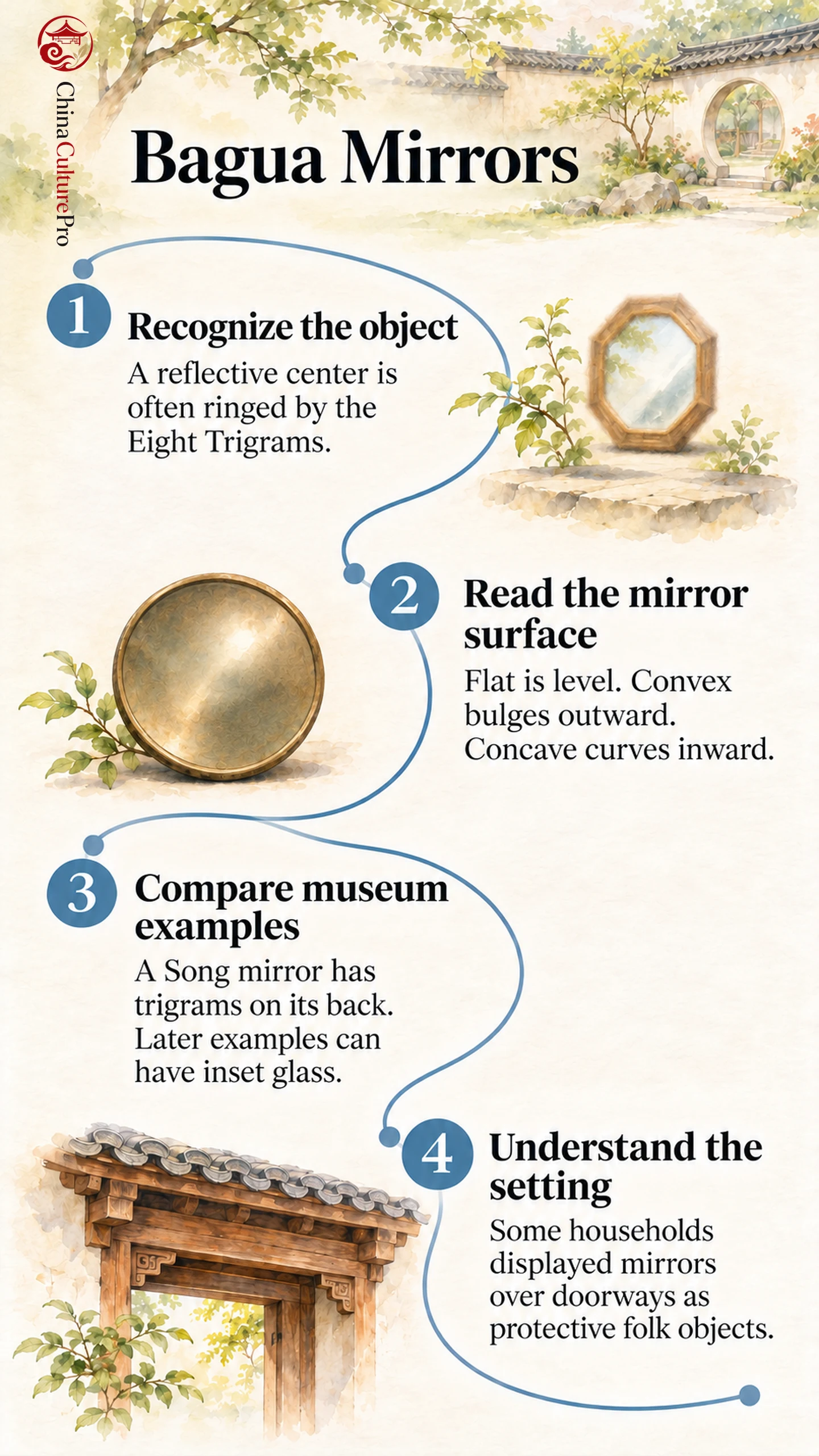
A small mirror over a doorway can be easy to miss. Look more closely and you may see short solid and broken lines around the center. These are trigrams, the feature that links the object to older Chinese images of the cosmos and to protective folk customs.[1][2][4]
Flat, Convex and Concave Mirrors
Identify the curved surface by looking across the reflective center from the side. These examples describe how each surface is shaped and how some feng shui manuals interpret it. Regional explanations can differ.[3][5]
| Forme | Comment le reconnaître | A traditional interpretation |
|---|---|---|
| Flat mirror | The face has no visible curve. | Used symbolically to reflect an unwanted influence. |
| Convex mirror | The center bulges outward. | Interpreted as dispersing an unwanted influence. |
| Concave mirror | The center curves inward. | Some practitioners interpret it as gathering. Other records associate the form with warding. |
An entry for a related print in the Lanyang Museum collections describes a concave mirror as part of a protective custom. That record and a modern explanation of gathering illustrate how one form can carry more than one interpretation.[3][5]
What the Patterns and Materials Tell You
A protective object in the National Taiwan Museum has a red ground, green frame, gold trigrams, an inset mirror and a tassel. Another object in the same collection has a wooden frame, inscriptions and a mountain-and-sea scene. The Eight Trigrams guide explains the patterned lines that give objects like these their name.[1][4]
A much older object in the National Palace Museum makes a useful comparison. The museum dates its round bronze mirror to the Song dynasty. The reverse carries trigrams and zodiac animals around a turtle-shaped knob. The designs show that the motif appeared on bronze mirrors well before the modern examples. The museum’s record is evidence for the form and decoration of this object.[2]
Why Some Mirrors Are Displayed Over Doorways
The National Taiwan Museum catalogues a wooden framed example among objects associated with doorway protection. In feng shui, an outward-facing mirror may be interpreted as a response to the direction of a street or a prominent corner. In related folk practice, people may see it as one of several Chinese symbols for protection. The place it is displayed helps tell you how it was understood in that setting.[1][3][4]
FAQs About Bagua Mirrors
Does an octagonal frame tell you whether the mirror is convex?
No. The outer frame and the surface are separate features. Look for an outward bulge or an inward curve in the center.[1][3]
Are all mirrors with trigrams the same kind of doorway object?
Museum records include a Song bronze mirror with trigrams on its back and a later folk object with a mirror set into a decorated frame. The same motif can appear on objects with different construction and contexts.[1][2][4]
Sources
[1] National Taiwan Museum. Protective Bagua, collection AH004978
[2] National Palace Museum. Song mirror with Eight Trigrams decoration
[3] FengShui.info. Mirrors, flat, convex and concave Bagua forms
[4] National Taiwan Museum. Wood-frame mountain-and-sea Bagua mirror, collection AH007335
[5] Lanyang Museum. Qian Kun Bagua print in the Taiwan Cultural Memory Bank