

Quick Answer: What Is Chinese Australian Gold-Rush Heritage?
Chinese Australian gold-rush heritage includes the sites, objects, and community traditions left by people who migrated during and after the nineteenth-century gold rushes. In the 1850s many arrivals headed to Victoria and New South Wales. Chinese migrants called the Australian goldfields New Gold Mountain (新金山, Xīn Jīnshān).[1]
- Migration. Arrivals included people from Guangdong who reached the mines by sea and overland routes.[1][2]
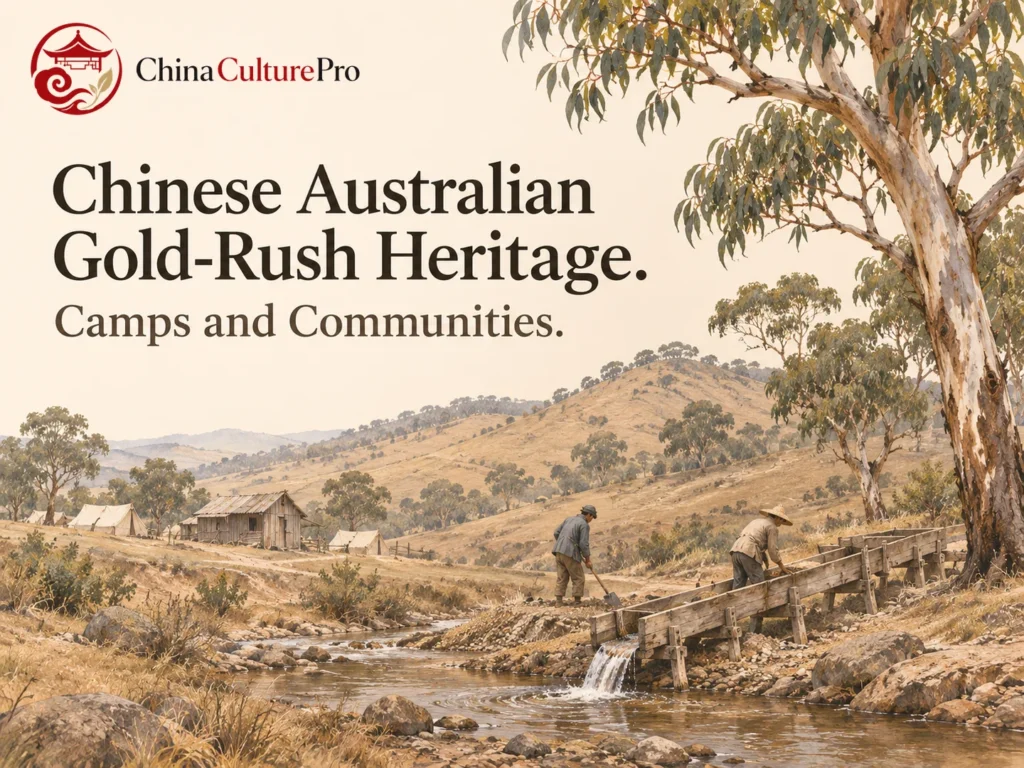
- Work. Miners worked claims with tools such as sluices and puddling mills.[1]
- Community. Museum collections and surviving sites record both discrimination and the life Chinese communities built.[3][4]
The story continued in towns after the mining boom.[4]

A goldfield record may follow a miner across a long overland route. A parade object in Bendigo tells a later story about what Chinese residents built together after arriving.[2][4]
From Guangdong to the Goldfields
Victoria imposed a £10 arrival tax on Chinese immigrants in 1855. Parks Victoria records people disembarking in South Australia and walking overland from places such as Robe or Port Adelaide to reach the goldfields. A port name on a record may therefore mark a stage of the journey rather than the intended destination.[2]
The National Museum of Australia records several ways migrants financed the voyage, including credit-ticket arrangements. Such travel was part of wider Cantonese diaspora networks that connected Guangdong with ports abroad.[1]
Mining and Anti-Chinese Exclusion
The National Museum’s Harvest of Endurance scroll depicts Chinese miners using a sluice box and puddling mill. These tools show some of the work involved in separating gold from the material dug on a claim.[1]
The same exhibition documents anti-Chinese attacks around Lambing Flat, now Young, in 1860 and 1861. Some miners lost their possessions in the attacks and later petitioned the colonial government for compensation. The New South Wales government passed a law restricting Chinese immigration later in 1861.[3]
How Communities Are Remembered Today
Bendigo’s Golden Dragon Museum stands on a former Chinese camp site. Its collections include Loong, a processional dragon brought from China for Bendigo’s Easter celebrations in the 1890s. The site and the dragon record different periods: settlement around the goldfields and later participation in a town celebration.[4]
The story also has a trans-Tasman comparison. The Lawrence Chinese Camp in Otago preserves a different goldfield history within Chinese culture in New Zealand. The two sites help place mining towns within the wider history of Chinese diaspora communities.[5]
FAQs About Chinese Australian Gold-Rush Heritage
What did New Gold Mountain mean?
Chinese migrants used the name for the Australian goldfields. The California goldfields were known as Old Gold Mountain in the distinction recorded by the National Museum of Australia.[1]
Was Bendigo’s Loong a gold-mining tool?
Loong is a processional dragon associated with the Bendigo Easter celebrations. It shows how the community took part in public life after the first decades of the rush.[4]
Sources
[1] National Museum of Australia. Chinese gold miners
[2] Parks Victoria. Castlemaine Diggings and Chinese routes to the goldfields
[3] National Museum of Australia. Violence on the goldfields
[4] Bendigo Region. Bendigo and Heathcote visitor guide, Chinese culture
[5] Heritage New Zealand Pouhere Taonga. Lawrence Chinese Camp