
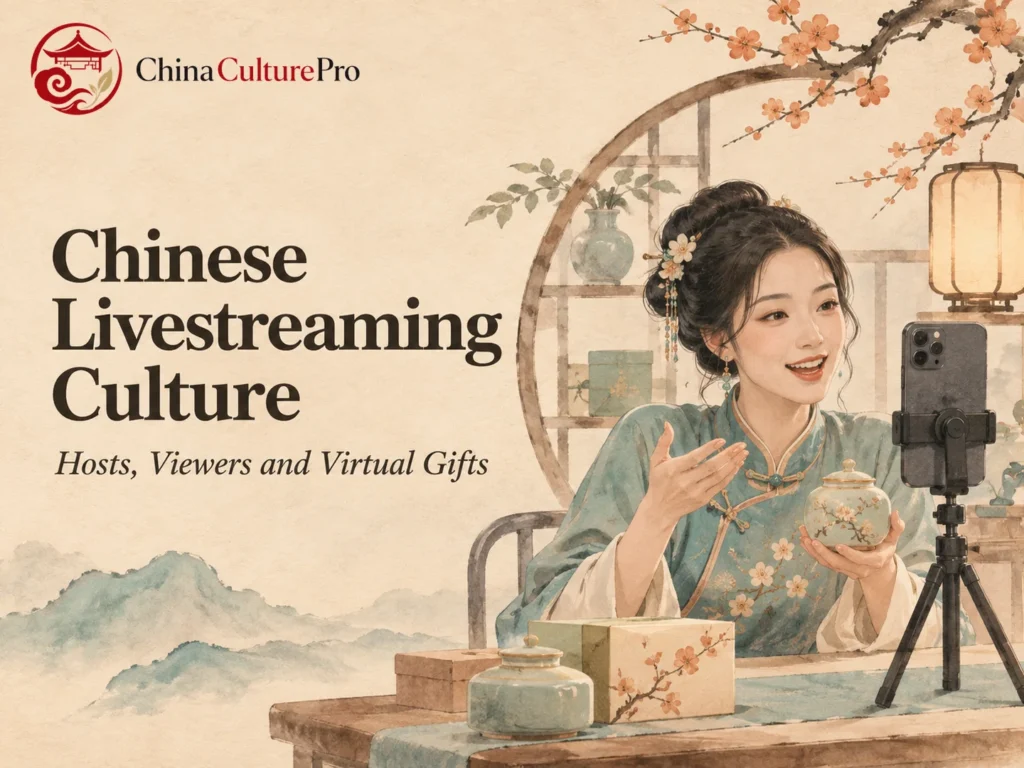

Quick Answer: How Does Chinese Livestreaming Culture Work?
In a Chinese livestream (直播, zhíbō), a host performs or talks while viewers respond through live comments or other reactions. Some platforms also allow virtual gifts, a form of tipping or appreciation called dashang (打赏, dǎshǎng). A gift can be visible to the room and, on some services, generate revenue shared with a host. [1][2][3]
- Hosts: A host can talk, play a game, demonstrate a skill or answer audience questions. [1][4]
- Viewers: People can watch, chat or respond to one another as the broadcast unfolds. [1][2]
- Gifts and sales: A gift recognizes a host. A live-shopping order buys a product. The two may be offered in the same setting. [3][4]
Chat, gifts and purchases are three different ways a viewer can interact with a broadcast.

A host says hello, a question appears in the chat and another viewer answers before the host has finished speaking. The conversation can change while the broadcast is still in progress. The audience is present while the events happen, and what its members do can become part of the broadcast. [1][2]
What Happens in a Chinese Livestream Room
A host, often called a streamer, provides a reason to join. The subject might be gaming, music, conversation or a product demonstration. The live format allows the host to respond in the moment. A viewer can ask a question, react to a performance or simply watch without sending anything. Repeat viewers might recognize an ongoing joke or a familiar greeting. [1][2][4]
Viewers also respond to one another. On services that display moving comments on screen, people may use danmu (弹幕, dànmù) to react to what happens. In a live room that reaction can be shown during the broadcast. Recorded videos on services such as Bilibili can use timed comments too, where a comment reappears later at the same place in a video. The experience of watching together can therefore come from different kinds of timing. [1][2][5]
What Virtual Gifts Do for Hosts and Viewers
A virtual gift is an in-app item someone can send to a host. The platform may display an animation or notice that others in the room see. A viewer might use a gift to signal appreciation or take part in a group moment. In one qualitative study of Douyin livestreams, interviewed participants mentioned wanting to make the host happy or help with a gift goal. That small study describes some motivations in particular rooms. [2][3][6]
Researchers have also used room data to ask how audience interaction and gifts relate. One study examined moving comments and paid gifts on Douyu. Its observations and the Douyin interviews answer different questions. Room records can show that certain forms of chat and gifts occur together. Interviews can give examples of the reasons viewers say they had. Taken together, the studies show why a gift’s context matters. [2][6]
Bilibili’s filing describes selling virtual gifts and sharing some related revenue with hosts or agencies. The filing describes Bilibili’s arrangements for the reporting period. A visible gift combines a gesture of recognition with a paid feature in some rooms. The practice differs in setting from a private greeting or one of China’s digital red envelopes in a family chat. The audience for the gesture can change what it means. [2][3][6]
How Entertainment Live Rooms and Live Shopping Overlap
Platforms such as Kuaishou support both short videos and live sessions. Douyin lists livestreams among several formats used for its commerce services. A user might first see a recorded clip and then join a room where the creator can respond to comments. The guide to social media in China places live rooms within that broader set of entry points. [4][7]
In an entertainment room, someone may stay for a performance and comment or send a gift. In a product session, a host may demonstrate an item while viewers ask questions, and a buyer can place an order. One room can combine entertaining presentation with product links. Around Singles’ Day, a retail campaign can give that format a shared promotional calendar. Look at what the viewer gets from the action to tell a purchase from a gift. [3][4][8]
FAQs About Chinese Livestreaming Culture
Do viewers have to send virtual gifts?
People can participate by watching or chatting. Paid gifts are an optional platform feature where available. [1][2][3]
Does every livestream sell products?
Hosts stream performances, games, conversations and other content. Live selling is one use of the format. [1][3][4]
What does dashang mean in a live room?
The term refers to rewarding or tipping a creator, often through virtual items handled by the platform. The format and payment arrangement vary. [2][3][6]
Sources
[1] ACM CHI. You Watch, You Give, and You Engage: A Study of Live Streaming Practices in China
[2] Electronic Commerce Research and Applications. The magic of danmaku
[3] Bilibili investor relations. Annual Report on Form 20-F for 2022
[4] ByteDance. Products and Services
[5] Discourse, Context & Media. Liquefaction of sociality: Exploring ambient affiliation in danmu comments
[6] Association of Internet Researchers. Motivations and Expectations for Virtual Gift-Giving in Douyin Live Streams
[7] Kuaishou Technology. Investor FAQs
[8] Alizila. Singles’ Day and live events