


Quick Answer: How Are Leibniz, Binary Arithmetic and the I Ching Connected?
Gottfried Wilhelm Leibniz worked on arithmetic using only 0 and 1 before he received a diagram of the I Ching (易经, Yìjīng) hexagrams from the Jesuit Joachim Bouvet. In his 1703 essay, he showed how one arrangement could be read using the same two symbols.[1][2][3]
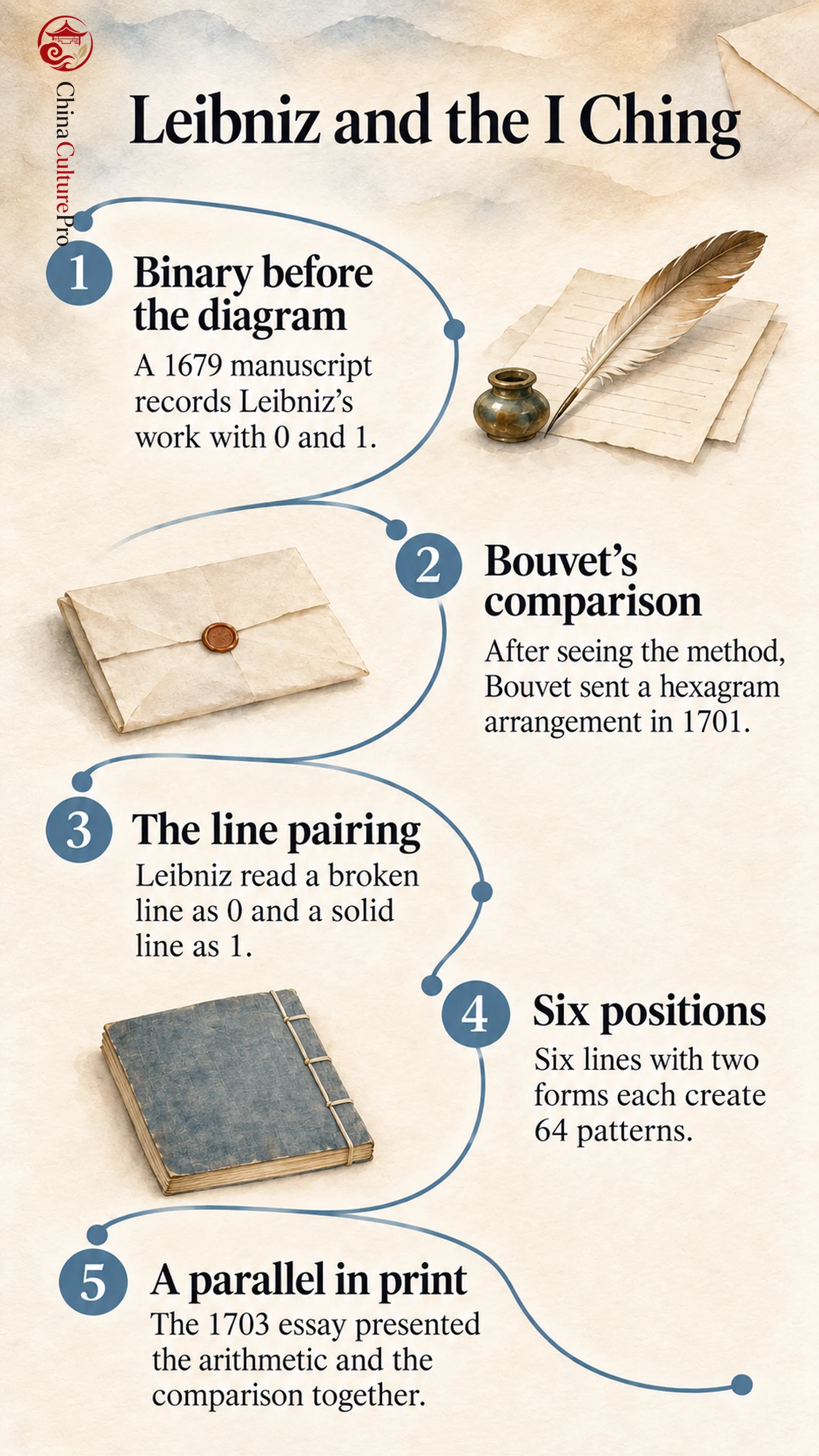
- 1679: Leibniz set out a working account of binary calculation in a manuscript.[2][3]
- 1701: Bouvet recognised the parallel after receiving Leibniz’s explanation, then sent a hexagram arrangement.[1][2][3]
- 1703: Leibniz’s public essay linked the arithmetic with the diagram.[1][2][3]
The exchange shows when Leibniz applied his arithmetic to a Chinese diagram. The dated manuscript gives a separate record of how early he had developed the calculation.[1][2][3]
Two kinds of line can make a set of figures, just as two digits can make a set of numbers. When an exchange of letters brought these ideas together, Leibniz saw that an arrangement of Chinese hexagrams could be read in a new way.
What Leibniz Developed Before the Diagram Arrived
In binary arithmetic, the places in a number represent powers of two. The rightmost position is worth one, the next two and the next four. The number 101 in binary therefore represents five (4 + 0 + 1). Leibniz’s work went beyond observing that two marks would suffice. He showed that numbers written this way could be used for arithmetic.[1][2][3]
His work in 1679 predates the 1701 exchange with Bouvet. The correspondence changed the way he presented the discovery. It supplied a Chinese pattern that he could discuss alongside his calculation.[1][2][3]
How Leibniz Matched Lines With Digits
A hexagram contains six positions, each occupied by a solid or broken line. That gives 64 possible patterns. Bouvet sent an arrangement associated with the Song thinker Shao Yong. Leibniz read the lines using the pairing below, with the numerical order depending on how the figures and their line positions are read.[1][2][3]
| Line in the diagram | Digit in Leibniz’s reading |
|---|---|
| Broken line | 0 |
| Solid line | 1 |
This mapping gives one way to read a selected arrangement of figures. The I Ching has its own textual and interpretive history, which includes the meanings assigned to the different figures and its uses in divination. A numerical parallel explains the structure Leibniz noticed.[1][2][4]
What the Correspondence Tells Us About Translation
Bouvet recognised the pairing in the diagram after seeing Leibniz’s method and sent the arrangement from China. Leibniz then used it to explain a possible reading of figures he and Bouvet attributed to the legendary Fuxi. The attribution belongs to the interpretation offered in the essay. The exchange offers a case in Chinese philosophy and translation: a familiar framework can reveal one feature of a source while leaving much of its meaning to other kinds of reading.[1][2][3]
FAQs About Leibniz and the I Ching
Did Leibniz get binary arithmetic from the I Ching?
His manuscript work on binary arithmetic dates to 1679, before the hexagram diagram Bouvet sent. The diagram contributed to his later explanation of a parallel.[1][2][3]
Does every I Ching sequence count in binary?
The comparison depends on the particular arrangement of figures and how the lines are read and assigned places. Leibniz’s essay discusses one arrangement through Bouvet’s correspondence.[1][2]
Sources
[1] Gottfried Wilhelm Leibniz. Explanation of Binary Arithmetic, 1703
[2] Osaka University Repository. The History of the Development of Zhou Yi
[3] Marie-Julie Maitre. The Development of Binary Arithmetic by Leibniz
[4] ChinaSage. Leibniz and China